
Villa Adriana a Tivoli — la Residenza Imperiale di Adriano (118-138 d.C.): 30 Ettari di Architettura Sperimentale come Enciclopedia del Mondo Romano (UNESCO 1999)
Hadrian’s Villa at Tivoli is the largest and most architecturally inventive complex ever built by a Roman emperor: 120 hectares of parkland with approximately 30 hectares of built structures, designed and built in just twenty years (118-138 CE) by the Emperor Hadrian himself — who was trained as an architect and is documented to have personally drawn the designs for at least some of the buildings — as a synthesis of every architectural tradition in the Roman world, from Egyptian to Greek to Mesopotamian, assembled as a single landscape statement about imperial power, cultural breadth, and architectural experimentation.
At a glance
Villa Adriana (Hadrian’s Villa, Tivoli, province of Roma, Lazio) is a UNESCO World Heritage Site inscribed in 1999 (ref. 907). The inscription covers the entire archaeological area of the imperial villa — approximately 120 hectares in total, of which roughly 30 hectares preserve visible structures, now enclosed as an archaeological park managed by the Italian Ministry of Culture. The site is located 6 km from the centre of Tivoli (ancient Tibur, 28 km east of Rome) at the foot of the Tiburtine hills, along the Via Tiburtina. The villa was built by the Emperor Hadrian (Publius Aelius Hadrianus, r. 117-138 CE) as his primary residence from approximately 118 CE until his death in 138 CE, supplementing the Domus Augustana on the Palatine Hill in Rome. The site was abandoned after Hadrian’s death by successive emperors and was progressively spoiled of its marble, mosaics, and sculptural decoration from the Renaissance onward (the Villa d’Este, 5 km away, was built in part from material removed from Villa Adriana); what survives today is primarily the brick and concrete substructure of the buildings, stripped of their decoration, along with the Canopo canal and its copies of Greek sculpture, which were restored and displayed in the 1950s.
Key facts
- Hadrian (76-138 CE): Emperor from 117 (nominated by Trajan before his death); famous as the builder of the Pantheon (completed under his reign, 120s CE), Hadrian’s Wall in Britain (122 CE), and the Castel Sant’Angelo (Mausoleum of Hadrian, 139 CE, built for his own burial and completed by his successor Antoninus Pius); a philhellene who wore a beard in the Greek manner, unusual for Roman emperors (Suetonius and the Historia Augusta describe him as the first emperor to wear a full beard since the Republic), and who is documented to have designed buildings himself (the Temple of Venus and Roma in the Roman Forum, completed 135 CE, is attributed to him by ancient sources — the same sources mention that Trajan’s architect Apollodorus of Damascus mocked one of Hadrian’s designs)
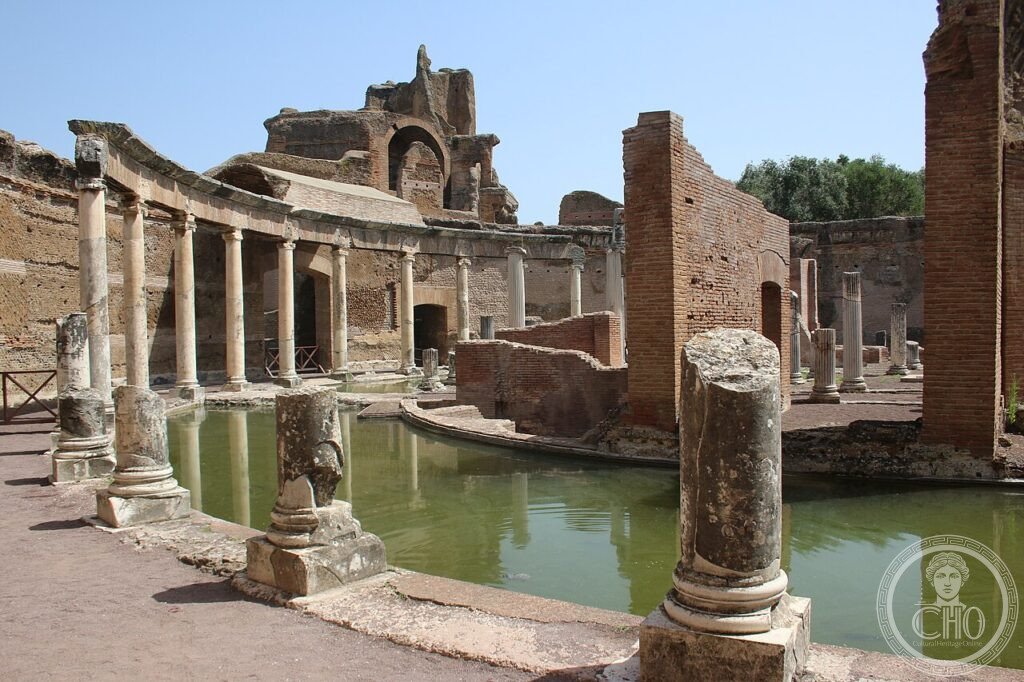
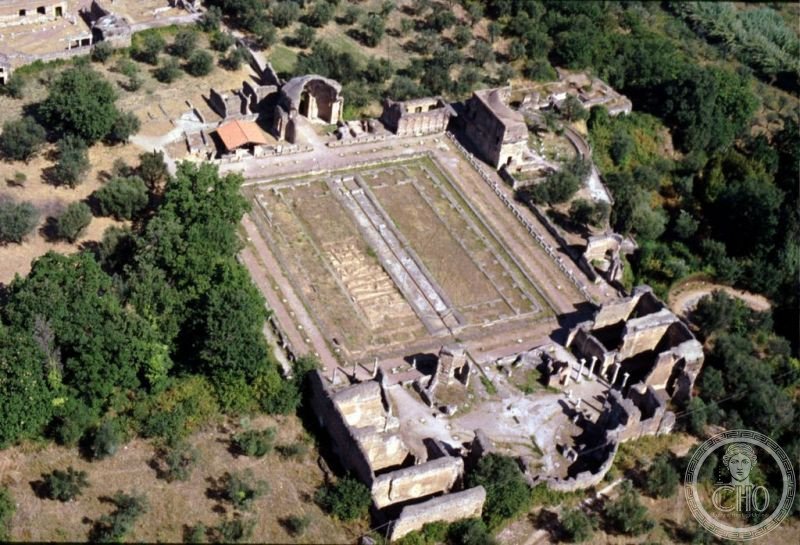
- The buildings: Villa Adriana contains approximately 30 major structures in 120 hectares; the most important are: the Pecile (a large rectangular pool 232 m × 97 m, modelled on the Stoa Poikile of Athens); the Teatro Marittimo (a circular “island villa” — a circular canal 43 m diameter with a circular island accessible only by drawbridge, used as a private retreat); the Canopo (a 119-metre canal flanked by copies of Greek sculptures and ending in the Serapeo); the Terme Maggiori (large bath complex); the Terme Minori (smaller private baths); the Accademia (a series of rooms possibly used for study and intellectual gathering); the Palazzo Imperiale (the main reception and residential complex); the Praetorium (servants’ quarters, underground service corridors)
- Architectural innovation: Hadrian’s Villa contains some of the most experimental concrete vaulting in Roman architecture: the Serapeo roof is a half-dome of pumpkin vaulting (a type of groined vault segmented like a pumpkin); the Vestibolo (entrance hall) has a cross-vault with unusual proportions; the teatrino (small theatre) has a curved plan adapted to the hillside. The underground service corridor system (the “cryptoportici,” approximately 1.5 km of barrel-vaulted tunnels) allowed the movement of servants and supplies without crossing the formal garden areas
- UNESCO: 1999, ref. 907
- GPS: 41.9428, 12.7740 — Google Maps
History
After Hadrian’s death in 138 CE, the villa passed to his successors: Antoninus Pius, Marcus Aurelius, Commodus, and Septimius Severus all used it as an imperial retreat. After the 3rd century, as the imperial court moved away from Rome, Villa Adriana fell out of regular use. By the 4th century it was being stripped of portable materials; by the 6th century (Gothic Wars and Byzantine reconquest) it was in ruins. Medieval occupation of the site is documented only in the scattered use of the substructures as quarries for lime-burning (the destruction of marble for lime was the primary mechanism of destruction for most Roman sites in the post-antique period).
Renaissance interest in Villa Adriana began in the 1460s when Flavio Biondo described it in his Italia Illustrata (1474); by the early 16th century, it had become a quarry for the marble and sculptures that would furnish the palaces and gardens of Rome. The Villa d’Este, built at Tivoli in 1550 by Cardinal Ippolito II d’Este (see CHO card), received significant quantities of marble, columns, and sculpture from Villa Adriana during its construction. Pirro Ligorio, the architect of the Villa d’Este, was simultaneously the first systematic archaeological investigator of Villa Adriana, producing in the 1560s-1570s a detailed plan and description of the visible ruins that remains a fundamental document. Systematic excavation began in the 17th-18th centuries (the most productive excavations were conducted by Francisco de Medicis in 1560, Cardinal Alessandro Farnese in 1550s-60s, and the Conte di Fede in 1700-1724) and continues today. The site became state property in 1870 (after Italian unification) and was opened as an archaeological park in 1870.
What you see
The site is large (plan at entrance essential — the site map is distributed at the ticket office; pick up the official map and the numbered itinerary card). The visit takes a minimum of 2 hours and ideally 3-4 hours for a complete circuit. The most important structures in order of visit:
Teatro Marittimo: The “island villa” — a circular canal with a rotating bridge giving access to a miniature villa on an island; the brick substructure of the island buildings is clearly legible; the canal is now dry (it was restored with its moat configuration, without water). Pecile: The great rectangular pool (232 m × 97 m), now dry, with the remains of the double-colonnaded walkway visible along the north side; the sheer scale (240 × 100 metres) is stunning. Terme Maggiori: The large bath complex, with some of the best-preserved vaulting at the site. Canopo: The star attraction — the 119-metre canal with the line of copies of Greek sculptures (caryatids, Silenus, Mars, Crocodile) leading to the Serapeo; the sculptures are copies installed in the 1950s restoration (the originals are in the on-site museum). On-site museum: Small but important, with original sculpture, mosaics, and architectural fragments from excavations.
Gallery
Practical information
- Parco Archeologico di Villa Adriana: Via di Villa Adriana 204, Tivoli; open daily 9:00 to sunset (17:00 November-February, 20:00 June-August); last entry 1.5 hours before closing. Admission ~€10 (EU citizens 18-25 ~€2; under 18 free). Book online at coopculture.it (advance booking recommended on summer weekends). Audioguide rental available at entrance (~€6). Walking distances: Pecile to Canopo is 700 m; full circuit of the main structures is approximately 3.5 km on unpaved paths.
- Season: October-April (cooler, less crowded; the brick structures are beautiful in autumn and winter light; the site has no shade in summer, which can be brutal). Bring water and comfortable shoes.
- Combined ticket: Villa Adriana + Villa d’Este (see CHO card) combined ticket available (~€14).
Getting there
Via di Villa Adriana 204, Tivoli (RM), Lazio. GPS 41.9428, 12.7740. By public transport from Rome: Cotral bus from Rome Ponte Mammolo (Metro B) to Tivoli (50 min, every 20-30 min); then local bus CAT line 4 from Tivoli Piazza Garibaldi to Villa Adriana (10 min; check schedule at tivoli-bus.it). By car from Rome: Via Tiburtina (SS5) east, 28 km to Tivoli then 6 km south to Villa Adriana on Via di Villa Adriana; alternatively A24 autostrada to exit “Via Tiburtina/Tivoli” then north 5 km (faster). Parking at the site entrance (paid). Villa Adriana is 5 km from Villa d’Este (Tivoli town centre) — a taxi or bus connects them (25 min walk on Via Tiburtina not recommended).
Nearby
- Villa d’Este, Tivoli — 5 km north; (see CHO card: Villa d’Este Tivoli UNESCO 2001 ref.1025) — the Cardinal d’Este’s terraced gardens (1560-1572) with 500 fountains, built partly from material taken from Villa Adriana
- Tivoli centro storico — 6 km north; the Temple of Hercules Victor (1st c. BCE; one of the best-preserved Roman temples in Italy; a rectangular temple on a massive substructure platform above the Aniene gorge); the Tempio della Sibilla (round temple, c.80 BCE, on the rim of the Aniene waterfall; the most photographed building in Tivoli); the Villa Gregoriana park (19th-c. landscaped park around the Aniene gorge and the Grande Cascata waterfall)
- Rome — 28 km west; the Pantheon, the Colosseo, the Roman Forum + Palatine Hill (all UNESCO 1980 ref.91)
Sources
- UNESCO: whc.unesco.org/en/list/907
- Wikipedia EN: Hadrian’s Villa
- MacDonald, William L. and Pinto, John A.: Hadrian’s Villa and its Legacy, Yale University Press, 1995
- Parco Archeologico di Villa Adriana: villadriana.beniculturali.it
Find it on the map
See this place and what’s around it →📷 Diventa un fotografo di Cultural Heritage Online
Condividi le tue foto dei luoghi: restano pubblicate con la tua firma come autore. Più vengono viste, più ti fai conoscere — e presto un concorso premierà le foto più apprezzate.
Accedi o registrati gratis per aggiungere una foto