
Verona — la Città di Romeo e Giulietta (e dell’Arena): dal Teatro Romano (I sec. a.C.) al Palazzo degli Scaligeri (1262-1387), la Più Integra Città Medioevale-Rinascimentale del Veneto (UNESCO 2000)
Verona is one of the most completely preserved medieval and Renaissance cities in northern Italy: built on two millennia of continuous occupation at the bend of the Adige river, it contains within its walls a Roman amphitheatre (the third largest in Italy), a Roman theatre, the best surviving sequence of Scaligeri Gothic architecture in the world (the Castelvecchio, the Arche Scaligere, the Ponte Scaligero), a Romanesque cathedral with a Titian altarpiece, a Pisanello fresco cycle, and the fictional house of Juliet Capulet — all within twenty minutes’ walk of each other.
At a glance
Verona (province of Verona, Veneto) is a UNESCO World Heritage Site inscribed in 2000 (ref. 797) as “City of Verona.” The inscription covers the historic centre of Verona within the Venetian city walls (Mura Magistrali, 16th century, largely surviving), together with the Roman and Scaligeri monuments outside the walls. Verona was a Roman colony (Colonia Augusta Verona, founded c.49 BCE), became part of the Ostrogothic kingdom (with Theodoric’s famous palace, 5th-6th c.), then a Lombard duchy, a Carolingian count’s seat, a free commune (12th century), then a signoria under the Scaligeri (Can Grande I and his successors, 1262-1387), then under Gian Galeazzo Visconti of Milan (1387-1405), then under Venice (1405-1797), and finally under Austrian rule until Italian unification (1866). Each successive power left architectural traces that survive today in the remarkably intact urban fabric of the historic centre.
Key facts
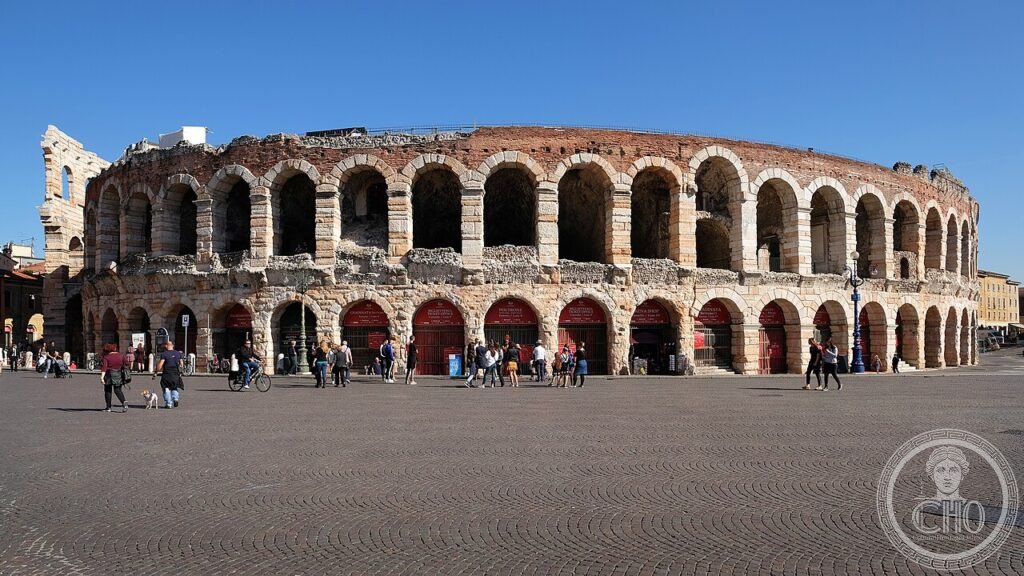
- Arena di Verona (1st century CE): The third largest surviving Roman amphitheatre in Italy (after the Colosseo, 188 × 156 m, and the Amphitheatre of Capua, 167 × 137 m); Verona’s Arena measures 138 × 109 m (exterior) with a seating capacity of approximately 30,000; built in the 1st century CE in pink-rose Lessinian limestone (pietra di Lessinia, from the hills north of Verona); the original outer ring (of which only the “ala,” a four-arch fragment, survives on the north-west) was demolished in the earthquake of 1183; the inner ring (the cavea, the seating tiers) survives almost completely, making it the best-preserved cavea of any Roman amphitheatre; open-air opera performances have been held here since 1913 (Arena di Verona Opera Festival, August-September)
- Scaligeri (della Scala family, 1262-1387): The most important medieval signoria of Verona; Can Grande I della Scala (1291-1329) was Dante’s host in exile and is mentioned in Paradiso XVII; he built the Castelvecchio (1354-1376, completed by Cangrande II) and the Ponte Scaligero; the Arche Scaligere (Gothic tomb monuments, Via Arche Scaligere, 1277-1380) are the most complete group of Scaligeri Gothic funerary monuments surviving; Can Grande I and Mastino II della Scala are buried in elaborate Gothic tabernacle tombs on the exterior wall of the Basilica di Santa Maria Antica (with the original Can Grande equestrian statue — the original is now in the Museo di Castelvecchio, replaced by a copy on the tomb)
- Romeo and Juliet: Shakespeare’s play (c.1594-1596) is set in Verona; the names Montecchi (Montague) and Cappello (Capulet) correspond to real Veronese noble families documented from the 13th century; but there is no historical evidence of the specific characters or story. The “Casa di Giulietta” (Via Cappello 23) is a 13th-century house purchased by the Verona municipality in the 1930s, with a balcony added in 1936, and marketed as the historical home of Juliet
- UNESCO: 2000, ref. 797
- GPS: 45.4388, 10.9951 — Google Maps (Arena di Verona)
History
Verona was a Celtic settlement before Roman colonization (c.49 BCE, after Julius Caesar’s Lex Roscia gave Roman citizenship to Cisalpine Gaul). The Roman colony grew rapidly as a strategic node on the Via Postumia (the road connecting Genova/Aquileia) and the crossing of the Adige — the Ponte Pietra (still standing, rebuilt after WWII destruction with the original stones recovered from the river) was a key crossing point. Catullus, the Roman lyric poet (c.84-54 BCE), was from Verona or the nearby Lake Garda region; Vitruvius, the architectural theorist, may have been from Verona. The amphitheatre was built under the Julio-Claudian or Flavian emperors (the date is uncertain, with estimates ranging from 30 CE to 90 CE).
The Ostrogothic king Theodoric the Great (r. 493-526 CE) made Verona (which he called Bern in his Germanic language) one of his principal residences, building a palace complex of which only the name “Palazzo di Teodorico” survives in medieval documents (no structure is certainly identified with it today). The medieval history is dominated by the Scaligeri, who transformed Verona from a commune into a successful northern Italian signoria: Can Grande I della Scala, who gave Dante hospitality in his exile from Florence (1311-1318), was celebrated by Dante as “the great Lombard” and described in the Paradiso (XVII, 71-93) as a model of generous lordship. Can Grande also hosted Giotto (who is documented in Verona between 1329 and 1336, working on commissions that are now lost) and was one of the major patrons of Gothic architecture in northern Italy.
What you see
The Arena di Verona (Piazza Brà) is the essential first stop: the interior of the cavea, accessed through any of the 72 arched entries, reveals the full scale of the elliptical seating bowl (the highest tier survives to its full ancient height on the south side); the pink Lessinian limestone of the tiers contrasts with the grey Roman concrete of the underground corridors (the hypogeum, sometimes open for visits); the “ala” (the surviving fragment of the outer ring, four bays of the original 72) is visible from Piazza Brà and provides the most elegant view of Roman amphitheatre construction in Italy outside Rome.
The Piazza delle Erbe (5 min walk from the Arena) is the site of the Roman forum: a long rectangle still following the Roman grid, lined with medieval and Renaissance palaces (the Domus Mercatorum, 1301; the Mazzanti houses, frescoed; the Torre dei Lamberti, 84 m, 1172-1464, with elevator access to panoramic terrace). The Arche Scaligere (2 min from Piazza delle Erbe, Via Arche Scaligere) are the richest ensemble of 14th-century Gothic funerary architecture in Italy — the wrought-iron enclosure and the three main tombs (Can Signorio, Mastino II, Can Grande) are visible from the street; the Mastino II tomb (1351) has the earliest naturalistic equestrian statue in Italian Gothic art. The Castelvecchio and Ponte Scaligero (10 min walk west along the Adige) are the major military monument: the castle (1354-1376) houses the Museo di Castelvecchio with the original Can Grande equestrian statue.
Gallery
Practical information
- Arena di Verona: Piazza Brà 1; open Tuesday-Sunday 9:00-18:00 (not on opera nights); on opera evenings open 9:00-15:30 and 19:30 until end of performance. Admission ~€10 (reduced ~€7.50). During the Opera Festival (July-August), evening seats range from ~€30 (gallery, unreserved stone steps — bring a cushion, traditional) to ~€250 (stalls). Book opera tickets at arena.it.
- Museo di Castelvecchio: Corso Castelvecchio 2; open Tuesday-Sunday 10:00-18:00 (first Sunday of month 13:30-19:30). Admission ~€6. Carlo Scarpa’s 1958-1973 renovation of the museum is considered one of the finest examples of 20th-century museum architecture in Italy.
- Arche Scaligere: Free, always visible from the street (Via Arche Scaligere); the courtyard with the Mastino II tomb is accessible from the street through the iron fence.
- Duration: Full Verona historic centre circuit: 1 full day. Minimum for Arena + Piazza delle Erbe + Arche Scaligere: 3 hours.
Getting there
Piazza Brà, Verona (VR), Veneto. GPS 45.4388, 10.9951 (Arena). By train: Trenitalia and Italo from Venice (120 km; 1h10 with Freccia; 1h30 regional); from Milan (160 km; 1h05 with Freccia; 1h50 regional); from Bologna (110 km; 1h10 Freccia). Verona Porta Nuova station is 800 m from the Arena (15-20 min walk or bus 11/12/13). By car: A4 Milan-Venice to Verona Sud exit, then 5 km north (follow “Centro Storico” signs); paid parking near Piazza Brà. By air: Verona-Villafranca airport (12 km from centre; bus ATV shuttle to Verona station; or taxi ~€20).
Nearby
- Lago di Garda — 30 km west; the largest lake in Italy; Sirmione on the southern tip (Grotte di Catullo, Roman villa complex c.1st c. BCE-1st c. CE, attributed by tradition to the poet Catullus — a partially surviving lakeside complex with panoramic terrace; also the thermal spa and Scaligeri castle of Sirmione; one of the most visited spots in northern Italy in summer)
- Vicenza — 55 km east; (see CHO card for Vicenza e le Ville Palladiane, UNESCO 1994 ref.712)
- Mantova — 40 km south-west; (see CHO card for Mantova e Sabbioneta, UNESCO 2008 ref.1287)
Sources
- UNESCO: whc.unesco.org/en/list/797
- Wikipedia EN: Verona and Verona Arena
- Puppi, Lionello (ed.): Palladio e Verona, Neri Pozza, 1980
- Arena di Verona Opera Festival: arena.it
Find it on the map
See this place and what’s around it →📷 Diventa un fotografo di Cultural Heritage Online
Condividi le tue foto dei luoghi: restano pubblicate con la tua firma come autore. Più vengono viste, più ti fai conoscere — e presto un concorso premierà le foto più apprezzate.
Accedi o registrati gratis per aggiungere una foto