
Castel del Monte — il Castello Ottagonale di Federico II (c. 1240-1250): l’Enigma Geometrico dell’Imperatore e il Più Misterioso Edificio del Medioevo (UNESCO 1996)
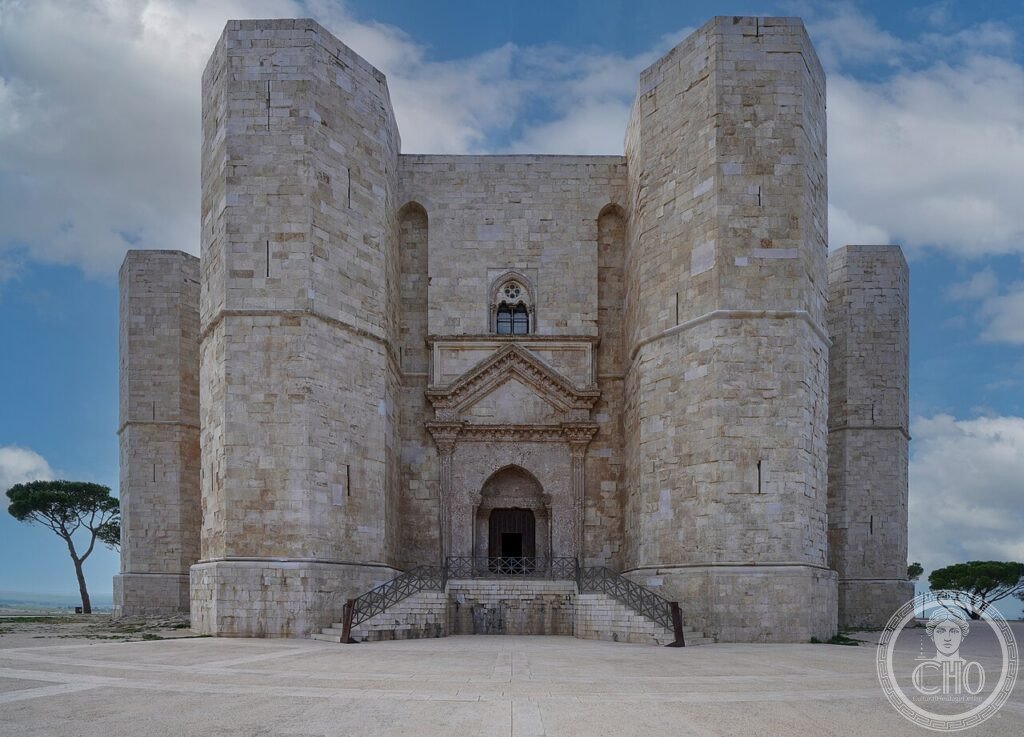
Castel del Monte is the most geometrically pure medieval building in Europe — a perfect octagon with eight octagonal towers at its corners, built by Emperor Frederick II of Hohenstaufen (known as Stupor Mundi, “the Wonder of the World”) between approximately 1240 and 1250 on a hill in the Murge plateau of Puglia, whose precise function has never been established and whose geometry — based on multiples of eight, on the golden ratio, and on astronomical alignments — has generated speculation ranging from hunting lodge to Templar initiation site to calculating machine for solar and lunar cycles, without any single theory gaining scholarly consensus.
At a glance
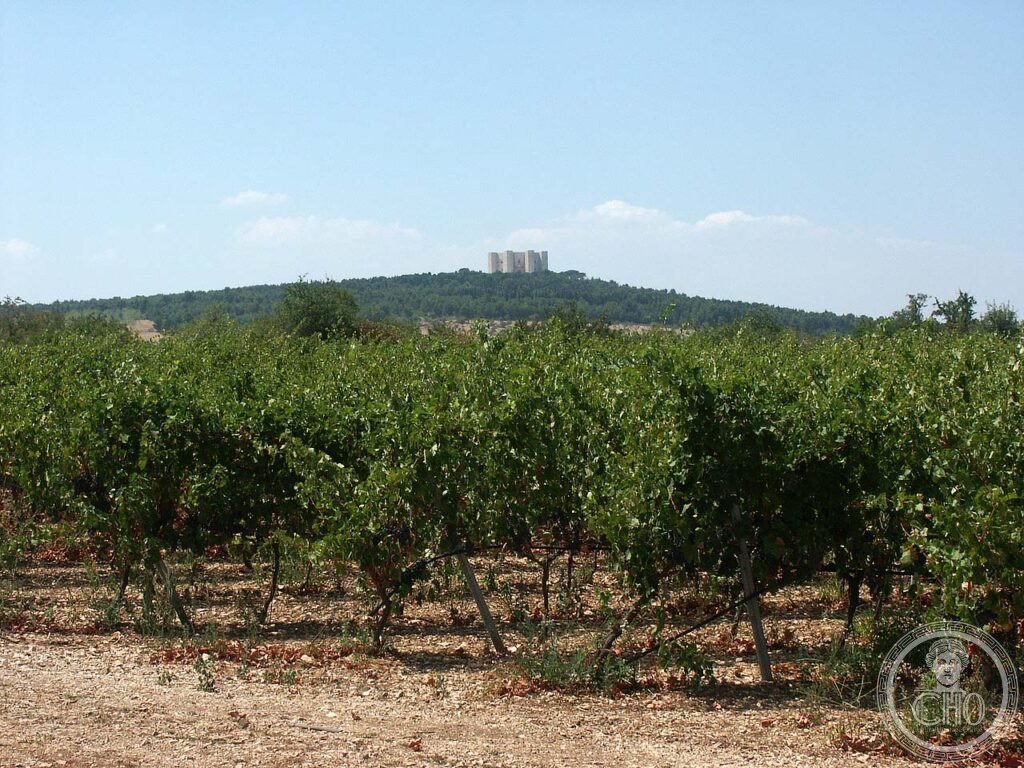
Castel del Monte (municipality of Andria, province of Barletta-Andria-Trani, Puglia) is a UNESCO World Heritage Site inscribed in 1996 (ref. 398). The castle stands on a hill (540 m a.s.l.) in the Murge plateau, visible for 50 km in all directions. The inscription covers the castle alone — a single building with an octagonal outer wall, eight octagonal corner towers, and an inner octagonal courtyard, all in local limestone. The building has two floors, each with eight trapezoidal rooms, one per side of the octagon, plus a corresponding room in each tower. The total ground floor area (castle + towers) is approximately 1,500 m². The castle is managed by the Italian Ministry of Culture and is the most visited Puglia monument after Alberobello.
Key facts
- Frederick II of Hohenstaufen (1194-1250): Holy Roman Emperor and King of Sicily from 1198 (making him sovereign of southern Italy) and King of Jerusalem from 1225; born in Jesi (Marche); raised in Palermo; the most intellectually ambitious ruler of the medieval west — he spoke six languages (Latin, Italian, French, German, Greek, Arabic), wrote a treatise on falconry (De arte venandi cum avibus, the first European work of systematic ornithology and zoology), founded the University of Naples (1224, the first European state university), and corresponded in Latin and Arabic with Muslim scholars at his court. He commissioned Castel del Monte as one of approximately 200 castles built in his kingdom of Sicily and southern Italy (many as watchtowers or garrison posts; Castel del Monte is architecturally unique among them)
- Geometry: The building is an octagon (outer wall side ~16.5 m each; overall diameter ~55 m) with eight octagonal corner towers (each ~3.5 m exterior side). The courtyard is also octagonal. The rooms are of trapezoidal plan (wider at the courtyard side, narrower at the exterior wall). The golden ratio appears in the relationship between the interior courtyard diameter and the overall building diameter. The building faces east (the main portal faces east, toward the rising sun at the equinoxes). At the summer solstice, the shadow of each tower aligns with the next, creating a chain of shadows around the octagon. At the winter solstice, the castle courtyard is fully in shadow. The geometric precision is extraordinary for a 13th-century building
- Materials and style: Local cream limestone (pietra calcarea) for the structure; imported Breccia corallina marble (now largely gone, visible in fragments in the window frames) for the interior mouldings; bronze eagle heads as water-spout bosses (partly surviving); 13th-century door frames with classical columns and pointed arches that combine Romanesque, Gothic, and Islamic architectural elements — consistent with Frederick’s court culture, which synthesized Christian, Islamic, and antique traditions
- UNESCO: 1996, ref. 398
- GPS: 41.0848, 16.2703 — Google Maps
History
The exact date of construction is not documented — there is no building contract, no accounts, and no contemporary description that would establish when Castel del Monte was built. The date c.1240-1250 is an inference from stylistic comparison with other Swabian castles in southern Italy and from a 1240 letter of Frederick II (in which he orders his officials in Andria to provide building materials “ad opus castri nostri Sancte Marie de Monte”) — the reference to a castle under construction near Andria. No document names the architect or builder. After Frederick’s death in 1250, the castle passed through the Angevin, Aragonese, and Spanish rulers of the Kingdom of Naples; it was used as a prison (notably for Frederick’s sons Manfred and Enzio, briefly imprisoned here after Frederick’s death), then as a hunting lodge, then abandoned. By the 18th century it was stripped of its marble, its doors, and its interior fittings (the spoliation was thorough — the interior walls today are bare limestone). The Italian state acquired it in 1876 and began restoration in the 1920s.
What you see
The visit is self-guided, counter-clockwise through the eight rooms of the ground floor and (via an internal staircase in one of the towers) the eight rooms of the upper floor. Each room has pointed-arch windows with slender colonnettes (the marble shafts of the colonnettes are largely original, the capitals range from original 13th-century to 19th-century replacements); the vaulted ceiling in each room is a different Gothic vault pattern (groin vault, diagonal rib vault, quadripartite vault); the walls are bare limestone, with occasional traces of red/ochre painted plaster in sheltered corners. The windows on the exterior wall frame views of the Murge plateau (flat limestone table-land stretching to the horizon); the windows on the courtyard side frame the octagonal courtyard and, looking across, the windows of the rooms on the opposite side of the castle.
The most important single space is the main portal (east face): a pointed arch with three orders of colonnettes and a carved tympanum (now eroded), flanked by the two easternmost towers — this is the face of the castle that Frederick designed as the “entrance front.” From outside, the best view of the overall form is from the south-west, where the two-storey octagonal mass with its eight towers reads against the sky with the Murge plateau below.
Gallery
Practical information
- Castel del Monte: SS170, Andria (BT); open daily 9:00-19:30 (April-September), 9:00-13:00 and 14:00-17:00 (October-March); last entry 30 min before closing. Admission ~€7 (EU citizens 18-25 ~€2; under 18 free). Combined ticket with Castel Fiorentino available. Book online at casteldelmonte.cultura.gov.it (advance booking recommended June-August when queues can be long). Audio guide available in 7 languages.
- Season: October-April is less crowded and the light on the limestone is excellent (low angle). Summer heat on the exposed hilltop can be extreme (bring water, sun protection); the castle interior has no A/C.
- Duration: 1-1.5 hours for the complete two-floor visit, including the courtyard and the roof terrace of one tower (when open).
Getting there
Castel del Monte, SS170, Andria (BT), Puglia. GPS 41.0848, 16.2703. The castle is 18 km south-west of Andria. By car: from Bari, A14 to Trani then SS170 south-west (50 km, 50 min); from Andria city, SS170 south-west (18 km, 20 min). Free parking at the base of the hill; a shuttle bus runs from the parking lot to the castle entrance (included in the ticket price; the walk up the hill path is 500 m/10 min). By public transport: Ferrotramviaria trains from Bari to Andria then STP bus to Castel del Monte (3-4 daily in summer season; check ferrotramviaria.it + STP Bari). The Trani-Andria-Barletta railway line (Ferrotramviaria) runs frequently from Bari.
Nearby
- Trani — 30 km north-east; the Cattedrale di Trani (Romanesque, 1099-1143, on the seafront — one of the most dramatic cathedral positions in Italy; the 59-metre campanile rises directly from the port); the Castello Svevo di Trani (Frederick II, 1233, on the seafront); Trani’s Jewish heritage (a medieval Jewish community; the San Nicola Pellegrino cathedral crypt is built on a synagogue foundation)
- Alberobello — 70 km south; the trulli (conical dry-stone houses, UNESCO 1996 ref.787) of the Rione Monti and Rione Aia Piccola
- Matera — 90 km south-east; the Sassi (cave city, UNESCO 1993 ref.670)
Sources
- UNESCO: whc.unesco.org/en/list/398
- Wikipedia EN: Castel del Monte, Apulia
- Götze, Heinz: Castel del Monte: Geometric Marvel of the Middle Ages, Prestel, 1998
- Castel del Monte (MiC): casteldelmonte.cultura.gov.it
Find it on the map
See this place and what’s around it →📷 Diventa un fotografo di Cultural Heritage Online
Condividi le tue foto dei luoghi: restano pubblicate con la tua firma come autore. Più vengono viste, più ti fai conoscere — e presto un concorso premierà le foto più apprezzate.
Accedi o registrati gratis per aggiungere una foto