
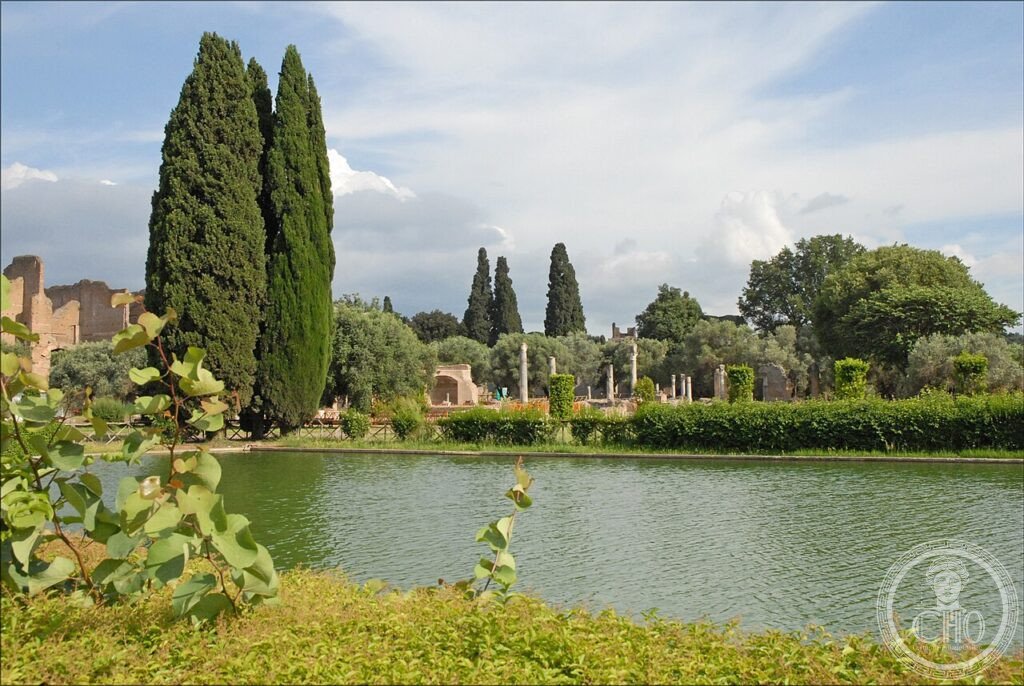
Villa Adriana
Villa Adriana (UNESCO 1999) is the most extensive surviving ancient Roman imperial villa — 120 hectares built by Emperor Hadrian from 117 to 138 CE as a literal anthology of the monuments he had seen during his travels from Britannia to Syria to Egypt, synthesizing Greek, Egyptian, and Roman architectural forms in a continuous landscape that remains the single most comprehensive surviving document of 2nd-century Roman architectural ambition.
At a glance
Villa Adriana (the most precisely VillaAdriana single Tivoli Lazio Italy 41.9417 N 12.7735 E UNESCO WHS 1999 reference 907: the villa’s scale and complexity: 120 hectares (the size of the center of Rome from the Colosseum to Piazza Navona); 30 individual named architectural complexes (the most important: the Teatro Marittimo, the Canopus, the Piazza d’Oro, the Sala dei Filosofi, the Accademia, the Libraries (Greek + Latin); the total number of individual rooms identifiable: approximately 900); Hadrian (76–138 CE; Emperor 117–138 CE; the most widely traveled Roman emperor (he visited every province of the empire at least once; the only emperor to visit Britannia and build Hadrian’s Wall (122 CE), visit Egypt and commission the Antinous cult after his favorite’s drowning in the Nile (130 CE), visit Greece and complete the Temple of Olympian Zeus in Athens (131 CE), and redesign Jerusalem as Aelia Capitolina (130–135 CE, provoking the Bar Kokhba Revolt 132–135 CE))); the architectural synthesis: Hadrian was himself a practicing architect (a hobby that Trajan (his predecessor) dismissed as an amateurism but that is documented by ancient sources (Cassius Dio; Historia Augusta) and confirmed by the originality of the Villa designs — the specific buildings at the Villa Adriana that cannot be paralleled in any other Roman architecture: the Teatro Marittimo (the round-island building; the idea of placing a private suite on an artificial island within a round canal has no Roman precedent and no Roman parallel); the Piazza d’Oro (the “Golden Square”; actually a square with one apsed end and one 9-sided vestibule — the 9-sided vestibule (a regular polygon with 9 sides, alternating semicircular and rectangular niches) is the most geometrically unusual interior in Roman architecture; no other 9-sided space survives from Roman antiquity); the Heliocaminus Baths (the “Sun Room Baths”; a heated bathing complex oriented to maximize solar gain in the cold months; the heating system is a hypocaust (the first surviving Roman hypocaust designed for both floor and ceiling radiation rather than floor only))).
Key facts
- The Teatro Marittimo and why it is the most private building ever built by a Roman emperor: the Teatro Marittimo (the “Maritime Theatre”; the name is misleading — there is no theatrical performance and no maritime setting; the name was given by 18th-century archaeologists because of the circular plan with a water element); the structure: a circular island (diameter approximately 40m; the island is 7m in diameter — the usable floor area of the island building is approximately 350 sq m (the floor plan of a 2-bedroom apartment)); the island is surrounded by a canal (width 4m; depth approximately 1.5m; the canal was navigated by small wooden boats (no surviving boats; the dimensions of the canal bollards and the tying points suggest vessels 2–3m long)); the island building (a ring of 40 Ionic columns surrounding a central open courtyard; within the ring, a complex arrangement of small rooms: an atrium, a tablinum (reception), a triclinium (dining room), two small bedrooms, a private bathing suite (2 rooms: a caldarium (hot) and a frigidarium (cold)), a small kitchen area, and a latrine (the only latrine in the Villa designed for a single user rather than the communal multi-seat latrines found elsewhere in the complex)); the specific significance: the island building is the only space in the entire 120-hectare Villa Adriana where Hadrian could be completely alone (the canal provided a water barrier; the small boats were the only means of access; the emperor could order the boats to the far bank and remain on the island without any other person (the island has no second entrance; the canal is the only access)); the island building was Hadrian’s private retreat within his retreat
- GPS: 41.9417° N, 12.7735° E
History
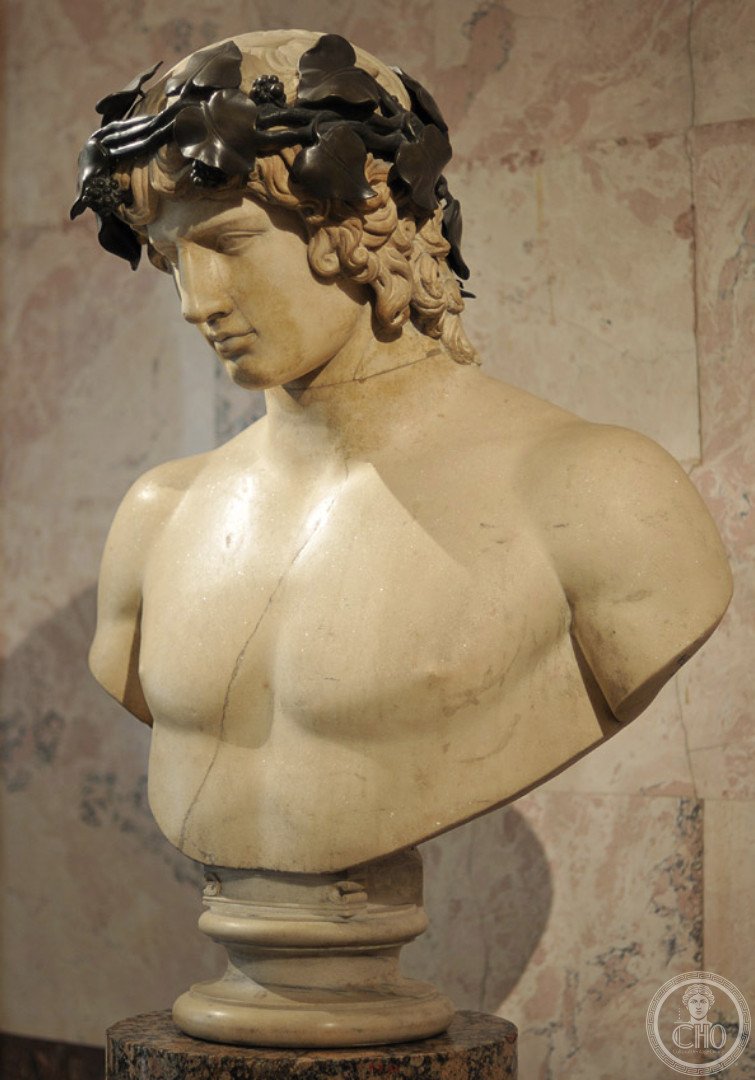
From Hadrian’s 117 CE commission to Pirro Ligorio’s excavations to UNESCO (the most precisely VillaAdriana single 117 CE construction start: Hadrian became emperor in 117 CE (on the death of Trajan at Selinus in Cilicia; the succession was announced by Trajan’s wife Plotina, creating suspicion that Hadrian’s adoption had been falsified; the legal ambiguity was one of the reasons Hadrian executed 4 senior senators immediately on becoming emperor — the most controversial act of his reign); Hadrian began constructing the villa at Tivoli in 117–118 CE; the main construction campaign (118–134 CE): the scale of construction required approximately 5,000–8,000 workers (the logistics: 120 hectares of marble-finished buildings; the marble came from at least 6 provinces (Carrara for the white; Afyon in Anatolia for the purple-veined; the Pentelikon quarries in Attica for the Greek-type marble (specially imported by Hadrian who was a conscious Hellenist))); the abandonment (138 CE; Hadrian died at Baiae; his successor Antoninus Pius used the villa but did not expand it; by the 3rd century CE the villa was selectively stripped for building material (the Canopus pool fill contains marble revetment fragments showing that the facing was systematically removed in the 3rd century); the medieval period: the villa was used as a quarry for the town of Tivoli and for the palaces of the Renaissance popes; Pirro Ligorio (the architect of the Villa d’Este, 1.5 km away) began the first systematic archaeological investigation of the villa in 1548–1553 CE (the excavation records and the Ligorio plan of the villa are in the Biblioteca Nazionale Napoli; they are the foundation document for all subsequent archaeological understanding of the site); 1550–1800 CE: systematic looting of the remaining sculptures (the Canopus caryatids, the Teatro Marittimo statues, the mosaic floors) into European collections; the most important single looted object: the “Antinous Mondragone” (a colossal marble head of Hadrian’s favourite Antinous; excavated from the Villa Adriana c.1600 CE; now in the Louvre); 1999 CE UNESCO inscription reference 907.
What you see
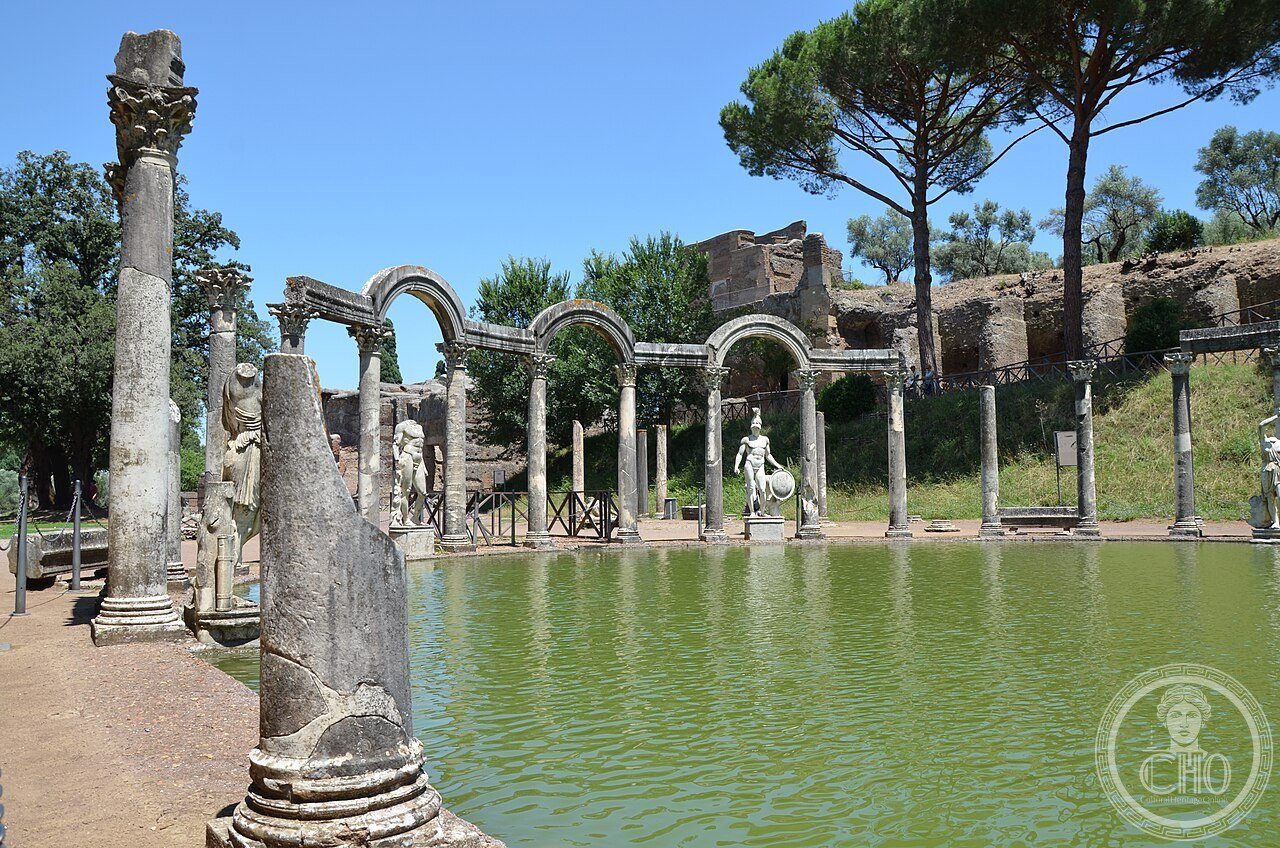
The Canopus, the Teatro Marittimo, the Piazza d’Oro, and the on-site museum (the most precisely VillaAdriana single visit (3–4 hours minimum; full day if seriously interested): 1) the site entrance (Via di Villa Adriana; the visitor centre + on-site museum (the Antiquarium: models showing the complete original villa; the surviving sculpture fragments (the Canopus caryatid casts; the mosaic fragments; a complete Corinthian capital)); the scale model (1:50; the only way to understand the spatial relationships of the 30 complexes)); 2) the Canopus (5 minutes from the entrance; the most visually complete element of the villa because the canal water is maintained and the colonnade has been partially reconstructed (the reconstruction is archaeologically based: the original column positions are marked by the column base stubs; the standing columns are casts of the original Doric columns found in the canal fill during 1950s CE excavations)); 3) the Teatro Marittimo (20 minutes from the Canopus via the main path; the circular ruins show the concentric rings of the canal (now dry) + the island foundation + the ring colonnade stumps; the best single view is from the restored footbridge (a 20th-century reconstruction of the original footbridge that allowed entry to the island)); 4) the Piazza d’Oro (25 minutes from the Teatro Marittimo; the most ruinous major complex — only the foundations survive above ground; the 9-sided vestibule: the apses are visible in plan from ground level; the original dome (a 9-sided dome with alternating semicircular and flat compartments — a dome type unprecedented in Roman architecture and not reconstructed since) is reconstructed only in the site model)); 5) the summer exit (the path south from the Piazza d’Oro to the exit gate; passing the Baths complex and the Heliocaminus; the total walk from entrance to exit (one-way): 2 km).
Practical information
- Combining Villa Adriana with Villa d’Este Tivoli in a single day from Rome: transport from Rome: COTRAL bus from Ponte Mammolo (Line B metro from Termini; 30 min by metro + 1h bus; total: 1h30min; every 30–40 min; the bus terminus is at Tivoli bus station in the town center); the combined 1-day visit sequence: 9:00 Rome departure; 10:30 arrive Villa Adriana (the bus stops at the Villa Adriana gate on Via di Villa Adriana; 5 min walk from the main entrance); 10:30–13:30 Villa Adriana (€10 admission); 13:30 shuttle bus Villa Adriana → Tivoli town center (COTRAL shuttle from the villa gate; 10 min; or 3 km walk via Via di Villa Adriana; or taxi from the villa gate (€8–10)); 14:00 lunch in Tivoli; 15:00–18:30 Villa d’Este (€14; the Organ Fountain plays at 15:30 and 17:30 — time the visit to hear at least one performance); 18:30 bus Tivoli → Rome Ponte Mammolo; 20:00 return to Rome; the museum in both villas requires significant walking on uneven terrain — wear appropriate footwear; the Villa Adriana site has limited shade in summer — bring water and a hat; the Villa Adriana picnic area (behind the Antiquarium) has shaded tables — bring lunch from Tivoli as the site café is expensive
Getting there
COTRAL bus from Rome Ponte Mammolo (Line B, 1h30 total, every 30-40 min). Or car: A24 Rome-L’Aquila exit Tivoli, 30 km. Open daily 9:00-19:00 (summer). Admission €10. GPS: 41.9417, 12.7735.
Nearby
- Villa d’Este — 1.5 km north (UNESCO WHS 2001; Pirro Ligorio Renaissance water garden; 500 fountains; Organ Fountain water organ plays every 2h; Liszt residence 1865–86; €14; combined day trip from Rome feasible)
- Roma — 30 km west (UNESCO WHS 1980; the Colosseum, Pantheon, Sistine Chapel, Castel Sant’Angelo; the Vatican Museums (entry via advance booking obligatory in summer))
Gallery
Sources
- Wikipedia, Hadrian’s Villa; Hadrian; Canopus (Hadrian’s Villa); Maritime Theatre (Hadrian’s Villa), accessed June 2026
- UNESCO, Villa Adriana (Tivoli), WHS reference 907, inscribed 1999
- MacDonald, William L., and John A. Pinto. Hadrian’s Villa and Its Legacy. New Haven: Yale University Press, 1995
Find it on the map
See this place and what’s around it →📷 Diventa un fotografo di Cultural Heritage Online
Condividi le tue foto dei luoghi: restano pubblicate con la tua firma come autore. Più vengono viste, più ti fai conoscere — e presto un concorso premierà le foto più apprezzate.
Accedi o registrati gratis per aggiungere una foto