
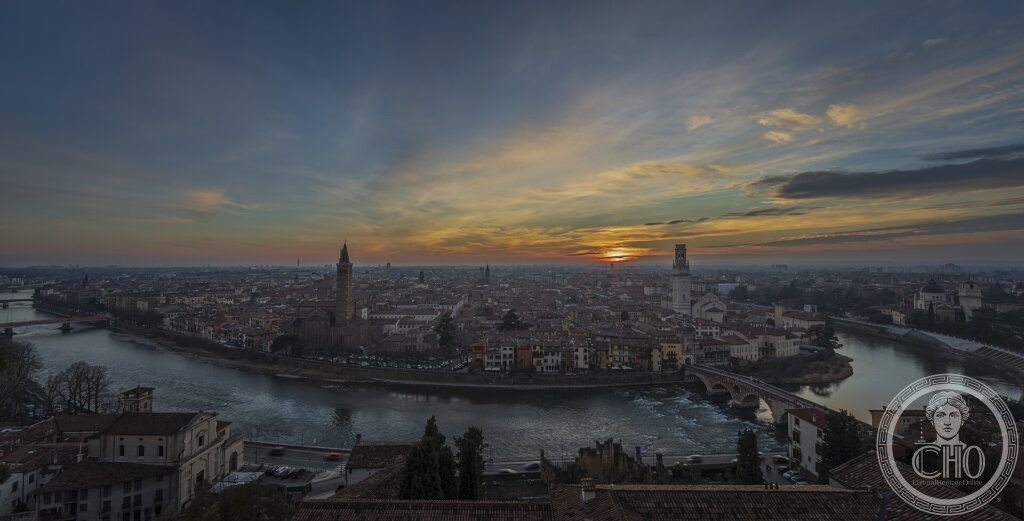
Verona Romana e Scaligera: l’Arena di Verona (30 d.C.), la Piazza delle Erbe, le Arche Scaligere e la Città di Romeo e Giulietta tra Anfiteatro Romano e Rinascimento Veneto (UNESCO 2000)
Verona — a Roman colony from 89 BCE, one of the most prosperous cities of the Roman Empire (visible today in the Arena, the theatre, the city gates, and the triumphal arches still standing in their original positions), capital of the Scaliger dynasty in the 13th-14th centuries (whose Gothic funerary monuments are the finest collection of medieval tomb sculpture in Italy), and Venetian territory from 1405 to 1797 (whose loggia, palazzi, and fortifications define the city's main public space) — offers the most complete stratified sequence of Roman, medieval, and Renaissance urban fabric surviving in the Po valley.
At a glance
Verona (province of Verona, Veneto; UNESCO 2000, ref. 797) was inscribed as “an outstanding example of a city that has maintained its historic urban fabric through the use and adaptation of its buildings through successive periods.” The inscription covers the full historic centre of Verona (approximately 2 km × 1 km within the Adige river bend), which preserves: the Arena (30 CE, the third-largest surviving Roman amphitheatre by seating capacity); the Roman theatre (1st century BCE, on the opposite bank of the Adige; partially restored, now used for the summer theatre festival); the Arco dei Gavi (1st century CE, the finest surviving Roman triumphal arch in northern Italy, with the original dedication inscription preserved); the Porta Borsari (3rd century CE city gate, with the inscription reading COLONIA VERONA AVGVSTA); the Piazza delle Erbe (the Roman forum, continuously used as a market from Roman times to the present); the Arche Scaligere (the Scaliger funerary monuments, 1277-1380, the most elaborate Gothic tomb sculptures in Italy); the Castelvecchio (1354-1376, the Scaliger fortress on the Adige); and the Palazzo Maffei and Palazzo della Ragione with their medieval towers and loggias.
Key facts
- Arena di Verona (30 CE): The third-largest surviving Roman amphitheatre in the world by seating capacity (22,000 spectators; the Colosseum had approximately 50,000, the Capua amphitheatre approximately 40,000); the arena is 152 m × 128 m in the outer perimeter; the four-storey outer facade (originally three orders of arches in marble) was largely destroyed by the earthquake of 1183 — only the “ala” (wing), a fragment of four arches of the original outer ring, survives; the inner cavea (44 rows of stone seating) is intact and still used. The Arena has hosted opera performances since 1913 (the first production was Aida, marking the centenary of Verdi's birth): the Arena di Verona Festival (July-August) is the largest open-air opera festival in the world, with audiences of 14,000-22,000 per performance
- Romeo and Juliet (Shakespeare, 1597): Shakespeare's Romeo and Juliet (1597) is set “in fair Verona, where we lay our scene”; Shakespeare had no known direct knowledge of Verona (he probably based the story on an Italian novella by Matteo Bandello, 1554, which was set in Verona), but the play made Verona internationally famous as the setting of the tragedy; since the 19th century the city has sustained a tourist industry built on the association, including the “Casa di Giulietta” (Via Cappello 23, a 14th-century courtyard palace that has no actual connection to any historical Capulet or Montague family but receives approximately 500,000 tourists per year), and the tradition of leaving letters “to Juliet” at the house (answered by a team of volunteers, the subject of a 2010 romantic film)
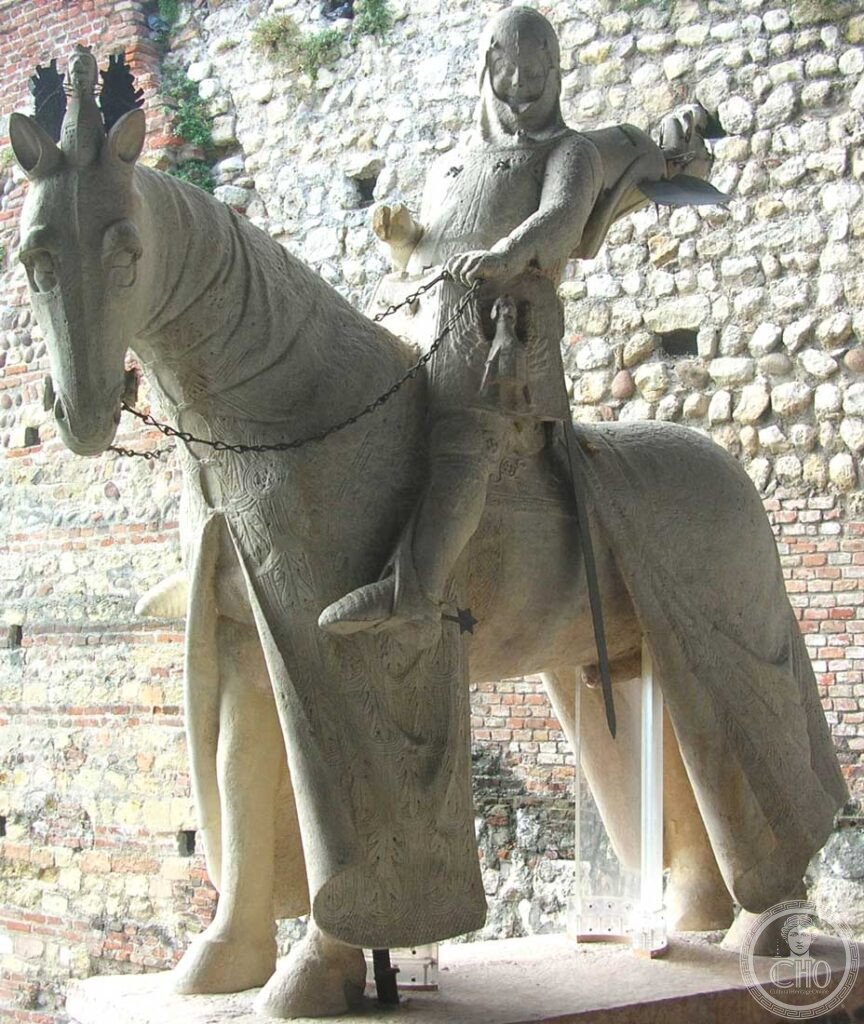
- Arche Scaligere (1277-1380): The funerary monument complex of the Scaliger (della Scala) family, the lords of Verona 1262-1387, in the courtyard of Santa Maria Antica (Piazza dei Signori); the three main tombs (of Cangrande I, 1329; Mastino II, 1351; and Cansignorio, 1375-1382) are the most elaborate Gothic funerary sculptures in Italy: each is a sarcophagus elevated on a Gothic tabernacle supported by columns, with an equestrian figure of the deceased on top (the originals of the Cangrande and Cansignorio equestrian figures are in the Museo di Castelvecchio; replicas are on the tombs)
- UNESCO: 2000, ref. 797
- GPS: 45.4385, 10.9945 — Google Maps (Arena di Verona)
History
Verona was founded as a Roman colony in 89 BCE (the current city was preceded by a settlement on the site but the Roman street grid and the public monuments date from the colonial period). Under the Empire (1st-3rd centuries CE) it was one of the most prosperous cities of northern Italy; the Arena, the theatre, the city gates, and the bridges date from this period. After the fall of the Western Empire (476 CE), Verona was an important Ostrogoth city (Theodoric's palace and court were at Verona in addition to Ravenna): the medieval legend of Dietrich von Bern (Theodoric) is set in Verona. The Scaliger (della Scala) family ruled Verona from 1262 to 1387, transforming it into one of the principal cultural centres of northern Italy: Dante Alighieri visited the court of Cangrande I (d.1329) and dedicated the Paradiso to him; Petrarch was a guest of the Scaliger court. Venice conquered Verona in 1405 and held it until Napoleon's Treaty of Campoformio (1797); the Venetian period (1405-1797) left substantial architectural additions to the city (the Venetian walls, the Loggia del Consiglio, the Palazzo Maffei).
What you see
The Verona monument circuit begins at the Piazza Bra (the largest piazza in Verona, south of the Arena): the Arena fills the north side; the Via Mazzini leads north from the piazza to the old city. The principal sequence is: Arena (exterior circuit from Piazza Bra; interior with the seating cavea, best seen when it is not in operation; the “ala” fragment of the outer ring is on the Via Leoncino/Via Anfiteatro side) → Piazza delle Erbe (the Roman forum, with the column of the Venetian lion, the 16th-century fountain of Madonna Verona on a Roman sculpture, and the medieval market stalls still in use) → Piazza dei Signori (the civic centre, with the Palazzo della Ragione, the Loggia del Consiglio, and the Arche Scaligere adjacent) → Via Cappello 23 (the Casa di Giulietta: if you want to see the balcony and the courtyard; the long queue and the proliferation of tourist shops is the main experience) → Sant'Anastasia (the Gothic Dominican church, with Pisanello's fresco of Saint George and the Princess, 1430-1438, one of the finest late Gothic paintings in Italy) → the Adige bridges and the Roman theatre (on the left bank).
Gallery
Practical information
- Arena di Verona: Piazza Bra 1, Verona; open Tuesday-Sunday 9:00-18:30 (non-performance days); on performance days (July-August), only tours 9:00-15:30; admission ~€10. The Arena Opera Festival runs July-August (opera performances 3-5 times per week); tickets from €30 (unreserved stone seats/gradinate) to €250+ (numbered armchairs in the VIP sections); book months in advance for premium seats at arena.it.
- Arche Scaligere: Piazza dei Signori, Verona; exterior always visible; the enclosure fee is ~€4.
- Castelvecchio e Museo Civico d'Arte: Corso Castelvecchio 2, Verona; open Tuesday-Sunday 8:30-19:30; admission ~€6. The museum has the original equestrian figure of Cangrande I della Scala (the finest 14th-century secular sculpture in Italy) and major collections of Veronese painting (Pisanello, Mantegna, Bellini, Titian).
- Season: Spring (April-June) and autumn (September-October) are best. July-August is Opera Festival season — the city is extremely crowded on performance nights.
Getting there
Piazza Bra, Verona (VR), Veneto. GPS 45.4385, 10.9945. By train: Trenitalia high-speed from Milan (1h15 Frecciarossa); from Venice (1h20 Frecciarossa); from Rome (3h30 Frecciarossa). Verona Porta Nuova station is 15 min on foot from the Arena. By car: from Milan, A4 east (170 km, 1h30); from Venice, A4 west (115 km, 1h15).
Nearby
- Lago di Garda — 30 km west; the largest lake in Italy; the eastern shore from Peschiera del Garda (15 km, Roman Veronese road station) to Malcesine (60 km, with the Scaliger castle above the lake); Sirmione (30 km, with the Grotte di Catullo Roman villa ruins and the Scaliger castle) is the most visited Garda town from Verona
- Mantova — 40 km south-west; (CHO card: Mantova Gonzaga UNESCO 2008); the Camera degli Sposi (Mantegna, 1474), Palazzo Te (Giulio Romano), Basilica di Sant'Andrea (Alberti)
- Vicenza — 60 km east; (CHO card TBD); the city of Andrea Palladio; UNESCO 1994 (ref.712); the Teatro Olimpico (1585, the first permanent indoor theatre in Europe), the Basilica Palladiana, and 24 Palladio villas visible from the city
Sources
- UNESCO: whc.unesco.org/en/list/797
- Wikipedia EN: Verona
- Morgan, Luke: The Arena of Verona, in Journal of Roman Archaeology, 2011
- Arena di Verona Festival: arena.it
Find it on the map
See this place and what’s around it →📷 Diventa un fotografo di Cultural Heritage Online
Condividi le tue foto dei luoghi: restano pubblicate con la tua firma come autore. Più vengono viste, più ti fai conoscere — e presto un concorso premierà le foto più apprezzate.
Accedi o registrati gratis per aggiungere una foto