
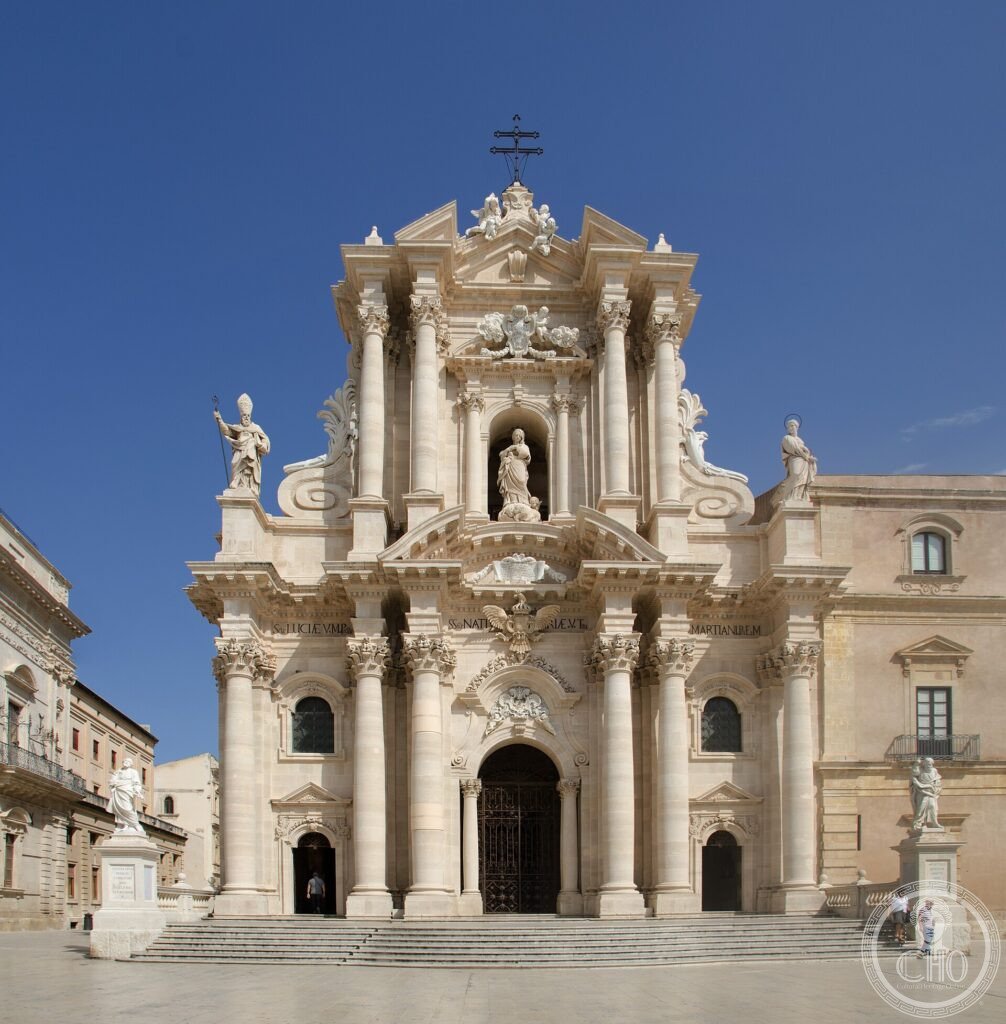
Siracusa e Ortigia (VI sec. a.C. — V sec. d.C.): il Duomo nella Colonne Greche del Tempio di Atena (480 a.C.), il Teatro Greco, l’Orecchio di Dionisio e la Prima Grande Città Greca d’Occidente (UNESCO 2005)
Syracuse — founded by Corinthian colonists in 734 BCE on the island of Ortygia, expanded to become the largest Greek city in the western Mediterranean by the 5th century BCE (with an estimated population of 270,000 at its peak under Dionysius I and Hiero II), and the site of the most dramatic single conservation decision in Western architectural history (the conversion of the 5th-century BCE Temple of Athena into the Christian cathedral by simply walling in the spaces between the Doric columns) — remains the city where Greek urban civilization and its transformation into Christian civilization are most compactly legible to a visitor.
At a glance
Siracusa (province of Syracuse, Sicilia; UNESCO 2005, ref. 1185) was inscribed as a serial property together with the Necropoli rupestri di Pantalica (the Bronze Age and Sicilian-Greek rock-cut tomb necropolis 40 km inland at Pantalica). The Siracusa component covers the island of Ortigia (the original Greek city and the medieval-Baroque historic centre) and the archaeological zone of the Neapolis (the ancient city on the mainland, 3 km north-west of Ortigia, containing the Greek theatre, the Roman amphitheatre, the Latomie quarries, and the Orecchio di Dionisio). Together, these two areas cover approximately 2,600 years of continuous human occupation from the Corinthian colonial period (734 BCE) to the present.
Key facts
- The Temple of Athena (480 BCE) / Duomo di Siracusa: The most visible monument of ancient Syracuse: a Doric hexastyle temple (6 columns across the front, 14 along each side = 36 total; the columns are the largest Doric columns in Sicily at 8.7 m high and 2.05 m base diameter) built immediately after the Greek victory over the Carthaginians at the Battle of Himera (480 BCE); in the 5th-6th century CE, the Byzantine Bishop Zosimos converted the temple into a church by walling in the spaces between the exterior columns with stone fill and rearranging the interior walls; the church became the current Duomo (with the Baroque facade by Andrea Palma, 1725-1753, added after the 1693 earthquake); the Greek columns are still visible in the side walls from the street (Via Minerva) and in the interior of the nave
- The Greek Theatre (5th century BCE): The largest and best-preserved Greek theatre in Sicily (and one of the largest in the world): 67 m in radius, carved into the rock of the Temenite hill (one of the hills of the ancient city north of Ortigia), with 42 rows of seats (the cavea) for an estimated audience of 15,000-20,000; Aeschylus' The Persians was performed here in 472 BCE (the playwright himself was present, probably directing); the theatre is still used for performances of ancient drama (the INDA — Istituto Nazionale del Dramma Antico — puts on annual performances of Greek tragedy and comedy in the theatre every spring-summer)
- The Orecchio di Dionisio (Ear of Dionysus): An artificial cave in the Latomie dei Cappuccini quarry complex (the ancient limestone quarries from which the stone for the Syracusan monuments was cut); 65 m deep, 23 m high, 5-11 m wide, with an S-shaped plan and extraordinary acoustic properties (a whisper at the far end can be heard at the entrance); the name was given by Caravaggio on his 1608 visit to Syracuse (he described the cave as “the ear of Dionysus” because of its ear-like shape and the tradition that Dionysius I (r.405-367 BCE) used to listen to the conversations of prisoners held in the quarries from a hole at the top of the cave)
- UNESCO: 2005, ref. 1185
- GPS: 37.0601, 15.2937 — Google Maps (Duomo di Siracusa, Ortigia)
History
Syracuse was founded in 734 BCE by Corinthian colonists on the small island of Ortygia at the mouth of a natural harbour on the Sicilian east coast. Within two centuries it had expanded to the mainland (the districts of Tyche, Neapolis, Achradina, and Epipole) and become the most powerful Greek city in the west, with a population estimated at 250,000-270,000 at its height under Dionysius I (r.405-367 BCE) and Hiero II (r.270-215 BCE). The city defeated two Athenian expeditions (the Sicilian Expedition of 415-413 BCE, the most complete military disaster in Athenian history) and the Carthaginian armies of the 4th century BCE. After the Roman conquest (212 BCE, after a two-year siege described by Polybius and Livy; Archimedes was killed during the sack by a Roman soldier who didn't recognize him) it became the capital of the Roman province of Sicily. The Baroque reconstruction after the 1693 earthquake gave Ortigia its current character (the Via Roma, the Palazzo Beneventano del Bosco, and the Cathedral facade date from the late 17th and early 18th centuries).
What you see
The Ortigia circuit (walkable in 2-3 hours): Piazza del Duomo (the main civic space of Ortigia, one of the finest Baroque piazze in Sicily, with the Cathedral, the Palazzo Beneventano del Bosco, and the former Bishop's Palace on three sides) → Via Minerva (the street along the Cathedral south side, where the Greek columns of the Temple of Athena are visible in the external wall) → Fonte Aretusa (the freshwater spring on the waterfront of Ortigia, described by Pindar in the 5th century BCE as the spring of the nymph Arethusa transformed; papyrus grows in the pool, as it has since antiquity — Syracuse is the northernmost natural papyrus-growing site in the world) → Castello Maniace (13th-century Norman castle at the southern tip of Ortigia, with the best view of the Grande Porto).
The Neapolis archaeological zone (3 km north-west of Ortigia): the Teatro Greco (5th century BCE, 67 m radius, rock-carved, still used for ancient drama performances in spring-summer; the INDA box office at the entrance) → the Latomie dei Cappuccini (the ancient quarries, with the Orecchio di Dionisio cave; entrance from the archaeological park) → the Roman Amphitheatre (2nd century CE, partially buried in the current parkland). The Museo Archeologico Regionale Paolo Orsi (Viale Teocrito 66, 1.5 km from the Neapolis) has the finest collection of Greek Sicily finds in any museum, including the Landolina Venus (a Roman copy of a Greek original, found near the theatre in 1804) and a complete sequence of Syracusan coins from the 6th to 3rd century BCE.
Gallery
Practical information
- Duomo di Siracusa: Piazza del Duomo, Ortigia; open daily 7:00-19:00; free.
- Parco Archaeologico della Neapolis: Viale Paradiso 14, Siracusa; open daily 8:30 to one hour before sunset; admission ~€16 (park+Museo Orsi combined); the Teatro Greco is open for visits year-round (and for performances from May-late June by INDA: book at indafondazione.org).
- Museo Archeologico Regionale Paolo Orsi: Viale Teocrito 66, Siracusa; open Tuesday-Sunday 9:00-18:00; admission ~€10 (combined with Neapolis park).
- Duration: Full Siracusa (Ortigia + Neapolis + Museo Orsi) requires a full day (6-8 hours). Ortigia alone is 2-3 hours.
Getting there
Piazza del Duomo, Siracusa (SR), Sicilia. GPS 37.0601, 15.2937. By train: Trenitalia from Catania (1h15 regional; 10 trains/day); from Messina (2h30 regional); from Palermo (4h with change at Caltanissetta Xirbi). The train station is 15-20 min on foot from Ortigia (or take a bus across the bridge). By car: from Catania, A18/SS114 south (60 km, 1h); from Palermo, A19 east to Catania then SS114 south (265 km, 3h).
Nearby
- Noto — 32 km south-west; (CHO card: Noto Barocco UNESCO 2002); the finest unified Baroque city ensemble in Sicily (UNESCO 2002 ref.1024)
- Pantalica — 40 km north-west; the rock-cut necropolis co-inscribed with Siracusa in UNESCO 2005 (ref.1185); approximately 5,000 tombs carved into the vertical cliff faces of two deep gorges carved by the Anapo and Calcinara rivers; accessible on foot (2-3h hiking circuit) or by car to the plateau above
- Agrigento / Valle dei Templi — 130 km west; (CHO card: Agrigento batch9 2026-05-29); the Valley of the Temples (UNESCO 1997 ref.831)
Sources
- UNESCO: whc.unesco.org/en/list/1185
- Wikipedia EN: Syracuse, Sicily
- Holloway, R. Ross: The Archaeology of Ancient Sicily, Routledge, 1991
- INDA Fondazione: indafondazione.org
Find it on the map
See this place and what’s around it →📷 Diventa un fotografo di Cultural Heritage Online
Condividi le tue foto dei luoghi: restano pubblicate con la tua firma come autore. Più vengono viste, più ti fai conoscere — e presto un concorso premierà le foto più apprezzate.
Accedi o registrati gratis per aggiungere una foto