
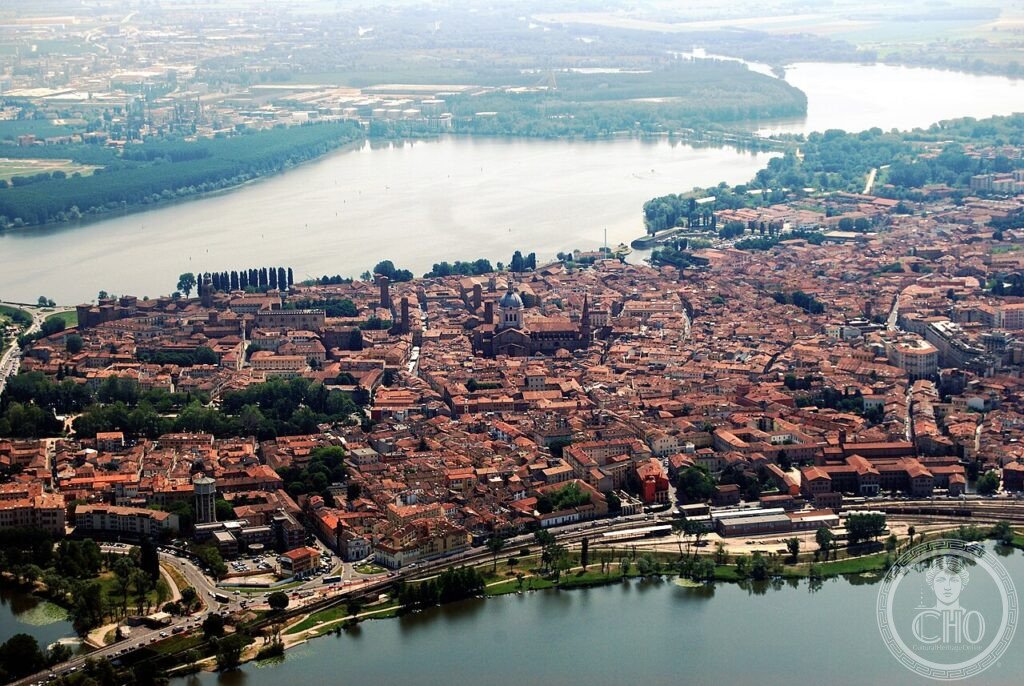
Mantova Gonzaghesca (1328-1630): la Camera degli Sposi di Mantegna (1474), il Palazzo Te di Giulio Romano (1524-1534) e la Corte dei Gonzaga tra Virgilio, Pico e Monteverdi nell'Isola Lacustre dell'Umanesimo Italiano (UNESCO 2008)
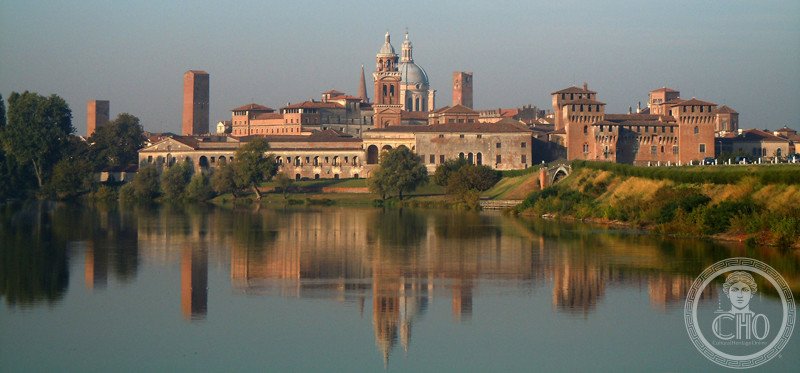
Mantua — almost entirely surrounded by the three lakes formed by the Mincio river, ruled by the Gonzaga family from 1328 to 1627, and the site of Andrea Mantegna's Camera degli Sposi (1474, the first interior space in Western art to be decorated with a complete illusionistic fresco programme turning the walls and ceiling into a continuous architectural illusion) and Giulio Romano's Palazzo Te (1524-1534, the Mannerist villa built on a marshy island for Federico II Gonzaga, with the Sala dei Giganti where the entire room — floor, walls, ceiling — is painted as one continuous scene of the giants being struck down by Jupiter) — is the most complete surviving Gonzaga court environment in Italy.
At a glance
Mantua (province of Mantova, Lombardia; UNESCO 2008, ref. 1287) was inscribed together with Sabbioneta (a planned Renaissance town 30 km south, built by Vespasiano Gonzaga from 1556 to 1591 as a miniature ideal city with a theatre, palace, and fortifications). The inscription covers the exceptional concentration of Gonzaga-period cultural assets in Mantua and the unique completeness of Sabbioneta as a planned Renaissance town. Within Mantua, the key UNESCO monuments are: the Palazzo Ducale (the largest Renaissance residence complex in Italy, with approximately 500 rooms and 35,000 m² of floor space, built progressively by the Gonzaga from the 14th to the early 17th century); the Camera degli Sposi (Andrea Mantegna's frescoed room in the Castello di San Giorgio, the inner keep of the Palazzo Ducale, completed 1474); the Basilica di Sant'Andrea (Leon Battista Alberti, designed 1470, built 1472-1494, the first Renaissance church to replace the Gothic system with a Latin cross plan combining a single wide nave with a barrel vault, derived from the Roman triumphal arch and the Pantheon); and the Palazzo Te (Giulio Romano, 1524-1534, outside the city wall on an island accessible by a causeway).
Key facts
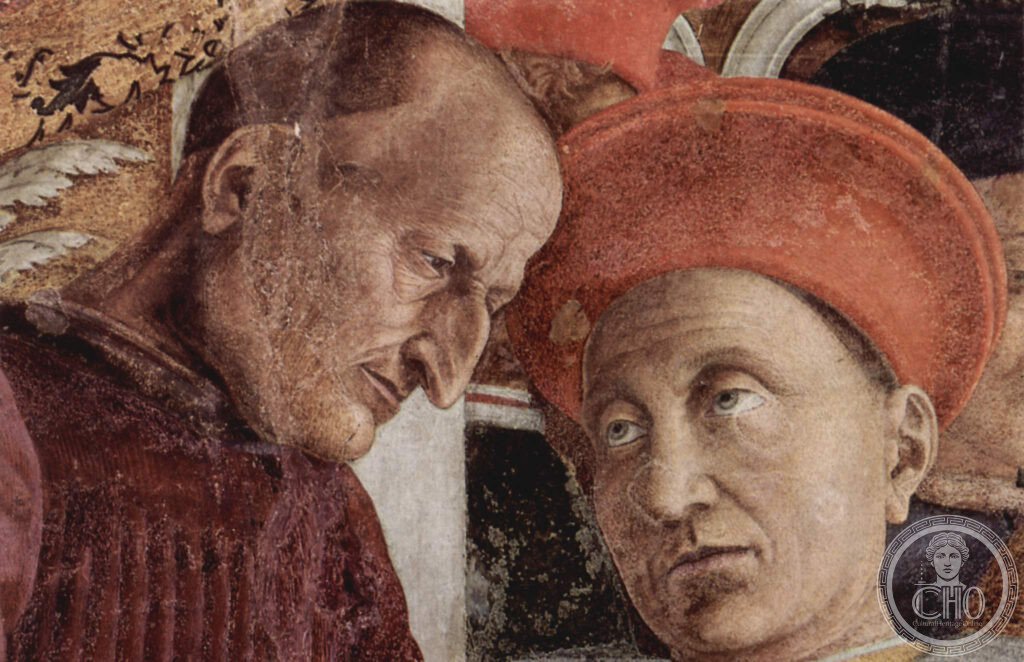
- Camera degli Sposi (Andrea Mantegna, 1474): The painted room in the Castello di San Giorgio (one of the corner towers of the Palazzo Ducale, added by Ludovico II Gonzaga in the 1390s): the room (approximately 8 m × 8 m square, with a barrel vault) was frescoed by Mantegna between 1465 and 1474 as a continuous painted environment; the four walls show scenes of Gonzaga court life (the famous “Audience Scene” and “Meeting Scene” in which Ludovico II Gonzaga and his court are depicted with courtiers, ambassadors, and horses in a continuous landscape), and the ceiling shows an oculus (a painted circular opening in the ceiling, approximately 2.5 m in diameter) with figures leaning over the edge to look down at the viewer — the first painted trompe-l'oeil ceiling in Western art, and one of the most influential single images in Renaissance painting (it directly inspired all subsequent painted ceiling illusionism, from Correggio to Tiepolo)
- Basilica di Sant'Andrea (Leon Battista Alberti, designed 1470): The theoretical masterpiece of Alberti's ecclesiastical architecture: a single wide nave (18 m wide, the widest nave of any Renaissance church) with a barrel vault (derived from the Roman triumphal arch) and lateral chapels opening off the nave walls; the facade is designed as a Roman triumphal arch applied to a church front; the plan is a Latin cross. The building established the architectural conventions that Bramante, Michelangelo, and subsequent church architects would follow for the next 150 years; it is arguably the most influential single church in Renaissance architectural history
- Palazzo Te (Giulio Romano, 1524-1534): Built by Federico II Gonzaga (the fifth Gonzaga Marquis, who commissioned Giulio Romano to design a suburban villa on a marshy island outside the city walls); the villa is the defining building of Mannerism in architecture: a single-storey building with a central courtyard, whose exterior facades systematically violate the classical rules of Vitruvius (columns that don't reach the entablature, keystones that appear to be “falling” from the arch, rough rustication interrupted by smooth surfaces) in a deliberate game of classical expectations. The interior has frescoes by Giulio Romano and his school: the most famous is the Sala dei Giganti (Room of the Giants), in which the entire room (floor, walls, and ceiling without interruption or framing border) is painted as a single composition showing the battle between Jupiter and the Giants (the Giants attempting to storm Olympus, Jupiter striking them down with thunderbolts while the mountain avalanches fall) — the visitor standing in the room is inside the painting
- Virgil (70-19 BCE): The greatest Roman poet was born near Mantua (in Andes, a village later identified with Pietole, 5 km southeast of the city); Mantua claims Virgil as its most famous son; the Piazza Virgiliana (the main public square of Mantua) has the Virgil statue (1927) and the city uses Virgilian imagery as a civic symbol
- UNESCO: 2008, ref. 1287
- GPS: 45.1564, 10.7913 — Google Maps (Palazzo Ducale)
History
The Gonzaga family acquired control of Mantua in 1328 (when Luigi I Gonzaga led a coup against the previous Bonacolsi rulers) and held the city for exactly three centuries: as Captains of the People (1328-1432), as Marquises (1432-1530), and as Dukes (1530-1627). The Gonzaga court became one of the principal cultural centres of Renaissance Italy under Ludovico II (1444-1478, who brought Mantegna to Mantua in 1460 as court painter for life, the first time any Italian court appointed a major artist on a permanent salaried basis) and Francesco II (1484-1519, who married Isabella d'Este, the most cultivated woman of the Italian Renaissance, who assembled the greatest art collection in 16th-century Italy in her Studiolo in the Palazzo Ducale). The Gonzaga court was dissolved by the Sack of Mantua (1630, during the Thirty Years' War, when an Imperial army looted the city and sold approximately 2,000 items from the Gonzaga collection to Charles I of England — the most important single transfer of Italian Renaissance art to a northern European collection before the Napoleonic confiscations).
What you see
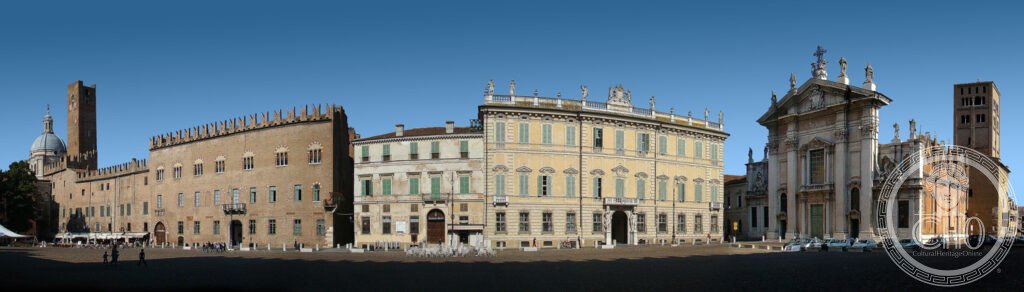
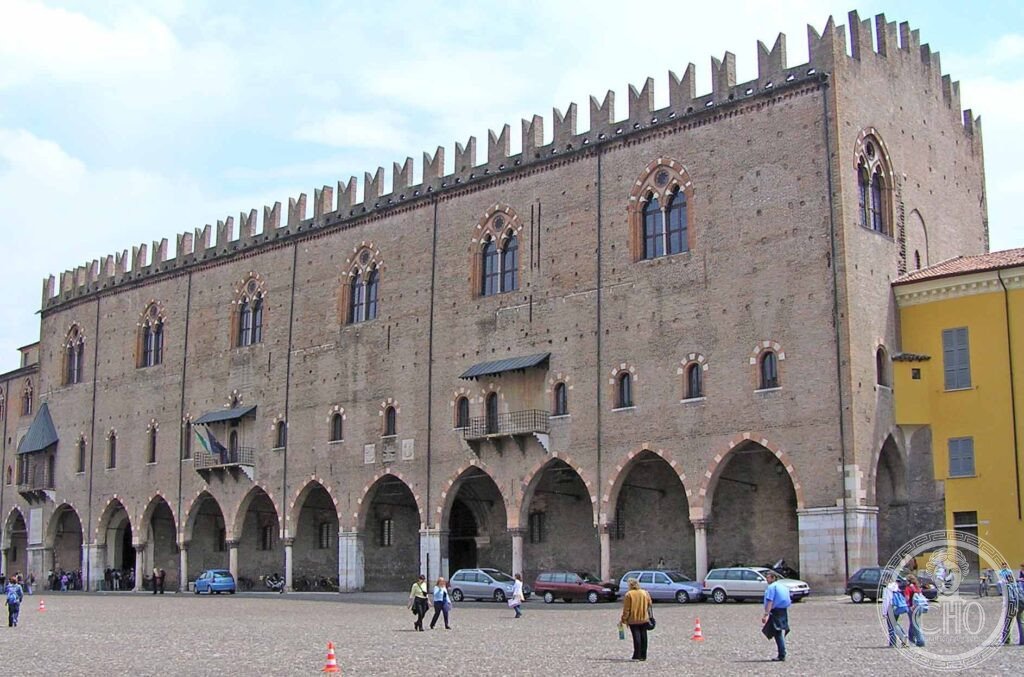
The monument circuit in Mantua covers: the Palazzo Ducale (multiple buildings around a series of courtyards and gardens; the Camera degli Sposi requires a timed ticket booked well in advance; the Bridal Suite, the Hall of Rivers, and the Galleria degli Specchi are also in the complex); the Basilica di Sant'Andrea (exterior facade on Piazza Mantegna; interior with the wide barrel-vault nave and the Mantegna Family Chapel in the first left transept, where Mantegna's tomb and a self-portrait bust are displayed); and the Palazzo Te (20-min walk or bus outside the historic centre on Viale Te). The Piazza delle Erbe and Piazza Sordello (the two main public spaces, connected by the Via Broletto) are flanked by medieval Romanesque and Gonzaga buildings and give the best sense of the continuous historical accumulation of the city centre.
Gallery
Practical information
- Palazzo Ducale (Camera degli Sposi): Piazza Sordello 40, Mantova; open Tuesday-Sunday 8:15-19:15 (booking mandatory for Camera degli Sposi; book at mantovacollections.it at least 2-3 weeks in advance in peak season); admission ~€15 (full), ~€2 (reduced EU 18-25).
- Palazzo Te: Viale Te 13, Mantova; open Monday 13:00-18:00, Tuesday-Sunday 9:00-18:00; admission ~€15 (full). Combined Palazzo Ducale+Palazzo Te ticket ~€22.
- Basilica di Sant'Andrea: Piazza Mantegna, Mantova; open daily 8:00-12:00 and 15:00-19:00; free.
- Season: Spring (April-June) and autumn (September-October) are ideal. July-August can be hot and crowded; the city has limited shade in the historic streets.
Getting there
Piazza Sordello, Mantova (MN), Lombardia. GPS 45.1564, 10.7913. By train: Trenitalia from Milan (1h50 regional; 1h30 some direct; limited high-speed connection — prefer regional); from Verona (35 min regional; frequent service); from Brescia (1h regional with change at Piadena). The station is 15 min on foot from the Palazzo Ducale. By car: from Milan, A4 to Brescia then SS236 to Mantova (165 km, 1h45); from Verona, SS62 west (40 km, 40 min).
Nearby
- Sabbioneta — 30 km south; the UNESCO co-inscription with Mantova (ref.1287, 2008); Vespasiano Gonzaga's miniature ideal Renaissance city (1556-1591) with the Teatro all'Antica (1590, the first purpose-built indoor theatre in Europe, by Vincenzo Scamozzi), the Galleria degli Antichi, and the Palazzo Ducale on a grid plan with complete walls
- Verona — 40 km east; the city of Romeo and Juliet; the Arena di Verona (1st century CE, the third-largest surviving Roman amphitheatre, still used for opera performances summer season); the Piazza delle Erbe (Roman forum + medieval market + Renaissance buildings); UNESCO 2000 (ref.797)
- Lago di Garda — 30 km west; the largest lake in Italy; the western shore (Salò, Gardone Riviera with the Vittoriale degli Italiani — Gabriele D'Annunzio's extraordinary villa-monument)
Sources
- UNESCO: whc.unesco.org/en/list/1287
- Wikipedia EN: Mantua
- Signorini, Rodolfo: Opus hoc tenue (Camera degli Sposi), 1985
- Comune di Mantova: mantovacollections.it
Find it on the map
See this place and what’s around it →📷 Diventa un fotografo di Cultural Heritage Online
Condividi le tue foto dei luoghi: restano pubblicate con la tua firma come autore. Più vengono viste, più ti fai conoscere — e presto un concorso premierà le foto più apprezzate.
Accedi o registrati gratis per aggiungere una foto