
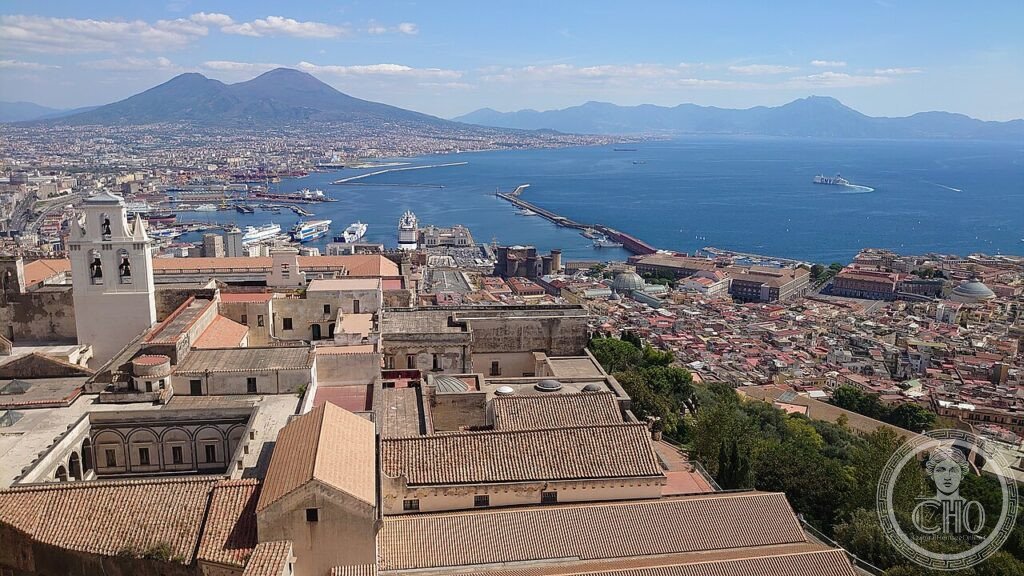
Napoli — il Centro Storico (X sec. a.C. – XIX sec.): dal Grechico di Neapolis al Barocco dei Borbone, la Città Stratificata più Densa d’Europa (UNESCO 1995)
Naples is the city with the greatest density of historical stratification in the western world: 2,800 years of continuous occupation by Greeks, Romans, Byzantines, Normans, Swabians, Angevins, Aragonese, Spanish Habsburgs, Bourbons, and Italians have deposited layer upon layer of buildings, streets, and underground archaeology in a historic centre that contains the highest concentration of churches, palaces, and ancient monuments per square kilometre in Italy — all of it alive, inhabited, and, in some districts, as chaotic and baroque as the 17th century.
At a glance
Naples (Napoli, province of Naples, Campania) is a UNESCO World Heritage Site inscribed in 1995 (ref. 726) as “Historic Centre of Naples.” The inscribed area covers the historic centre of the city within the 16th-century Spanish city walls, approximately 1,700 hectares with a resident population of approximately 200,000 people — making it one of the most densely inhabited UNESCO World Heritage Sites in the world. The historic centre is built on and around the ancient Greek grid of Neapolis (founded c.474 BCE after the refoundation of Parthenope), whose three main east-west streets (the decumani — the Decumano Superiore, Decumano Maggiore/Via dei Tribunali, and Decumano Inferiore/Spaccanapoli) still define the street pattern of the centro storico 2,500 years later. The Greek street grid is overlaid by Roman insulae, medieval monastic complexes, Angevin and Aragonese fortifications and palaces, Spanish Baroque churches, and Bourbon neoclassical institutions, all compressed into the same urban fabric.
Key facts
- Foundation: Cumae (the oldest Greek colony in mainland Italy, c.750 BCE) founded a sub-colony at Parthenope (c.680 BCE, on the hill of Pizzofalcone); a new city (Neapolis, “New City”) was founded on the flat coastal ground nearby c.474 BCE (possibly after Cumae’s victory over the Etruscans at the Battle of Cumae); Neapolis was organized on a Hippodamian grid (the rational Greek city plan of equal rectangular blocks) whose three main east-west decumani are still followed by Via dei Tribunali, Spaccanapoli (Via San Biagio dei Librai / Via Benedetto Croce), and Via dell’Anticaglia in the modern street plan
- Roman Napoli: Neapolis maintained Greek as its official language and preserved its Greek cultural institutions (Greek games, Greek theatre, Greek intellectual life) until at least the 1st century CE; the Roman emperors Augustus and Nero had particular affection for the city; Virgil is buried at the Parco Virgiliano; the Grotto of Posillipo (Crypta Neapolitana, a Roman road tunnel 711 m long, 1st c. BCE) survives under the Posillipo hill
- Key monuments: Castel dell’Ovo (first fortress on the Megaride islet, Norman origins, 12th c.; current structure 15th-16th c.); Maschio Angioino/Castel Nuovo (1279, Carlo I d’Angiò; triumphal arch 1442-43, Francesco Laurana; bronze doors, Guglielmo Monaco 1474-1490); Duomo di Napoli / Cattedrale di Santa Maria Assunta (1294-1323, with the Chapel of San Gennaro, 1608, containing the blood relic of the patron saint); San Gregorio Armeno (Baroque street of presepi/nativity workshops); Cappella Sansevero (baroque mausoleum with the Cristo Velato, Giuseppe Sanmartino, 1753, the most extraordinary marble carving in Naples); Sotterranei di Napoli (ancient Greek/Roman and WWII underground tunnels and cisterns, open for guided visits)
- UNESCO: 1995, ref. 726
- GPS: 40.8518, 14.2681 — Google Maps (Piazza del Plebiscito)
History
Naples’s extraordinary density of historical monuments reflects the city’s continuous status as a major political capital from Greek antiquity to Italian unification (1861). The main medieval layer was deposited by the Norman kings (1130-1194), who built the city’s first major fortifications and churches; the Swabian layer (1194-1266, including Frederick II, see Castel del Monte) added the Castel dell’Ovo; the Angevin layer (1266-1442) is the most architecturally decisive: Charles I of Anjou built the Castel Nuovo (1279), Charles II built the Basilica of San Lorenzo Maggiore over the ancient agora (1285-1324), and Robert I “the Wise” (r.1309-1343) made Naples one of the most important cultural centres of 14th-century Europe, attracting Giotto (who painted the Castel Nuovo frescos, 1328-1333, now lost), Boccaccio (who wrote the early Neapolitan works including the first drafts of the Decameron), Petrarch, and the founder of Italian humanism Giovanni Boccaccio. The Aragonese layer (1442-1501) added the triumphal arch of Alfonso I (Castel Nuovo) and reorganized the city’s street system.
The Spanish Habsburg viceroyalty (1504-1707) transformed Naples from a medieval city into a Baroque metropolis: the Spanish constructed the Spaccanapoli axis as the city’s main commercial street, built the Royal Palace (Palazzo Reale, Domenico Fontana, 1600), and attracted the greatest painters of the early Baroque (Caravaggio lived in Naples 1606-1607 and 1609-1610, producing paintings now in the Pio Monte della Misericordia and the Museo di Capodimonte). The 17th-century Naples was, with a population of 300,000-350,000, the largest city in Europe after Paris and London. The Bourbon layer (1734-1861) added the Teatro San Carlo (1737, the oldest continuously active opera house in the world), the Caserta Palace (separately listed UNESCO 1997, see CHO card), and the National Archaeological Museum (Museo Nazionale, 1777) with its unparalleled collection of Greek, Roman, and Etruscan material.
What you see
The essential circuit of central Naples covers approximately 4 km and requires a full day. Starting at Piazza del Plebiscito (the neoclassical square with the Palazzo Reale and the Basilica of San Francesco di Paola): the Piazza gives access to Via Toledo (the main Spanish-era shopping street, 1536) and, via a short walk east, to Spaccanapoli. Spaccanapoli (the straight west-east street that “splits Naples in two” — a literal description, since the street follows the ancient Greek decumanus inferior in a perfectly straight line for over 2 km) concentrates the most dense baroque architecture in the city: Santa Chiara (Aragonese Gothic church, 1310-1328; Baroque cloister with majolica-tiled pillars, 1739-1742, Domenico Antonio Vaccaro); Gesù Nuovo (Jesuit church, 1584-1601, with an unusual rusticated stone facade that belonged to a 15th-century palace); and the Cappella Sansevero (Via Francesco de Sanctis 19, open Tuesday-Monday 10:00-17:40: the Cristo Velato marble is worth a journey from any point in Italy).
The Decumano Maggiore (Via dei Tribunali) concentrates the oldest city fabric: the Duomo (Cathedral, Vico Donnaromita; the Chapel of San Gennaro with its liquefaction ceremony, held three times a year, is inside; open Monday-Saturday 9:00-17:30, Sunday 8:00-13:30), the Basilica of San Lorenzo Maggiore (13th-14th c., with archaeological excavations of the ancient agora beneath the church), and the Pio Monte della Misericordia (Via dei Tribunali 253; seven rooms; Caravaggio’s Seven Acts of Mercy, 1607, over the altar — one of the painter’s masterpieces).
Gallery
Practical information
- Cappella Sansevero: Via Francesco de Sanctis 19; open Wednesday-Monday 10:00-17:40; closed Tuesday; advance booking required (online at museosansevero.it); admission ~€10. Absolutely essential.
- Sotterranei di Napoli: Piazza San Gaetano 68; guided tours of the ancient Greek cisterns and WWII underground network daily (hourly departures from 10:00 to 18:00); admission ~€10; no advance booking. 80-90 min tour; some narrow passages (claustrophobic warning).
- Museo Nazionale Archeologico: Piazza Museo 19; open Wednesday-Monday 9:00-19:30; admission ~€22. The Farnese collection (Ercole Farnese; Toro Farnese) + the Pompeii/Herculaneum finds (Gabinetto Segreto with erotic art of Pompeii; mosaics from Pompeii including the Alexander mosaic). Essential if you plan to visit Pompeii or Herculaneum (it provides the context for the finds).
- Duration: Minimum 1 full day for the essential historic centre. The full Naples experience requires 2-3 days.
Getting there
Piazza del Plebiscito, Napoli (NA), Campania. GPS 40.8518, 14.2681. By train: Trenitalia and Italo from Rome (230 km; 1h05 with Freccia; 1h40 regional from Termini); from Milan (785 km; 4h20 Freccia). Naples Centrale station (Piazza Garibaldi) is the main hub; take Metro Line 1 to Piazza del Plebiscito or Toledo (the Toledo Metro station, 2012, is itself an architectural attraction — Oscar Niemeyer-influenced design, voted “most beautiful metro station in Europe” by the Daily Telegraph 2012). By car: from Rome, A1 south (230 km, 2h15); from Salerno/Amalfi, A3 north (50-80 km); parking is extremely difficult in the historic centre; use the Mergellina or Bagnoli park-and-ride options. By air: Napoli Capodichino airport, 7 km from centre; AliBus shuttle to Piazza Garibaldi (25 min); taxi ~€25.
Nearby
- Pompei and Herculaneum — 25-30 km south-east; the Roman cities buried by the eruption of Vesuvius in 79 CE (UNESCO 1997 ref.829); Circumvesuviana train from Naples Centrale to Pompei Scavi-Villa dei Misteri (38 min) or Ercolano-Scavi (20 min)
- Certosa e Museo di San Martino — 3 km west of the historic centre, on the Vomero hill; the Carthusian monastery (founded 1325, completely rebuilt in Baroque 1580-1656, painted by Jusepe de Ribera and Luca Giordano) and national museum (Neapolitan paintings, ceramics, presepi, history); accessible by Funicolare Centrale (from Toledo) or Funicolare Montesanto
- Costiera Amalfitana — 65 km south; (see CHO card: Amalfi Coast UNESCO 1997 ref.830)
Sources
- UNESCO: whc.unesco.org/en/list/726
- Wikipedia EN: Historic Centre of Naples
- De Seta, Cesare: Naples, Laterza, 1981 (4th ed. 2004)
- Museu Nazionale di Capodimonte: museodicapodimonte.beniculturali.it
Find it on the map
See this place and what’s around it →📷 Diventa un fotografo di Cultural Heritage Online
Condividi le tue foto dei luoghi: restano pubblicate con la tua firma come autore. Più vengono viste, più ti fai conoscere — e presto un concorso premierà le foto più apprezzate.
Accedi o registrati gratis per aggiungere una foto