
A City Carved in Stone
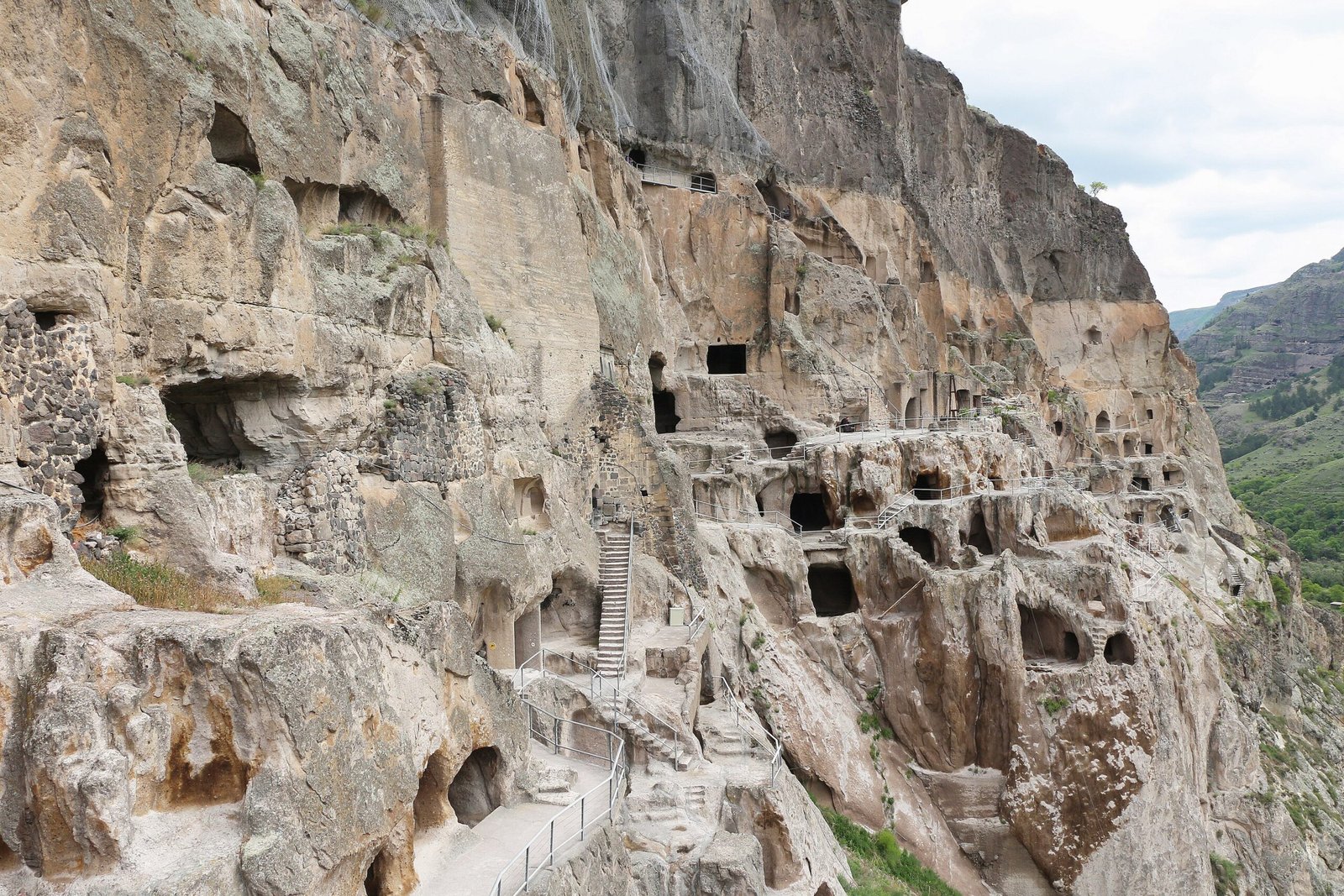
Vardzia is a vast cave monastery complex hewn from the volcanic rock of a cliff face rising above the Mtkvari (Kura) River in the Samtskhe-Javakheti region of southern Georgia. Commissioned by King George III of Georgia and completed under his daughter Queen Tamar between 1185 and 1200 AD, the complex extended across 13 vertical levels into the cliff, containing more than 500 rooms: chapels, a throne room, a pharmacy, a library, stables, wine cellars, bakeries, and an elaborate irrigation system fed by a spring inside the mountain. At its peak it sheltered a community of some 2,000 monks in what was, in effect, a self-contained city invisible from below.
The genius of Vardzia original design was its total concealment: the entire complex was accessible only through hidden tunnels cutting through the rock face, with no openings visible from the valley. To an approaching army it appeared as a sheer cliff. The monastery functioned simultaneously as a spiritual centre and a strategic fortress, guarding Georgia southern frontier during the zenith of the Georgian Golden Age.
Queen Tamar and the Name
Queen Tamar (reigned 1184-1213 AD) is the most celebrated ruler in Georgian history, the only woman to have reigned in her own right over the unified Georgian Kingdom. Under her leadership Georgia reached its greatest territorial extent, controlling much of the Caucasus and exerting influence from the Black Sea to the Caspian. Vardzia was among the most significant works she patronised, conceived as a monument to Georgia power and Orthodox faith.
The name Vardzia is said to derive from a childhood memory of Tamar herself. As a small child she hid during a hunt in the caves near this very cliff. Her uncle called out searching for her; she replied “Var dzia!” — “Here I am, uncle!” in Georgian. Whether legend or history, the name attached itself to the place and has never been forgotten.
The main Church of the Assumption (1185 AD), built at the heart of the complex, preserves two extraordinary frescoes: portraits of Queen Tamar and her father King George III. These are among the very few surviving medieval Georgian royal portraits and among the oldest known lifelike royal likenesses from the entire Caucasus region.
The Earthquake of 1283
In 1283, two generations after the monastery completion, a catastrophic earthquake shook the Mtkvari valley. The seismic event fractured the cliff face, and the entire outer section of the rock — covering roughly two-thirds of the monastery — collapsed into the river below. In a single disaster, Vardzia strategic invisibility was destroyed forever. The interior galleries, chapels, and rooms that had been sealed behind metres of solid rock were suddenly exposed to the open air, their carved facades facing the valley for the first time.
What visitors see today — the honeycomb of cave openings climbing the cliff face — is the direct result of that earthquake. The fallen rock also destroyed an unknown number of rooms, frescoes, and structures that had been carved in the outermost section of the complex. What survives is estimated to be roughly one-third of Vardzia original extent.
Mongol Invasion, Persian Fire, and Survival
The 1283 earthquake was only the first of Vardzia catastrophes. In 1285 Mongol forces swept through the region, damaging and partially destroying the complex. Then, in 1551, the Safavid Persian Shah Tahmasp I invaded Georgia; his forces burned Vardzia, destroying many of the frescoes and killing or scattering the monks. The monastery was effectively abandoned for a century following this attack, stripped of the continuous monastic community that had maintained it since the 12th century.
Yet Vardzia survived. Georgian monks gradually returned, and the monastery has been in more or less continuous use since the 17th century. Today a small community of Georgian Orthodox monks still inhabit the deeper caves of the complex, celebrate the liturgy in the Church of the Assumption, and tend the site that Queen Tamar built as Georgia fortress of faith.
Architecture and Engineering
The technical achievement of Vardzia is difficult to overstate. The entire complex was carved from the living rock of a volcanic cliff using iron tools, without mortar or cut stone. The 13 levels of caves are interconnected by a network of tunnels, stairways, and passageways cut through the rock, many of which are barely a metre wide. The church — the largest space — is a three-aisled basilica carved from the cliff, with a vaulted ceiling cut directly from the rock face and original 12th-century frescoes still covering its walls.
Water supply inside the cliff was managed through channels cut to guide spring water to cisterns distributed through the complex. Wine cellars were cut at consistent depths to maintain a stable temperature year-round. The pharmacy room preserves stone shelving and mortars carved from the cave walls. The scale of coordinated labour required — the planning, the precision of the carved interconnections, the logistics of feeding and supplying workers inside a cliff — rivals any major medieval construction project in Europe or the Middle East.
The Frescoes
The Church of the Assumption preserves the most important surviving examples of Georgian medieval painting. The cycle of frescoes, dating from the late 12th and early 13th centuries, covers the carved walls of the basilica with scenes from the life of Christ, the Virgin, and the saints. Two portraits stand apart from the theological programme: the likenesses of King George III and Queen Tamar, depicted as royal donors on either side of the apse, their faces individualised in a style that blends Byzantine formal hierarchy with a striking naturalism rare in medieval royal portraiture anywhere.
The frescoes survived the earthquake, the Mongol raid, and much of the Persian burning, though many have suffered from centuries of smoke, moisture, and occasional vandalism. Conservation work has stabilised the most important panels.
Visiting Vardzia
Vardzia is located approximately 70 km from the regional town of Akhaltsikhe, the nearest substantial urban centre, via a road that follows the Mtkvari River upstream through increasingly dramatic gorge scenery. The site is accessible by car, shared minibus from Akhaltsikhe, or organised day tour from Tbilisi (approximately 5 hours each way). The cave complex can be explored independently along defined paths; certain sections, including areas where monks reside, are closed to visitors. The Church of the Assumption is open to visitors; modest dress is required. Spring and autumn offer the best conditions; summer heat on the exposed cliff face can be intense. GPS: 41.3900 N, 43.2800 E.
Location: Aspindza municipality, Samtskhe-Javakheti, Georgia
Period: 1185-1200 AD (Georgian Kingdom, Queen Tamar)
Open: Daily; church hours may vary
Nearest town: Akhaltsikhe (~70 km north)
UNESCO: Not listed (Georgian national monument)
Find it on the map
See this place and what’s around it →📷 Become a Cultural Heritage Online photographer
Share your photos of places: they stay published under your name as the author. The more they're seen, the more you get noticed — and soon a contest will reward the most appreciated photos.
Log in or sign up free to add a photo