
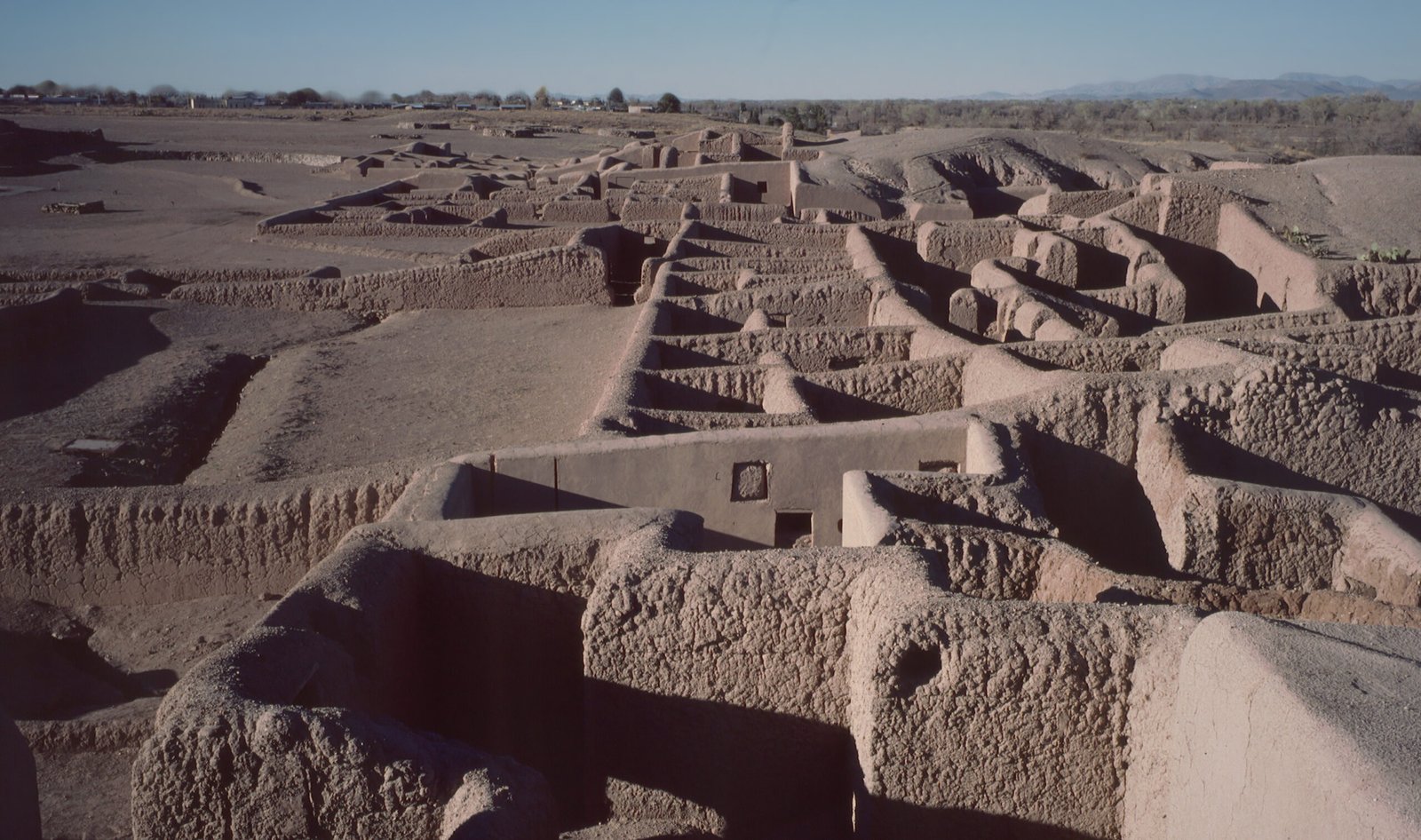
Where Two Worlds Met
Paquime — known also as Casas Grandes, after the modern municipality that surrounds it — was the largest and most sophisticated pre-Columbian city in northern Mexico, and one of the most remarkable trading hubs in all of pre-Columbian North America. Located in the Casas Grandes River valley of the Chihuahuan Desert, it sat at the precise geographic pivot between two of the ancient world greatest civilisations: the Ancestral Puebloan cultures of the American Southwest to the north (Chaco Canyon, Mesa Verde) and the Mesoamerican civilisations to the south (Aztec, Toltec). Paquime did not merely connect these worlds — it mediated them, in goods, ideas, and architectural forms, for at least 750 years.
The city reached its maximum extent and complexity between approximately 1200 and 1450 AD, when its multi-storey adobe buildings, specialised breeding compounds, and ceremonial ball courts made it a node of continental significance. Its collapse around 1450 AD remains, in many respects, as puzzling as its rise.
The Macaw Breeders of the Desert
The single most extraordinary feature of Paquime — the detail that distinguishes it from every other pre-Columbian site in North America — is its macaw breeding operation. Archaeologists excavating the site in the late 1950s and early 1960s found the remains of specialised pens designed to house scarlet macaws and military macaws: large, brilliantly coloured parrots native to the humid lowland forests of Mexico and Central America, hundreds of miles from the Chihuahuan Desert.
The pens were purpose-built with individual clay-lined nest boxes for each bird, and with evidence of heated chambers — essential because macaws cannot survive the cold desert winters of Chihuahua without supplemental warmth. At any given time, Paquime may have maintained between 300 and 500 macaws in these facilities. This is the only known pre-Columbian macaw husbandry operation anywhere in North America.
Why? Because macaw feathers were among the most prized luxury commodities in the ancient Southwest. Brilliant red, blue, and yellow feathers appear in ceremonial regalia at Ancestral Puebloan sites 600 to 1,000 kilometres away — at Pueblo Bonito in Chaco Canyon, at sites in the Rio Grande valley, at Hopi villages in Arizona. Paquime was their source. The operation transformed what would otherwise have been an impossibly scarce wild resource into a reliable, controllable supply of prestige goods that could be traded northward in exchange for turquoise, pottery, cotton, and other commodities flowing south.
Turkey Breeding and the Economy of Specialisation
Alongside the macaw pens, Paquime maintained separate breeding compounds for domestic turkeys — a more familiar animal but one managed here at a scale and sophistication that goes beyond ordinary food production. The turkey compounds were architecturally similar to the macaw pens: purpose-built, subdivided, carefully maintained. Both operations point to an economy that had moved beyond subsistence farming into specialised production for long-distance trade — a level of economic organisation more familiar from Mesoamerican cities than from Southwestern sites of comparable date.
T-Shaped Doorways and the Southwestern Connection
Walking through Paquime, a visitor familiar with Ancestral Puebloan architecture will notice something immediately: the doorways are T-shaped — wider at the top, narrowing at the bottom, with a characteristic step cut into each side jamb. This is a distinctively Ancestral Puebloan design, found at Chaco Canyon, at Mesa Verde, at Aztec Ruins — sites 600 kilometres to the north. Its presence at Paquime is not a coincidence.
The T-shaped doorway appears to have carried ritual or social meaning beyond mere construction convenience: it is consistently used in ceremonial or high-status contexts at Ancestral Puebloan sites, and its repetition at Paquime suggests that the architectural tradition — and the social meanings attached to it — travelled with the trade networks that connected these cultures. Whether Paquime builders adopted this form from northern visitors, from shared ancestors, or from some common cultural exchange that archaeologists have not yet fully traced remains an open question.
Architecture: Adobe at Scale
Paquime buildings were constructed from shaped adobe bricks — a technique that allowed the city to rise to two and three storeys in some sections, with interior rooms connected by the T-shaped doorways, and with flat roofs that served as outdoor working platforms for upper floors. The layout was not a single planned grid but an organic accumulation of adjacent room blocks, each expanded and modified over generations. By its peak, the city covered approximately 36 hectares and contained several thousand rooms.
The site also includes a series of effigy mounds — earthen constructions in the shapes of a cross, a serpent, a bird — whose precise ceremonial function is not established but which point to a ritual landscape embedded within the urban fabric. Ball courts of Mesoamerican type further confirm the city southern cultural connections.
Discovery and Excavation
Paquime was not unknown to Spanish colonial settlers in Chihuahua, but it was largely invisible to the broader scholarly world until the Swiss-American archaeologist Adolph Bandelier visited and documented the site in 1884. Bandelier recognised its significance and described its ruins in terms that would not have been out of place applied to any major site in the American Southwest — because the two traditions were, as he suspected, related.
The defining excavation of Paquime was carried out by Charles C. Di Peso, director of the Amerind Foundation in Arizona, as part of the Joint Casas Grandes Project (1958-1961). Di Peso and his team spent three field seasons excavating approximately 80 percent of the accessible site, producing the most comprehensive dataset ever gathered from a single major pre-Columbian North American city. The resulting publication — eight volumes, running to thousands of pages — remains the foundational reference for Casas Grandes scholarship. The macaw pens, turkey compounds, and elaborate drainage systems were all documented during this project.
Collapse and Legacy
Around 1450 AD Paquime was abandoned. Evidence from the excavations suggests violence: burned structures, unburied bodies, disrupted storage rooms. Whether this represents an external attack, an internal collapse, or a combination of factors including prolonged drought (tree-ring data from the region shows severe drought conditions in the mid-15th century) has not been definitively established. The city was not reoccupied. The Casas Grandes River valley was effectively depopulated for several generations before the arrival of Spanish missionaries in the 17th century.
The descendants of the people who built and traded with Paquime are thought to include some communities of Puebloan peoples in modern New Mexico and Arizona, and possibly the Tarahumara (Raramuri) of Chihuahua, though direct cultural continuity has not been conclusively established. What is certain is that Paquime sat at the centre of a trade network whose feathers reached ceremonial kivas from Colorado to Arizona, whose pottery styles echoed from the Rio Grande to the Sonoran Desert, and whose architectural DNA — the T-shaped door — survived in built form hundreds of kilometres away.
Visiting Paquime
The site lies approximately 5 km outside the town of Casas Grandes (also called Nuevo Casas Grandes), in northern Chihuahua, about 300 km southwest of El Paso, Texas. The Museo de las Culturas del Norte is located adjacent to the ruins and provides essential context on the archaeology, the trade networks, and the macaw breeding operation. The ruins are partially reconstructed and stabilised, allowing visitors to walk through the room blocks and see the original adobe construction at close range. The macaw pens are among the most clearly explained features on site. GPS: 30.3667 N, 107.9333 W.
Location: Casas Grandes, Chihuahua, Mexico
Period: c. 700-1450 AD (peak 1200-1450 AD)
Museum: Museo de las Culturas del Norte (on site)
Nearest city: Nuevo Casas Grandes (5 km)
UNESCO: World Heritage Site since 1998
Find it on the map
See this place and what’s around it →📷 Become a Cultural Heritage Online photographer
Share your photos of places: they stay published under your name as the author. The more they're seen, the more you get noticed — and soon a contest will reward the most appreciated photos.
Log in or sign up free to add a photo