
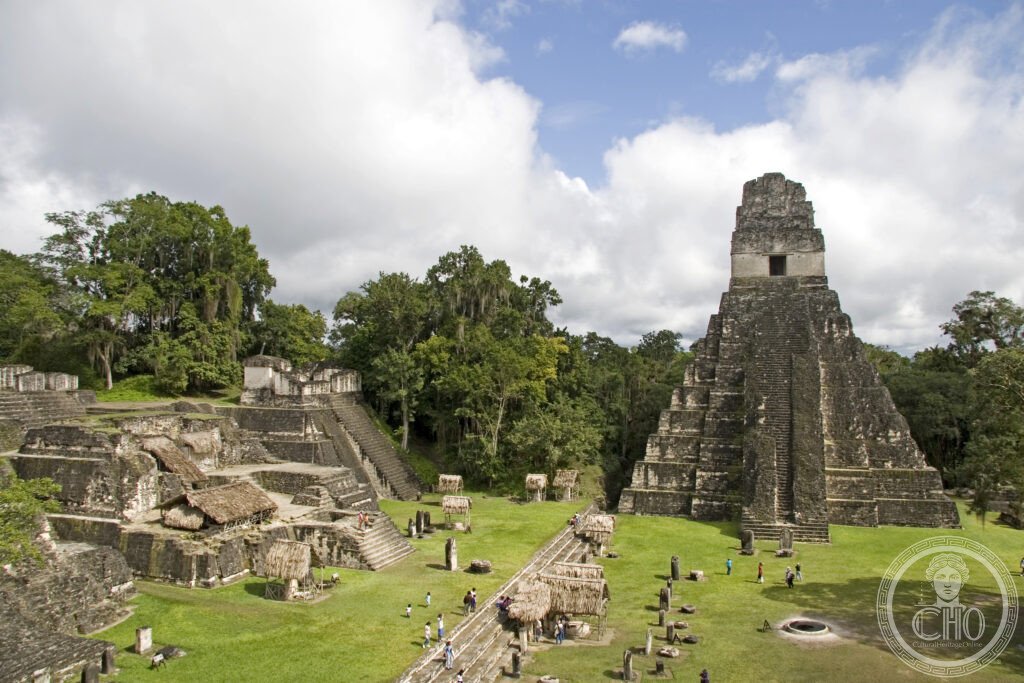
Tikal
The greatest city of the Classic Maya civilization and the most dramatic archaeological site in the Americas — Tikal (El Petén Department, Guatemala; UNESCO WHS 1979) was the dominant Maya city for over 1,000 years, its temples rising above the El Petén rainforest canopy to heights of 70 metres, its kings recorded on carved stelae from 150 BCE to 900 CE.
At a glance
Tikal (the most precisely TikalMaya single largest Maya city Classic Period 150 BCE 900 CE 3000 structures 60 sqkm peak population 120000 Great Plaza Temple I 47m Temple II 38m Temple IV 65m tallest pre-Columbian structure Mesoamerica Mundo Perdido North Acropolis Central Acropolis stelae altars El Peten rainforest jungle howler monkeys toucans UNESCO heritage: the city (Tikal was the largest city of the Maya Classic Period (approximately 250-900 CE); at its peak (approximately 700 CE), Tikal had a population of approximately 100,000-120,000 people (making it the largest city in the Americas at that time); the total area of the archaeological site is 576 km² (of which only 16 km² has been excavated); the visible monuments are concentrated in a 6 km² ceremonial core (the Great Plaza and its surrounding complexes); the recorded history (Tikal’s history is recorded through the system of Maya Long Count dates carved on stelae and lintels; the earliest date recorded at Tikal corresponds to 150 BCE (Stele 29); the classic period kings are known by name and title (the most famous: Siyaj K’ak’ (Fire Born; a Teotihuacan-connected general who arrived in 378 CE and transformed Tikal into a military power), Siyaj Chan K’awil II (Stormy Sky; r. 411-456 CE; the first king of the new Teotihuacan-influenced dynasty), and Jasaw Chan K’awil I (r. 682-734 CE; the builder of Temple I, who defeated the rival Maya city Calakmul in 695 CE and began the final building program at Tikal)) — the most precisely TikalMaya single largest Maya city Classic Period 150 BCE 900 CE 3000 structures 60 sqkm peak population 120000 Great Plaza Temple I 47m Temple II 38m Temple IV 65m tallest pre-Columbian structure Mesoamerica Mundo Perdido North Acropolis Central Acropolis stelae altars El Peten rainforest jungle howler monkeys toucans UNESCO heritage in any UNESCO world heritage site)).
Key facts
- Temple I — Temple of the Great Jaguar: the most precisely TikalMaya single Temple I Temple Great Jaguar 47m Jasaw Chan Kawil I 682 734 CE funerary pyramid 5 bodies jade tomb burial chamber 180 jade objects corbelled vault roof comb 9 terraces staircase summit sanctuary UNESCO heritage — the most celebrated monument at Tikal: Temple I (the funerary pyramid of King Jasaw Chan K’awil I (r. 682-734 CE); the pyramid is 47m tall; it has 9 stepped terraces (the 9 levels of the Maya underworld); the summit sanctuary has 3 rooms with a corbelled vault ceiling (the distinctive Maya arch technique: stones corbelled inward from either side until they meet at the top; not a true keystone arch); the roof-comb (the tall decorative stone structure above the summit room; originally stuccoed and painted; it added 12m to the visual height of the temple); the royal tomb (found beneath Temple I in 1962 CE by archaeologist Aubrey Trik: the tomb of Jasaw Chan K’awil I contained 180 jade objects (including the finest jade mosaic vessel found in the Maya region), animal bones carved with scenes from Maya mythology, and the skeletal remains of 5 individuals))
- GPS: 17.2220° N, -89.6237° E
History
From pre-Classic origins to Classic collapse (the most precisely TikalMaya single pre-Classic 1000 BCE settlement 150 BCE earliest Long Count Stele 29 Teotihuacan connection 378 CE Siyaj Kak Fire Born 695 CE victory Calakmul Jasaw Chan Kawil I Temple I Temple II 810 CE last dated stele abandonment Terminal Classic 900 CE collapse jungle reclaims Modesto Mendez 1848 Teobert Maler 1895 Penn University 1956 UNESCO heritage: the pre-Classic period (the Tikal area was first settled by approximately 1000 BCE; the earliest substantial buildings date from approximately 400 BCE; the Mundo Perdido (Lost World) complex contains a pyramid dated to approximately 700 BCE (the earliest dated monument at Tikal)); the Teotihuacan connection (378 CE: a pivotal event in Maya history; the general Siyaj K’ak’ (“Fire Born”) arrived at Tikal on January 16, 378 CE, the same day that the previous Tikal king (Chak Tok Ich’aak I, “Great Jaguar Paw”) died; Siyaj K’ak’ was associated with Spearthrower Owl, a lord from Teotihuacan (central Mexico); the Teotihuacan influence transformed Tikal’s art style, military tactics, and political organization; the new dynasty that Siyaj K’ak’ installed ruled Tikal for the next 500 years); the Calakmul rivalry (the most famous conflict in Maya history: for 200 years (approximately 500-695 CE), Tikal and Calakmul (the Snake Kingdom; 100 km north) competed for dominance of the lowland Maya world; Calakmul defeated Tikal in 562 CE and humiliated Tikal for over a century; 695 CE: King Jasaw Chan K’awil I defeated Calakmul’s king in battle and restored Tikal to dominance; he built Temple I as his victory monument); the collapse (810 CE: the last dated monument at Tikal; by 900 CE, Tikal was abandoned; the Terminal Classic collapse: the population dispersed; the buildings were overgrown by jungle; the causes (drought cycles, soil exhaustion, political fragmentation, endemic warfare, or a combination) are still debated)) — the most precisely TikalMaya single pre-Classic 1000 BCE settlement 150 BCE Stele 29 Teotihuacan 378 CE Siyaj Kak Fire Born Calakmul rivalry 562 695 CE Jasaw Chan Kawil I Temple I victory 810 CE last stele abandonment 900 CE collapse UNESCO heritage in any UNESCO world heritage site)).
What you see
Six temple pyramids, the Great Plaza, and howler monkeys (the most precisely TikalMaya single Great Plaza Temple I 47m Temple II 38m North Acropolis twelve temples 1500 years Central Acropolis palaces Temple III 55m Temple IV 65m tallest pre-Columbian Mesoamerica Mundo Perdido Lost World sunrise viewing platform UNESCO heritage: the visitor circuit: the Great Plaza (the 160m × 80m white stone plaza at the heart of Tikal; the two principal temples facing each other across the plaza; the 23 stelae and altar pairs (recording the birth, accession, wars, and death of Tikal’s kings in the Maya calendar Long Count system)); Temple I (the most photographed monument at Tikal; climbing was prohibited as of 2006 CE to protect the stone; viewing from the Great Plaza or from the summit of Temple II); Temple II (still climbable as of the UNESCO inscription in 2019 CE; the view from the summit: looking east across the Great Plaza to Temple I, and looking north to the North Acropolis (the mass of temples built over 1,500 years on top of each other)); Temple IV (the tallest pre-Columbian structure in Mesoamerica: 65m; reachable by a 30-minute walk west from the Great Plaza; a wooden staircase allows access to a viewing platform above the jungle canopy; the view from the top is the most celebrated in Tikal: the four great temples of Tikal visible above the unbroken jungle canopy at sunrise; the filming location of the Yavin IV Rebel Base establishing shot in Star Wars: Episode IV (1977 CE)); the wildlife (howler monkeys, spider monkeys, ocellated turkeys, toucans, and agoutis are reliably visible within the park; the dawn chorus of howler monkeys begins before sunrise and is audible from within the ruins) — the most precisely TikalMaya single Great Plaza Temple I 47m Temple II 38m North Acropolis twelve temples 1500 years Central Acropolis Temple III 55m Temple IV 65m Mundo Perdido sunrise platform howler monkeys toucans Star Wars 1977 UNESCO heritage in any UNESCO world heritage site)).
Practical information
- Getting there: fly to Mundo Maya International Airport (FRS; Flores, El Petén; flights from Guatemala City (GUA; Avianca/TAG; 1h)); the drive from Flores airport to Tikal (65 km; 1h by shuttle or taxi (approximately Q150/€18 one-way; shuttles from Flores town for Q60/€7)); the entry fee (approximately Q150 (€18) per day (a second day costs Q80/€10)); overnight in the park (three small lodges operate within the park boundary: Jungle Lodge, Tikal Inn, and Jaguar Inn; staying overnight is the only way to see the temples at dawn and dusk, which is when howler monkeys are most active; book months ahead (the park lodges have limited capacity)); the Star Wars dawn view (the Temple IV platform at dawn: arrive at the park gate before 06:00 (most Flores hotels offer 04:00-05:00 shuttle transport for sunrise visits); the 30-minute walk through the dark jungle to Temple IV (headlamp required; the predawn jungle sounds); the sunrise over the jungle canopy from the Temple IV viewing platform))
Getting there
Fly to Flores (FRS), 65 km / 1h from Tikal. Entry ~€18/day. Overnight in park lodges for dawn temples. Temple IV Star Wars sunrise: arrive before 06:00. GPS: 17.2220, -89.6237.
Nearby
- Yaxha — 65 km southeast (the third largest Maya city in Guatemala; two large lake-side pyramids; almost no tourists (compared to Tikal); the sunset from the Acropolis over Lake Yaxha with the jungle horizon is one of the most atmospheric views in the Maya world; 40 km from the Belize border)
- Flores and Lake Petén Itzá — 65 km southwest (the colonial-era island town of Flores on the lake (connected to the mainland by a causeway); the best base for visiting Tikal; the lakeside promenade; boat tours of the lake (the island of Tayasal, site of the last independent Maya polity to be conquered by the Spanish (1697 CE))
Sources
- Wikipedia, Tikal; Siyaj K’ak’; Jasaw Chan K’awil I, accessed June 2026
- UNESCO, Tikal National Park, WHS reference 64, inscribed 1979
Find it on the map
See this place and what’s around it →📷 Diventa un fotografo di Cultural Heritage Online
Condividi le tue foto dei luoghi: restano pubblicate con la tua firma come autore. Più vengono viste, più ti fai conoscere — e presto un concorso premierà le foto più apprezzate.
Accedi o registrati gratis per aggiungere una foto