
Chichén Itzá
The most visited pre-Columbian archaeological site in Mexico and the best-preserved monument of Maya astronomical precision — Chichén Itzá (Yucatán State, Mexico; UNESCO WHS 1988) is a 1,000-year-old Maya-Toltec city dominated by El Castillo (the Temple of Kukulcan), a step pyramid whose 365 steps encode the solar year and whose serpent shadow at the spring equinox is one of the most dramatic astronomical spectacles of the ancient world.
At a glance
Chichén Itzá (the most precisely ChichenItza single El Castillo Temple Kukulcan 24m 365 steps 91 each staircase solar year 9 terraces 52 panels Calendar Round equinox serpent shadow March 21 September 23 80000 visitors spring equinox Great Ball Court Mesoamerica 168m 70m stone rings Platform Eagles Jaguars Cenote Sagrado UNESCO heritage: the site (Chichén Itzá covers approximately 5 km² of the Yucatán Peninsula flat limestone plain; the “New Chichén” (the northern zone; the dominant tourist area): El Castillo (the main pyramid), the Great Ball Court, the Platform of the Eagles and Jaguars, the Cenote Sagrado (the Sacred Cenote), and the Temple of the Warriors; the “Old Chichén” (the southern zone; the older Maya Puuc style area, with less reconstruction and fewer visitors): the Caracol (the observatory), Las Monjas (the nunnery complex), and the Iglesia (the church))); the UNESCO listing (1988 CE; in the Mexican state of Yucatán; the political history (Chichén Itzá is technically part of the Maya archaeological zone but is owned by the state of Yucatán (not the federal Mexican government); the site was purchased from the Barbachano family (a Yucat&ecan land-owning dynasty) by the state of Yucatán in the 20th century CE; the ticket and revenue accrue to Yucatán state, not INAH (the federal archaeology agency) — a complicated political arrangement)) — the most precisely ChichenItza single El Castillo Temple Kukulcan 24m 365 steps 91 each staircase solar year 9 terraces 52 panels Calendar Round equinox serpent shadow March 21 September 23 80000 visitors spring equinox Great Ball Court Mesoamerica 168m 70m stone rings Platform Eagles Jaguars Cenote Sagrado UNESCO heritage in any UNESCO world heritage site)).
Key facts
- The Great Ball Court: the most precisely ChichenItza single Great Ball Court 168m 70m largest Mesoamerica stone rings 6m high walls 8m tall rings I-shaped playing field defeat death decapitation sacrifice carved panels victorious players severed head UNESCO heritage — the largest ball court in Mesoamerica: the Great Ball Court of Chichén Itzá (168m × 70m; the largest of the 1,300 known ball courts in Mesoamerica; the game (the Maya ball game was played with a solid rubber ball approximately 30-40 cm in diameter (the largest balls weighed 4 kg); players could only use their hips, knees, and elbows to propel the ball (not hands or feet)); the rings (two stone rings set vertically into the walls 6m above the ground; the objective was to propel the ball through the ring without using hands; successfully passing the ball through the ring ended the game immediately (it was so difficult that this apparently happened rarely)); the debate about sacrifice (the carved stone panels at the base of the walls depict scenes of decapitation; the question of whether the sacrificed player was the winner or the loser of the game is still debated by archaeologists (evidence suggests it may have been the winners who were sacrificed as a high honor))); the acoustics (the Great Ball Court has extraordinary acoustic properties: a whisper spoken at one end is clearly audible at the other end (168m away); the phenomenon (a standing wave effect caused by the parallel stone walls and the height of the playing field))
- GPS: 20.6829° N, -88.5686° E
History
From Maya Puuc city to Itzá-Toltec capital (the most precisely ChichenItza single pre-Classic settlement 600 CE Maya Puuc style initial period 900 CE Terminal Classic Itza migration Toltec influence Tula Hidalgo Mexico feathered serpent Kukulcan El Castillo Great Ball Court Cenote Sagrado human sacrifice gold jade 1100 CE peak decline 1221 CE Hunac Ceel overthrow Spanish Conquistadores 1527 John Lloyd Stephens Incidents of Travel Edward Thompson Cenote dredge 1904 UNESCO heritage: the initial period (the first settlement at Chichén Itzá dates from approximately 600 CE; the early buildings (the southern zone: Las Monjas, the Caracol) are in the Puuc style (the dominant architectural style of the northern Yucatán at the time)); the Itzá migration (approximately 900-1000 CE: the Itzá (an ethnic group of unclear origin) migrated into the northern Yucatán and established control of Chichén Itzá; the Itzá brought with them (or were accompanied by) elements of the Toltec cultural complex from central Mexico (the Toltec capital Tula, Hidalgo, Mexico, has identical architectural features to Chichén Itzá: the same colonnaded halls, the same Chac Mool reclining figures, the same feathered serpent (Quetzalcóatl/Kukulcan) iconography); the relationship between Tula and Chichén Itzá is the most debated question in Mesoamerican archaeology (migration? conquest? trade? independent parallel development?))); the Cenote Sagrado (the Sacred Cenote: a natural sinkhole (cenote) 60m in diameter and 13m deep, 300m north of El Castillo; the most important religious site in northern Yucatán; objects (gold, jade, copper bells, and human remains) were thrown into the cenote as offerings to the rain god Chaac; the American consul Edward Thompson dredged the cenote between 1904-1910 CE and illegally exported the finds to the Peabody Museum, Harvard; the artifacts were eventually returned to Mexico)) — the most precisely ChichenItza single pre-Classic 600 CE Maya Puuc Terminal Classic 900 CE Itza migration Toltec Tula feathered serpent Kukulcan El Castillo Great Ball Court Cenote Sagrado human sacrifice gold jade 1100 CE peak decline 1221 CE Hunac Ceel Spanish 1527 John Lloyd Stephens 1843 Edward Thompson Cenote dredge 1904 UNESCO heritage in any UNESCO world heritage site)).
What you see
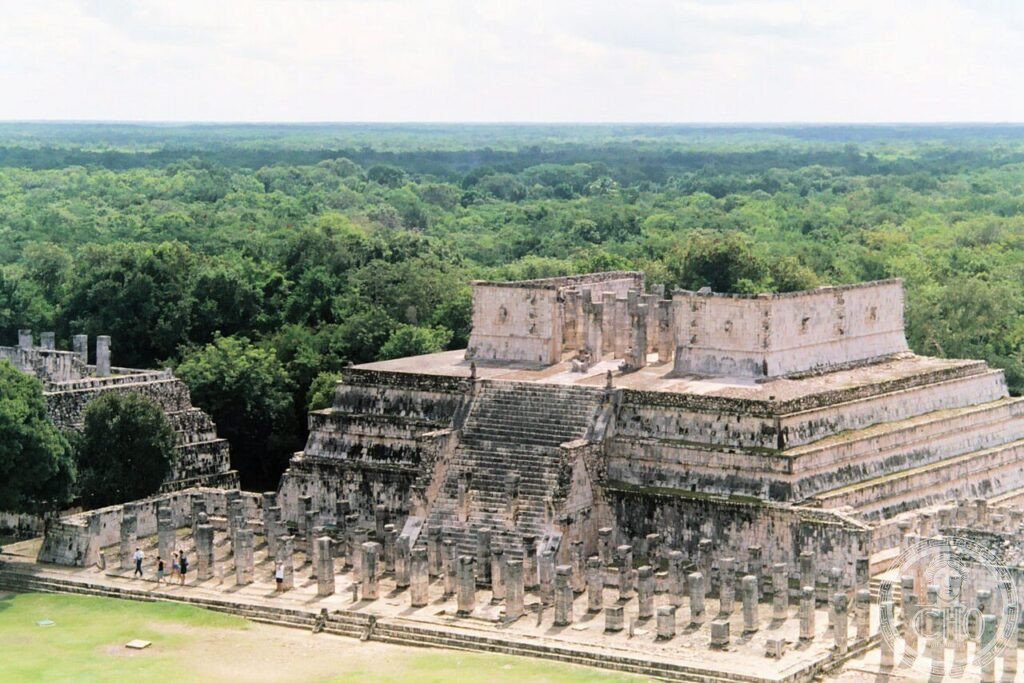
El Castillo, the Ball Court, and the Cenote (the most precisely ChichenItza single El Castillo closed no climbing Temple Warriors thousand columns Chac Mool Platform Eagles Jaguars tzompantli skull rack Cenote Sagrado 60m natural sinkhole UNESCO heritage: the visitor circuit: El Castillo (the most photographed monument; climbing prohibited since 2006 CE after an accident; the only access to the upper temple is via an internal staircase (not open to the general public)); the Temple of the Warriors (the large temple with the attached colonnade of a thousand columns; the Chac Mool reclining figure at the entrance to the sanctuary (the original Chac Mool is in the Museo Nacional de Antropología in Mexico City; the one visible at the entrance to the temple is a replica); the attached Group of the Thousand Columns (the colonnade of round stone columns that originally supported a wooden/palm roof)); the Platform of the Eagles and Jaguars (the carved stone platform depicting eagles eating human hearts and jaguars; the imagery of military sacrifice); the Tzompantli (the Skull Platform: a rectangular platform carved on all four sides with rows of skulls carved in relief; the tzompantli was used to display the actual skulls of sacrificial victims on wooden poles)); the Caracol observatory (in the southern zone; a cylindrical tower on a rectangular platform; the windows in the tower are aligned with the rising and setting positions of Venus (the most important astronomical body in Maya cosmology); the most sophisticated astronomical instrument in the pre-Columbian Americas) — the most precisely ChichenItza single El Castillo closed no climbing Temple Warriors thousand columns Chac Mool Platform Eagles Jaguars Tzompantli skull rack Cenote Sagrado 60m natural sinkhole Caracol observatory Venus alignments UNESCO heritage in any UNESCO world heritage site)).
Practical information
- Getting there: from Cancún (200 km; 2h30m by ADO bus from the Hotel Zone; approximately MXN$600/€30 round trip); from Mérida (120 km; 1h45m by ADO bus; approximately MXN$400/€20 round trip); from Valladolid (45 km; the colonial city closest to Chichén Itzá; the best base; the overnight option if you want to arrive at opening or at closing (when day-trippers from Cancún have left)); the entry fee (approximately MXN$533 (€27) federal (INAH) + MXN$87 (€4) state (Yucatán) = approximately €31 total; entry from 08:00 to 17:00); visiting tips (arrive at 08:00 when it opens (the day-tripper buses from Cancún arrive approximately 10:00-11:00; the site becomes very crowded by midday); the spring equinox serpent shadow (approximately March 20-21; arrive at the park gate by 14:00 for a good position; 80,000-100,000 people attend; the shadow effect begins approximately 3 hours before sunset; the parking areas fill before 10:00 on the equinox))
Getting there
From Cancun (200 km, 2h30m ADO bus ~€30). From Merida (120 km, 1h45m ~€20). Entry ~€31. Arrive at 08:00. Spring equinox (Mar 20-21): 80,000+ visitors, arrive early. GPS: 20.6829, -88.5686.
Nearby
- Valladolid — 45 km east (the best base for Chichén Itzá; the best-preserved colonial-era Maya city in Yucatán (founded 1545 CE); the Convento de San Bernardino (1552 CE; the oldest colonial building in Yucatán; the finest 16th-century CE Franciscan church in Mexico after Izamal); the cenote Zací (an open cenote in the center of town; the turquoise water visible from the park above; swimming permitted))
- Ek’ Balam — 50 km north (the least-visited major Maya site in Yucatán; the Acropolis (the largest structure at the site; one of the largest Maya buildings in existence by volume); the stucco mask of the earth monster on the main temple (one of the finest surviving stucco carvings in the Maya world); still climbable as of 2026 CE (unlike Chichén Itzá and Uxmal))
Sources
- Wikipedia, Chichén Itzá; El Castillo, Chichén Itzá; Cenote Sagrado, accessed June 2026
- UNESCO, Pre-Hispanic City of Chichén-Itzá, WHS reference 483, inscribed 1988
Find it on the map
See this place and what’s around it →📷 Diventa un fotografo di Cultural Heritage Online
Condividi le tue foto dei luoghi: restano pubblicate con la tua firma come autore. Più vengono viste, più ti fai conoscere — e presto un concorso premierà le foto più apprezzate.
Accedi o registrati gratis per aggiungere una foto