
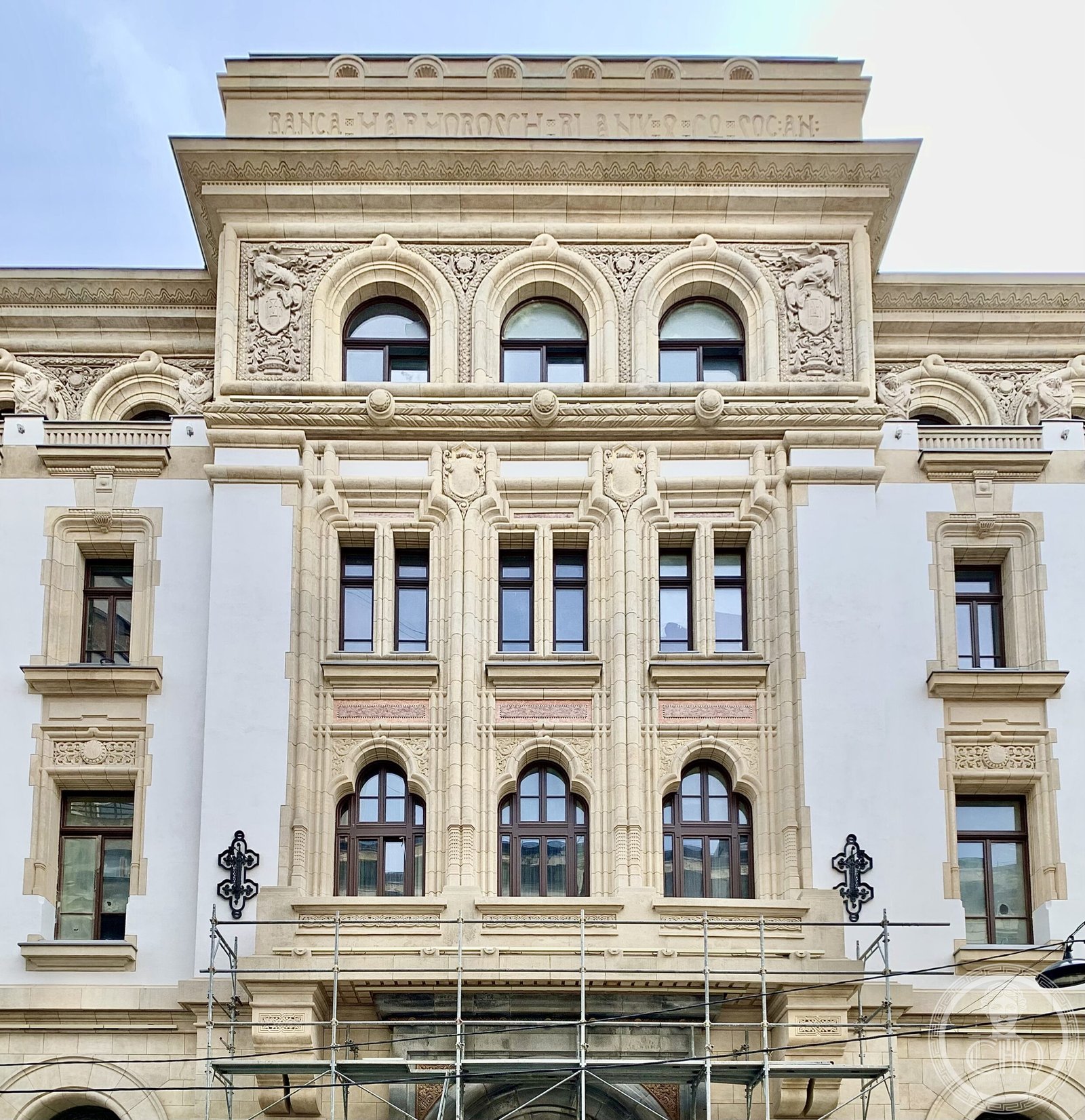
Petre Antonescu’s bank palace for Marmorosch Blank, engineered by Anghel Saligny and painted by Cecilia Cuțescu-Storck, reopened in 2021 as a 217-room hotel that serves cocktails inside the old vault.
At a glance
The Marmorosch Bucharest occupies the former head office of the Marmorosch Blank Bank at Strada Doamnei 2, one block from the Lipscani lanes of the old commercial centre. The palace was designed by Petre Antonescu and built between 1915 and 1923, with structural engineering by Anghel Saligny. It is listed as a Class A Historic Monument, Romania’s highest heritage grade. After a restoration of some EUR 42 million carried out between 2018 and 2021, the building reopened in August 2021 as a five-star hotel under Marriott’s Autograph Collection, with 217 rooms behind the original stone front.
Key facts
- Architect: Petre Antonescu (1873–1965)
- Structural engineering: Anghel Saligny
- Built: 1915–1923, as headquarters of the Marmorosch Blank Bank
- Style: Neo-Romanian, with Byzantine and Art Deco elements
- Interior murals: Cecilia Cuțescu-Storck
- Heritage status: Class A Historic Monument
- Restoration: 2018–2021, CUMULUS ARCHITECTURE, approx. EUR 42 million
- Today: The Marmorosch Bucharest, Autograph Collection — 217 rooms, five-star
History
The Marmorosch Blank Bank was one of the powerful financial houses of early twentieth-century Romania, and its new headquarters was meant to say so. The bank turned to Petre Antonescu, the architect who would later give Bucharest its Arcul de Triumf, and to Anghel Saligny, the engineer of the Cernavodă bridge over the Danube. Design work began in the early 1910s; construction ran from 1915 to 1923, a window that straddled the First World War and the occupation of Bucharest.
Antonescu delivered a banking palace in the Neo-Romanian manner — the national style that was Romania’s answer to the era’s search for architectural identity across Europe — layered with Byzantine references and, in the later phases, Art Deco detail. Inside, the painter Cecilia Cuțescu-Storck contributed murals for the bank’s representative spaces. The result was judged, in the words of the SHARE Architecture Awards jury a century later, “an eloquent example of bank architecture of traditional inspiration of the early XX century”.
Between 2018 and 2021 the palace underwent a full consolidation and restoration led by CUMULUS ARCHITECTURE, with restoration works by DANART and interiors by YES Architecture & Design, at a cost of roughly EUR 42 million. It reopened in August 2021 as The Marmorosch Bucharest, Autograph Collection. The strong room that once held the bank’s reserves was kept and converted: it is now The Vault, the hotel’s bar.
What you see
From Strada Doamnei the palace reads as a single mass of carved stone, its arched openings and dense ornament unmistakably Neo-Romanian against the plainer office fronts around it. The scale is that of an institution, not a hotel: the building runs to some 16,700 square metres, filling its block at the edge of the old town.
Inside, the restoration kept the sequence of representative banking interiors and Cuțescu-Storck’s murals, folding the hotel’s lobby, restaurant and spa into them. The most literal survival is below: guests drink inside the bank’s original vault, the one space in the building where the first function needs no explaining.
Practical information
- Address: Strada Doamnei 2, Sector 3, Bucharest
- Access: the facade is visible from the street at any hour; the interiors, restaurant and The Vault bar are accessible to hotel and bar guests
- GPS: 44.43375, 26.09910 — open in Google Maps
- Time needed: 15–30 minutes for the exterior and a drink in the vault
Getting there
The palace stands a few minutes on foot from Universitate metro station (line M2) and from the pedestrian core of the Lipscani district. Henri Coandă International Airport lies roughly 17 km north, connected to the city centre by train and express bus.
Nearby
- National Bank of Romania Palace — the older banking landmark, one street south on Strada Lipscani
- Stavropoleos Monastery — the 18th-century Brancovan church, a short walk into the old town
- CEC Palace — the domed savings-bank headquarters on Calea Victoriei
- Curtea Veche, the Old Princely Court — at the heart of the Lipscani district
Sources
- Romanian Architecture Annual, “The Marmorosch Hotel / Marmorosch Blank Bank Palace” — anuala.ro
- SHARE Architecture Awards, project sheet “The Marmorosch Hotel / The Marmorosch Blank Bank Palace” — awards.share-architects.com
- Bucharest City Hall portal, article on the Marmorosch Blank Palace — bucharest.ro
- Romania Insider, “Petre Antonescu, the architect of Bucharest’s centennial landmarks” — romania-insider.com
Find it on the map
See this place and what’s around it →
📷 Become a Cultural Heritage Online photographer
Share your photos of places: they stay published under your name as the author. The more they're seen, the more you get noticed — and soon a contest will reward the most appreciated photos.
Log in or sign up free to add a photoIs this page about you?
This page is read by travellers and heritage enthusiasts who find it on Google. Tell us how you are connected to this place and we will take it from there.