
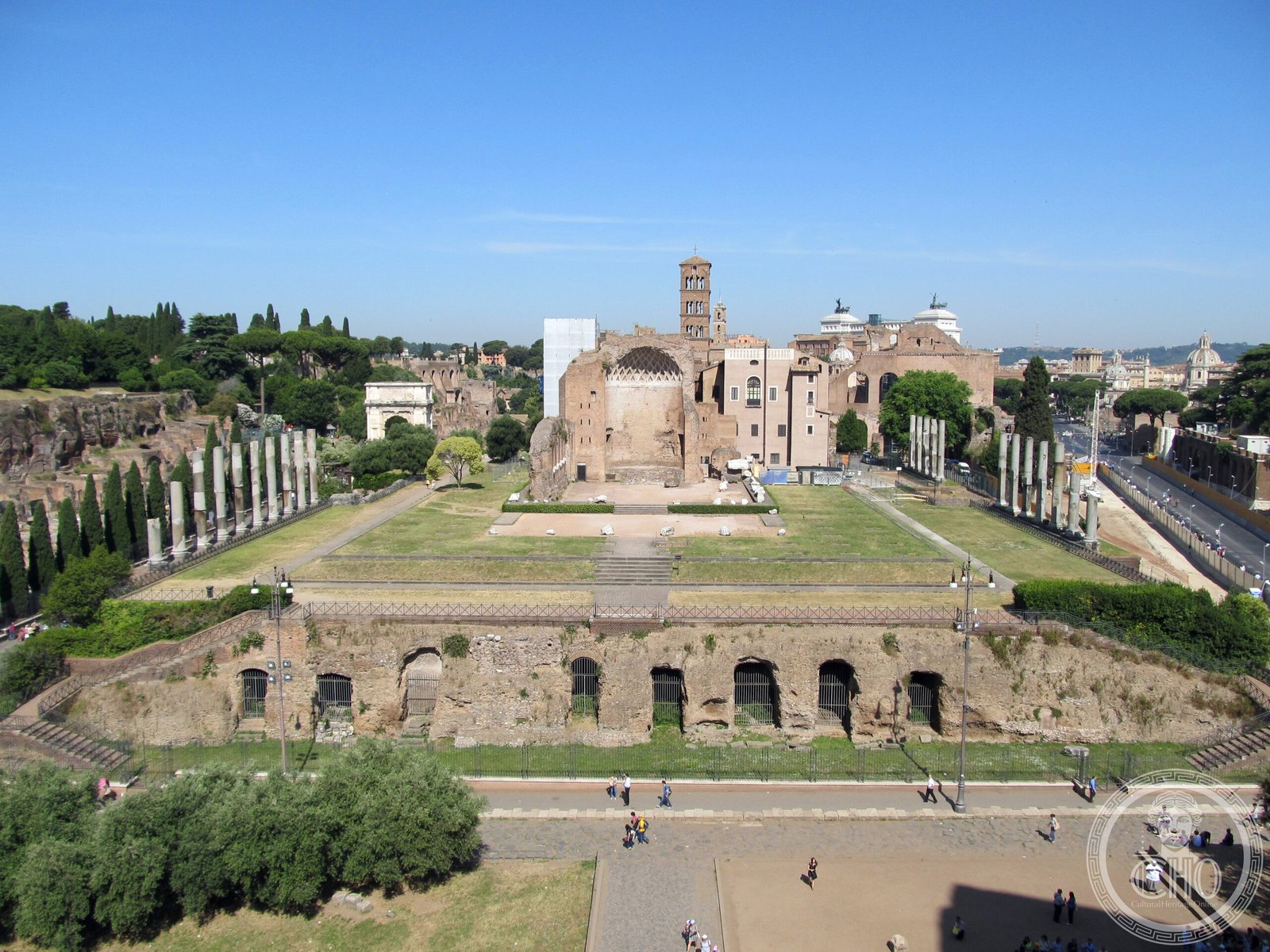
Temple of Venus and Rome
The largest temple of ancient Rome, this monumental structure occupied the eastern Forum between the Basilica of Maxentius and the Colosseum, dedicated to the goddesses Venus Felix and Roma Aeterna.
At a glance
Inaugurated in 141 AD by Emperor Antoninus Pius, the Temple of Venus and Rome rose from the vestibule of Nero’s Domus Aurea. A double-celled sanctuary with opposing orientations, it remains one of antiquity’s most ambitious religious projects. Hellenizing in form, the structure dominated the Forum landscape through successive reconstructions and restorations.
History
The temple was erected on the site of the Domus Aurea’s vestibule, whose orientation was preserved and foundations partially reused. In 307 AD, Emperor Maxentius commissioned a major restoration after fire destroyed the central Forum. This reconstruction produced most surviving elements today.
Dismantling began in the seventh century when Emperor Heraclius granted Pope Honorius the bronze roof tiles for St. Peter’s Basilica. Medieval structures eventually occupied the site until systematic excavation during French administration (1810–1817) revealed the archaeological remains.
What you see
The temple functioned as a dipterus: two cells facing opposite directions, each dedicated to a different goddess, preceded by a vestibule. The podium was flanked by double porticos of gray granite columns, with propylaea opening at the center and staircases connecting to the Colosseum square and Forum.
Surviving elements include brick apsidal cells with coffered vaults, stucco coffers, porphyry wall columns, and marble flooring from Maxentius’s restoration. Only the apse of the Venus cell survives intact; the Roma cell’s apse was incorporated into the adjacent convent of Santa Francesca Romana. The Corinthian peristyle has vanished entirely. Modern granite columns visible today were raised during 1930s restoration work.
Cultural significance
As the largest temple in the Roman world, this sanctuary embodied imperial piety and architectural ambition. Its design influenced Renaissance architects: Palladio notably copied its coffered vault stuccoes. The building’s layered history—from Hadrianic vision through Maxentian reconstruction to papal reuse—illustrates Rome’s religious and political transformations across centuries.
Key facts
- Address: Piazza di Santa Maria Nova, 53, 00186 Rome
- Coordinates: 41.89085702404937, 12.48971164226532
- Inaugurated: 141 AD by Emperor Antoninus Pius
- Major restoration: 307 AD under Emperor Maxentius
- Phone: 06 6998 4422
Practical information
Open from 8:30 AM until one hour before sunset. Closed January 1 and December 25. The ticket office closes one hour earlier.
Full ticket €12.00; reduced €7.50. Admission grants access to the Roman Forum, Palatine Hill, and Colosseum. Guided tours available upon request.
Getting there
You may enter from two central archaeological area entrances: via dei Fori Imperiali or via di San Gregorio. Once inside, access to the Temple of Venus and Rome is located next to the Arch of Titus. For information and guided tours, call 06 6998 4422.
Sources & resources
Find it on the map
See this place and what’s around it →📷 Diventa un fotografo di Cultural Heritage Online
Condividi le tue foto dei luoghi: restano pubblicate con la tua firma come autore. Più vengono viste, più ti fai conoscere — e presto un concorso premierà le foto più apprezzate.
Accedi o registrati gratis per aggiungere una foto