
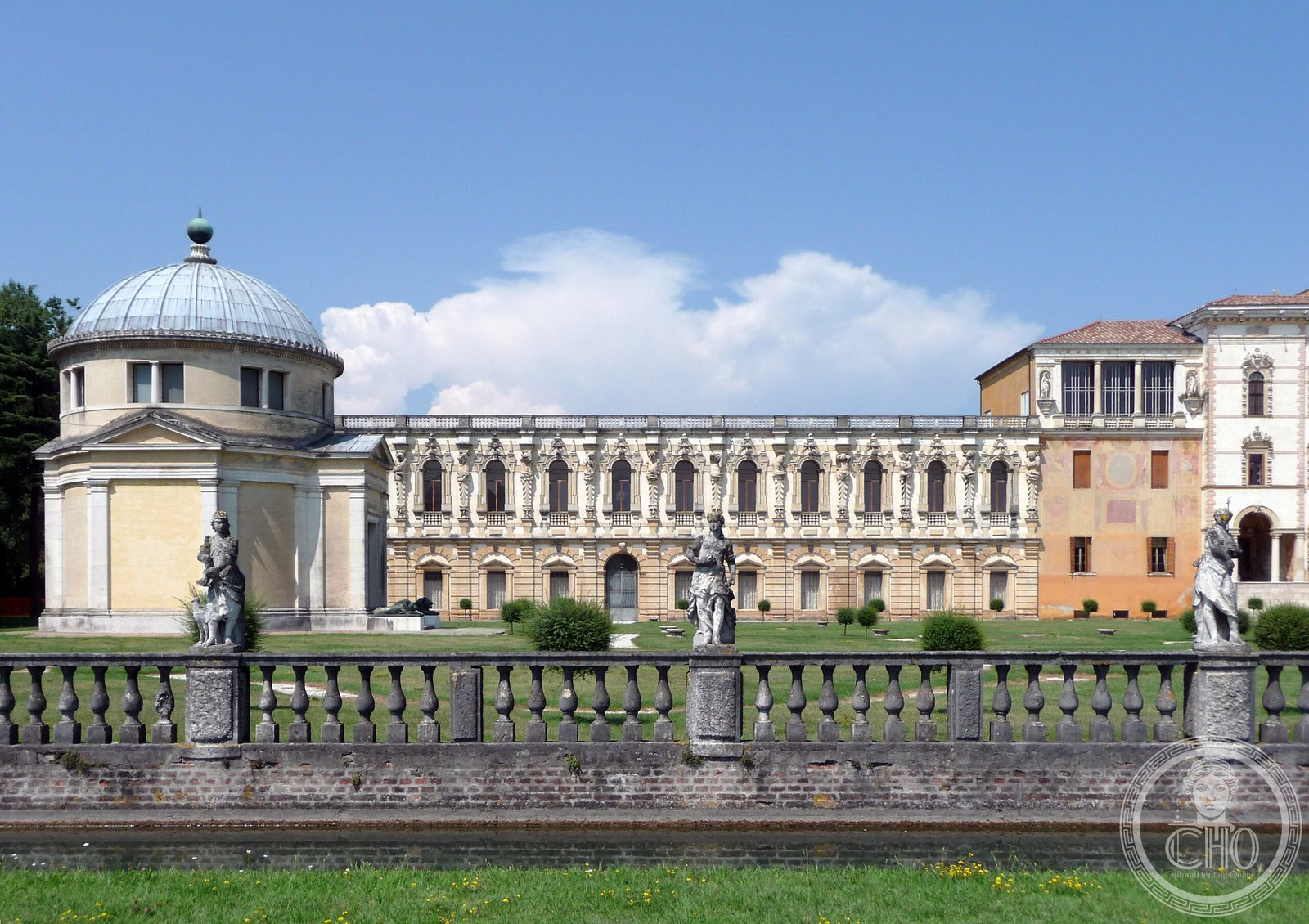
Villa Contarini Camerini
One of the Veneto’s largest villas, this sprawling Baroque complex began as a modest castle in 1546 and evolved into a palatial entertainment venue through successive expansions—now a museum and cultural foundation.
At a glance
Villa Contarini Camerini dominates the semicircular arcaded piazza at the heart of Piazzola sul Brenta. Its Baroque façade conceals a layered architectural history spanning five centuries, from its origins as a fortified rural dwelling to its transformation into one of the Veneto’s most ambitious domestic palaces. Today it operates as a museum, exhibition space, and seat of the Ghirardi Foundation.
History
Paolo and Francesco Contarini erected the central body in 1546, likely designed by Andrea Palladio. For over a century the villa remained a rural residence. The true reinvention came under Marco Contarini, the ambitious prosecutor of San Marco, who in the late seventeenth century commissioned sweeping expansions to transform the complex into a sophisticated palace fit for grand entertainment.
In 1676 the right wing received a dramatic remodeling with double-tiered rustic columns, telamons, and lavish sculptural decoration. The hemicycle arcade framing the main square was complete by 1788. Though the expansion project remained incomplete—perhaps due to financial constraints—the villa had achieved palatial stature.
After decades of decline, the Camerini family purchased the property in 1852 and undertook extensive restoration and nineteenth-century-style embellishment. An expansive English garden of over forty hectares, with fish ponds and tree-lined avenues, was added at the century’s end. The Ghirardi Foundation acquired the villa in 1970, reopening it to the public; the Veneto Region assumed ownership in 2005.
What you see
The villa’s current appearance is unmistakably Baroque, yet its layers reveal earlier phases. The central nucleus preserves traces of Palladian proportioning, though little of the original sixteenth-century work remains visible following repeated renovations from 1662 onward.
The most dramatic elements are the seventeenth-century additions: the right wing’s rusticated columns and sculpted figures, which extend onto the main body with sumptuous decoration. The hemicycle of arcades that embraces the forecourt is a defining feature, completed by the eighteenth century and partly surviving today.
The private chapel ranks among architect Tommaso Temanza’s principal works. Nineteenth-century restoration introduced eclecticism alongside original elements, while the surrounding landscape—its fish ponds, avenues, and gardens—completes an extraordinary composition of over forty hectares.
Cultural significance
Villa Contarini Camerini exemplifies the ambitions of Venetian merchant families to assert wealth and taste through architectural patronage. Its evolution reflects shifting ideals: from functional fortified manor to theatrical palace designed for spectacle and hospitality.
The villa’s attribution history—involving Palladio, Vincenzo Scamozzi, and Baldassare Longhena—underscores its importance in seventeenth-century Veneto architecture, even as ambitions exceeded completion. As a museum and cultural venue, it continues its traditional role as a space for artistic and intellectual exchange.
Key facts
- Address: Via L. Camerini, 1, 35016 Piazzola sul Brenta, Veneto
- Coordinates: 45.544071, 11.785252
- Ownership: Veneto Region (acquired 2005); operates under the Ghirardi Foundation
- Website: http://www.villacontarini.eu/
- Phone: 049 5591717
Practical information
The villa is open to the public year-round as a museum and exhibition space. Guided tours and educational programs are available; the site also hosts art exhibitions of regional and national significance. Opening hours and admission fees should be confirmed via the official website or by phone.
Getting there
Piazzola sul Brenta lies in the Veneto, approximately 30 kilometres west of Venice. The villa sits in the town’s main piazza. Regional trains and buses connect to nearby Castelfranco Veneto and Padua; a car allows flexibility for exploring the surrounding Brenta valley estates.
Sources & resources
Find it on the map
See this place and what’s around it →📷 Diventa un fotografo di Cultural Heritage Online
Condividi le tue foto dei luoghi: restano pubblicate con la tua firma come autore. Più vengono viste, più ti fai conoscere — e presto un concorso premierà le foto più apprezzate.
Accedi o registrati gratis per aggiungere una foto