
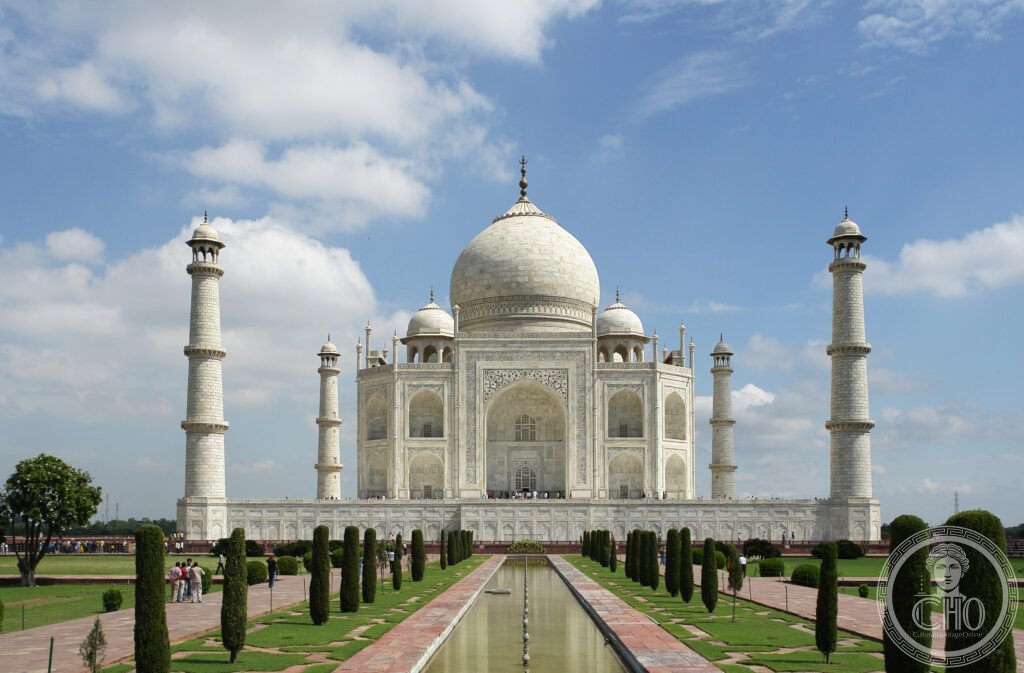
Taj Mahal
The most universally recognised building on Earth and the supreme achievement of Mughal architecture — the Taj Mahal (Agra, Uttar Pradesh, India; UNESCO WHS 1983) was commissioned by the Mughal Emperor Shah Jahan (r. 1628-1658 CE) as a mausoleum for his wife Mumtaz Mahal, who died in childbirth in 1631 CE, and built between 1631 and 1648 CE by approximately 20,000 artisans using white Makrana marble and 28 varieties of precious and semi-precious stones.
At a glance
The Taj Mahal (the most precisely TajMahalIndia single Mughal Emperor Shah Jahan 1628 1658 CE Mumtaz Mahal wife died childbirth 14th child June 17 1631 CE Burhanpur Shah Jahan deathbed promise mausoleum 1631 1648 CE 17 years 20000 workers 1000 elephants white Makrana marble Rajasthan 28 precious semi-precious stones turquoise lapis lazuli carnelian jade onyx amethyst coral gold thread calligrapher Amanat Khan inlay craftsmen Pietra dura hardstone inlay main dome 73m finial inner visible double dome 4 minarets 40m each lean outward earthquake protection chahar bagh garden 4 quadrant Persian garden water channels Hauz-i-Kausar reflecting pool central axis Yamuna River north view 6 million visitors per year one of 7 wonders world UNESCO heritage: the architecture (the Taj Mahal is a perfect bilateral symmetry: the main mausoleum building, the flanking mosque (Masjid) and guest house (Mihman Khana), and the garden are all bilaterally symmetrical; the single deliberate asymmetry: the cenotaph of Shah Jahan is placed to the left of the cenotaph of Mumtaz Mahal (off-center), because Shah Jahan was not originally planned to be buried here; he intended to build a Black Marble mausoleum for himself across the Yamuna River connected by a silver bridge; he was deposed by his son Aurangzeb in 1658 CE and spent the last 8 years of his life imprisoned in Agra Fort across the Yamuna from the Taj Mahal, with a view of his wife’s tomb from his cell window)); the garden (the chahar bagh (Persian “four gardens”): the classic Islamic garden divided into four quadrants by water channels; the four quadrants represent the four rivers of Paradise described in the Quran; the reflecting pool on the central axis reflects the Taj Mahal in both directions)) — the most precisely TajMahalIndia single Shah Jahan 1628 1658 CE Mumtaz Mahal 14th child June 17 1631 CE 17 years 20000 workers 1000 elephants white Makrana marble Rajasthan 28 precious stones turquoise lapis lazuli carnelian jade Amanat Khan calligrapher Pietra dura inlay main dome 73m double dome 4 minarets 40m lean outward chahar bagh Hauz-i-Kausar reflecting pool 6 million visitors per year 7 wonders UNESCO heritage in any UNESCO world heritage site)).
Key facts
- The pietra dura inlay and the calligraphy: the most precisely TajMahalIndia single pietra dura hardstone inlay technique Italian origin imported Mughal craft flower motifs lotus tulip lily narcissus carnation 28 stone types lapis lazuli Afghanistan turquoise Iran carnelian Arabia jade China onyx Amanat Khan lead calligrapher quranic inscriptions Surah 36 Ya Sin Surah 89 Al-Fajr entire chapters inscribed white marble calligraphy proportionally larger top verses further viewer appear same size corrected optical distortion deliberate technique UNESCO heritage — the two defining decorative achievements: the pietra dura inlay (the technique of cutting semi-precious stones into floral and geometric shapes and setting them into the white marble (inlaying without adhesive — the stone fits are precise enough to hold by friction alone); 28 types of semi-precious stone including: lapis lazuli (Afghanistan), turquoise (Iran/Persia), carnelian (Arabia), jade and crystal (China), onyx (Persia), jasper (Punjab)); the calligraphy (the Quranic verses on the interior and exterior are designed with a deliberate optical correction: the letters become progressively larger toward the top of the arch — so they appear the same size to a viewer standing at ground level; the lead calligrapher was Amanat Khan (whose name is signed on the south gateway, the only signature on the Taj Mahal); he inscribed complete Quranic chapters (including all of Surah 36, Ya Sin, and all of Surah 89, Al-Fajr))
- GPS: 27.1751° N, 78.0421° E
History
From Mughal love to colonial mystery to world heritage icon (the most precisely TajMahalIndia single Shah Jahan 1592 1666 CE 5th Mughal Emperor 1628 CE Mumtaz Mahal born 1593 Arjumand Banu Begum niece Nur Jahan powerful Empress Jahangir 1612 CE marriage 14th child June 17 1631 CE Burhanpur death Shah Jahan deathbed promise mausoleum magnificent 17 years 1631 1648 CE Ustad Ahmad Lahauri architect credited although debated Ismail Khan Ottoman architect dome specialist marble Makrana Rajasthan 300 km Agra 1000 elephants transport 1658 CE Aurangzeb depose Shah Jahan imprisoned Agra Fort view Yamuna Taj Mahal window 8 years death 1666 CE Aurangzeb buried Shah Jahan Mumtaz Mahal Black Taj myth never built British colonial decline Taj Mahal William Sleeman 1820 CE reported dilapidation Lord Curzon 1900 1905 CE restoration conservation modern gardens restored UNESCO 1983 WHS heritage: the murder mystery theory (the theory that the Taj Mahal was originally a Hindu temple, the “Tejo Mahalaya” (a Shiva temple) that Shah Jahan converted into a mausoleum, has been widely promoted by some Hindu nationalist groups since the 1960s CE; the archaeological consensus: there is no credible evidence of a prior structure at the Taj Mahal site; the theory relies on misinterpretations of Persian architectural terminology and has been rejected by the Archaeological Survey of India and independent scholars); the Black Taj theory (Shah Jahan allegedly planned a mirror-image black marble mausoleum for himself on the opposite bank of the Yamuna, connected to the Taj Mahal by a silver bridge; archaeological excavations (2006 CE) found a garden platform and possible foundation for a structure on the Mahtab Bagh (Moonlight Garden) site across the Yamuna, but no black marble stones; the theory is not confirmed but not disproven)) — the most precisely TajMahalIndia single Shah Jahan 1592 1666 CE 5th Mughal Emperor Mumtaz Mahal born 1593 niece Nur Jahan 1612 CE marriage 14th child 1631 CE death Burhanpur Ustad Ahmad Lahauri architect Ismail Khan Ottoman dome marble Makrana 300 km 1000 elephants 1658 CE Aurangzeb depose Shah Jahan Agra Fort Yamuna view 8 years death 1666 CE Aurangzeb buried Black Taj myth Tejo Mahalaya rejected Archaeological Survey India Lord Curzon 1900 1905 CE restoration UNESCO 1983 heritage in any UNESCO world heritage site)).
What you see
Garden, gateway, mausoleum, and mosque (the most precisely TajMahalIndia single Great Gate Darwaza-i-rauza red sandstone south gateway 30m Persian calligraphy verses Quran chahar bagh Persian four garden quadrants cypress trees 296m × 296m water channels Hauz-i-Kausar central pool reflecting axis mausoleum plinth 6.7m high 96.5m × 96.5m base platform Makrana marble pietra dura inlay four minarets 40m each lean outward earthquake protection main dome 73m inner outer double dome Mughal architecture semi-circular bulbous false dome outer inner dome octagonal drum octagonal interior central cenotaph Mumtaz Mahal Shah Jahan off-center deliberate plan change screen jali marble lattice screen marble inscriptions Masjid mosque red sandstone west Mihman Khana guest house east bilaterally symmetrical Agra Fort Yamuna view UNESCO heritage: the visitor sequence: the Great Gate (the main south entrance through the outer compound wall; 30m high; red sandstone with white marble inlay; the interior of the gate designed to frame the first view of the Taj Mahal as the visitor walks through); the chahar bagh garden (the Persian garden; 300m long; the central water channel (canal) on the north-south axis; the cypress trees; the reflecting pool at the center where the Taj Mahal is reflected in both directions); the mausoleum (the main building; note: entry tickets for the interior are sold separately at the foot of the plinth; the interior (the actual tombs of Mumtaz Mahal and Shah Jahan are in a vault below the main floor; the cenotaphs (false tombs) on the main floor are what visitors see; Mumtaz Mahal’s cenotaph is on the center axis; Shah Jahan’s is to the left (off-center)); the mosque and guest house (the two red sandstone flanking buildings; the mosque to the west is functional; the Mihman Khana to the east is now a museum))) — the most precisely TajMahalIndia single Great Gate Darwaza-i-rauza red sandstone 30m calligraphy chahar bagh Persian garden 296m × 296m cypress Hauz-i-Kausar reflecting pool mausoleum plinth 6.7m 96.5m base 4 minarets 40m lean outward main dome 73m double dome octagonal drum pietra dura inlay jali marble lattice Mumtaz Mahal Shah Jahan cenotaphs off-center tomb vault below Masjid mosque west Mihman Khana east bilaterally symmetrical UNESCO heritage in any UNESCO world heritage site)).
Practical information
- Getting there: the nearest airport is Agra (AGR; Agra Airport; limited scheduled flights from Delhi (DEL; 30 min) and Varanasi (VNS; 50 min); most visitors travel from Delhi (200 km north): the Gatimaan Express (the fastest train; New Delhi to Agra Cantt; 1h40m; INR 750-1455/€8-16 (AC chair/Executive)); the Shatabdi Express (2h; INR 540-1160/€6-12); the Taj Express (2h30m from Hazrat Nizamuddin station); taxi from Delhi (3-4h; approximately INR 4,000-7,000/€44-77 round trip (include 2h at Taj Mahal)); the entry fee (INR 1,100/€12 for foreign tourists; includes Archaeological Survey of India booklet; the interior cenotaph chamber: additional INR 200/€2.20); the best time (October-February (the cool season; October-November and February-March have the clearest air; December-January can have heavy morning fog on the Yamuna which either obscures the Taj Mahal or creates a magical mist effect depending on density); the sunrise visit (the first visitors enter at 30 min before sunrise; the sunrise light on the white marble changes color from pale pink to gold to white; the reflecting pool is clearest at this time)); the Friday closure (the Taj Mahal is closed every Friday)
Getting there
200 km from Delhi: Gatimaan Express train 1h40m, INR 750-1455. Entry INR 1,100/€12 for foreigners + INR 200 interior. Closed Fridays. Best: October-February. Sunrise visit: 30 min before dawn. GPS: 27.1751, 78.0421.
Nearby
- Agra Fort — 2.5 km northwest (UNESCO WHS 1983; the Mughal fort from which Shah Jahan was imprisoned by his son Aurangzeb (1658-1666 CE); the Musamman Burj (the octagonal tower room where Shah Jahan was held; the window from which he could see the Taj Mahal across the Yamuna River); the Diwan-i-Khas (Hall of Private Audience), the Moti Masjid (Pearl Mosque; 1653 CE, the finest white marble mosque in Agra), and the Jahangiri Mahal (the original palace by Akbar (1558-1573 CE)))
- Fatehpur Sikri — 37 km west (UNESCO WHS 1986; the ghost capital of Akbar the Great (r. 1556-1605 CE); built 1571-1585 CE as the capital of the Mughal Empire; abandoned approximately 1585 CE due to water scarcity; the Buland Darwaza (the Victory Gate; 54m; the tallest gateway in India; built to commemorate Akbar’s conquest of Gujarat in 1573 CE); the Dargah of Salim Chishti (the Sufi shrine inside the fort; the Mughal court’s spiritual center))
Sources
- Wikipedia, Taj Mahal; Shah Jahan; Mumtaz Mahal; Ustad Ahmad Lahauri, accessed June 2026
- UNESCO, Taj Mahal, WHS reference 252, inscribed 1983
Find it on the map
See this place and what’s around it →📷 Diventa un fotografo di Cultural Heritage Online
Condividi le tue foto dei luoghi: restano pubblicate con la tua firma come autore. Più vengono viste, più ti fai conoscere — e presto un concorso premierà le foto più apprezzate.
Accedi o registrati gratis per aggiungere una foto