
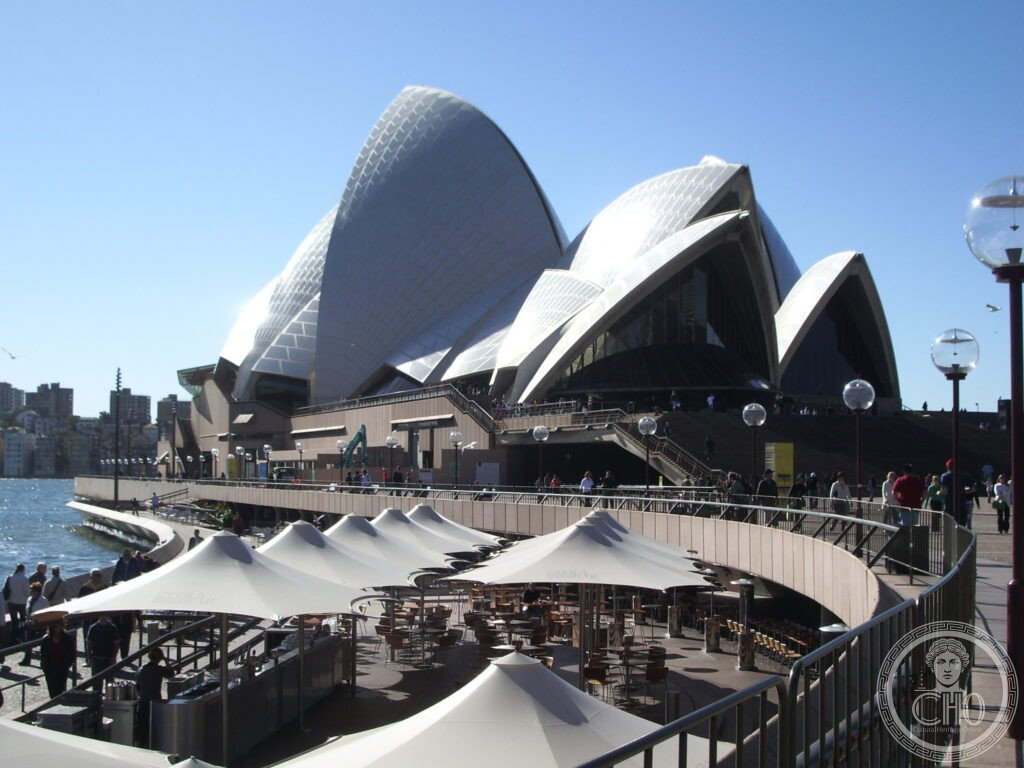
Sydney Opera House — Australia
Jørn Utzon conceived the shells in 1956 — their geometry could not be built with existing technology; the engineering solution that finally made them possible changed the history of computer-aided design, and the building they enclose is now the most recognisable structure of the 20th century.
At a glance
The Sydney Opera House occupies Bennelong Point, a promontory at the eastern end of Circular Quay in Sydney Harbour, its cluster of sail-like shells rising above the water with the Harbour Bridge as a backdrop to the west. The building was designed by the Danish architect Jørn Utzon (1918–2008), who won an international competition in 1957 with a design sketched in 10 pages; its construction, from 1959 to 1973, became one of the most complex and controversial architectural projects of the 20th century. The interlocking series of precast concrete shells that form the roof — ultimately derived from the geometry of a sphere, after Utzon’s team spent years on the problem — required the development of new computer calculation methods and fabrication techniques. Utzon resigned from the project in 1966 following political disputes; the interiors were completed by a team of Australian architects. The Opera House opened on 20 October 1973, Queen Elizabeth II presiding. It was inscribed as a UNESCO World Heritage Site in 2007.
Key facts
- Architect: Jørn Utzon (1918–2008), Denmark; structural engineer Ove Arup & Partners (Peter Rice, lead engineer for the shells); interiors completed by Hall, Todd and Littlemore after Utzon’s resignation in 1966
- Construction: 1959–1973; fourteen years; original budget AUD 7 million; final cost AUD 102 million
- The shells: 14 interlocking concrete shells clad in 1,056,006 Swedish Höganäs tiles in two colours (glossy white and matte cream); all shell surfaces derived from the surface of a sphere of 75.2 metres radius — Utzon’s 1961 “spherical solution” that made the construction feasible
- Venues: Concert Hall (2,679 seats), Joan Sutherland Theatre (1,507 seats), Drama Theatre (544 seats), Playhouse (398 seats), Studio (364 seats), Utzon Room (210 seats); approximately 1,800 performances a year
- Heritage: UNESCO World Heritage Site, inscribed 2007; one of the first buildings of the 20th century to receive this designation
- GPS: 33.8568° S, 151.2153° E
History
The 1957 competition drew 233 entries from 32 countries. The assessors — including the Finnish-American architect Eero Saarinen — had initially set aside Utzon’s design as too vague to evaluate, then retrieved it from the rejected pile on Saarinen’s initiative. The scheme showed the shells in a sketch style that could not yet be resolved into buildable geometry; the assessors declared it the winner on the basis of the power of the concept. The subsequent engineering challenge consumed fifteen years and the talents of Peter Rice, one of the most gifted structural engineers of the century.
Utzon’s “spherical solution” of 1961 — realising that if all the shells were portions of a single sphere, they could be precast from identical ribs — was the breakthrough that made the building constructible. The shells were precast in segments and assembled on a temporary steel armature, then clad in the Swedish ceramic tiles. The tiles arrive at Sydney in a condition of permanent moisture from the harbour; the two-colour pattern (which looks like a single colour in most photographs) only becomes apparent in raking light.
Utzon resigned in February 1966 after the new Liberal government cut his fees and refused to make advance payments; he never returned to Sydney and never saw the completed building. The political dispute permanently overshadowed the project’s completion. Utzon was awarded the Pritzker Prize in 2003; the citation noted that there was no doubt that the Sydney Opera House was “one of the great buildings of the 20th century.” He died in 2008, five years before the building’s 40th anniversary. The Utzon Room, completed in 2004 to his designs, was the only interior he ever saw executed.
What you see
The approach from Circular Quay, with the Harbour Bridge to the left and the water of the harbour on both sides, is one of the great urban promenades of the 20th century. As you approach, the shells shift in apparent relationship to one another — the building never presents the same composition twice as the angle changes. The tiled surfaces catch the harbour light and reflect it; in certain conditions the tiles appear to glow from within.
The shells are not, as commonly assumed, the roofs of the performance halls below — they are structural envelopes over glazed foyer spaces; the concert halls are embedded in the massive podium beneath. Inside, the Concert Hall’s ceiling of acoustic panels is the primary architectural gesture; the Joan Sutherland Theatre’s horseshoe is more conventionally theatrical. The building is in use 363 days a year and presents itself best from the water, from the Bridge, or from Mrs Macquarie’s Chair across the harbour — perspectives from which the shells are seen against open sky rather than the city behind.
Practical information
- Address: Bennelong Point, Sydney NSW 2000, Australia
- Tours: 1-hour general tour AUD 42 (adults); 2-hour backstage tour AUD 145; booking at sydneyoperahouse.com
- Performances: Opera Australia, Australian Ballet, Sydney Symphony Orchestra, Sydney Theatre Company; check sydneyoperahouse.com for programme
- The walk: the building’s exterior and forecourt are free to walk around at any time; the view from the south-east corner toward the bridge is the most photographed
- Restaurants: Bennelong restaurant (in the shell) and Opera Bar (outdoor terrace, harbour views) are popular without requiring performance tickets
Getting there
Circular Quay station (train) or Circular Quay ferry terminal, both 5 minutes walk from the Opera House. By ferry from Manly or other harbour suburbs, alight at Circular Quay. From Sydney Airport (15 km south): Airport Link train to Circular Quay (20 minutes). GPS: -33.8568, 151.2153.
Nearby
- Sydney Harbour Bridge — the 1932 steel arch bridge 500 metres west; BridgeClimb offers guided ascents to the summit arch (134 metres above sea level); the view from the top has the Opera House shells below
- Royal Botanic Garden — 30 hectares of historic gardens between the Opera House and Macquarie Street; free; the walk around Farm Cove with the harbour on one side and the gardens on the other is excellent
- The Rocks — the historic district adjacent to Circular Quay; Sydney’s oldest neighbourhood, with the original colonial-era sandstone buildings
- Museum of Contemporary Art (MCA) — at Circular Quay, the Art Deco building with the best harbour view; free permanent collection
Sources
- Wikipedia, Sydney Opera House, accessed June 2026
- Official site: sydneyoperahouse.com
- UNESCO, Sydney Opera House, WHS reference 166rev, inscribed 2007
- Philip Drew, The Masterpiece: Jørn Utzon, a Secret Life, Hardie Grant Books, 1999
Find it on the map
See this place and what’s around it →📷 Diventa un fotografo di Cultural Heritage Online
Condividi le tue foto dei luoghi: restano pubblicate con la tua firma come autore. Più vengono viste, più ti fai conoscere — e presto un concorso premierà le foto più apprezzate.
Accedi o registrati gratis per aggiungere una foto