
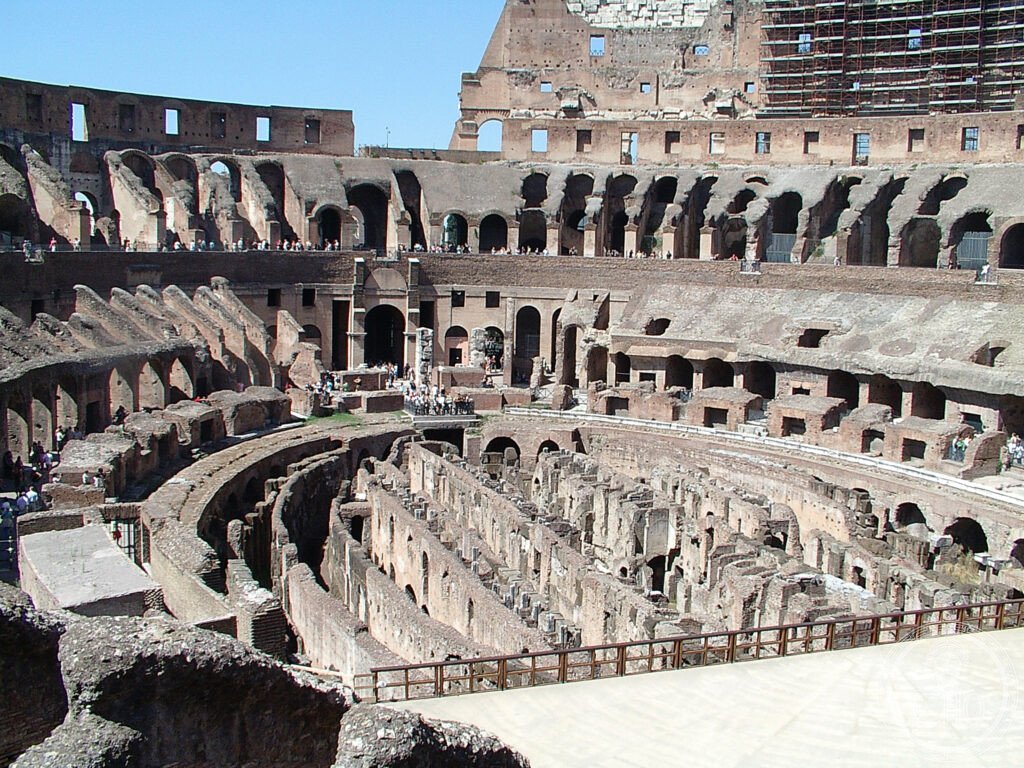
The Flavian Amphitheatre — built between 70 and 80 AD as a gift to the Roman public from the Flavian emperors, its 80 arched entrances feeding 50,000 spectators to their numbered seats in eight minutes — remains the largest amphitheatre ever constructed and the prototype for every sports arena since.
At a glance
The Colosseum (officially the Flavian Amphitheatre) stands in the valley between the Caelian and Palatine hills at the centre of ancient Rome, on the site of the ornamental lake of Nero’s Domus Aurea. Construction began under Vespasian in 70 AD and was completed under his son Titus in 80 AD; a further tier was added by Domitian. The building is a freestanding ellipse 188 metres long, 156 metres wide, and 48 metres tall; its outer wall of travertine limestone carries three storeys of arched openings framed by engaged columns in the Doric, Ionic, and Corinthian orders. At the inauguration in 80 AD, games lasting 100 days were held; the building could accommodate approximately 50,000–80,000 spectators in a tiered seating system that separated the audience by social class. The Colosseum was added to the Historic Centre of Rome UNESCO World Heritage Site in 1980, and is one of the most visited monuments in Italy with approximately 7 million visitors annually.
Key facts
- Builders: Vespasian (begun 70 AD); completed under Titus (80 AD); upper tier added by Domitian; architect unknown (Roman tradition)
- Dimensions: outer ellipse 188 × 156 metres; height 48–50 metres; 80 arched entrances; seating capacity estimated 50,000–80,000
- Materials: travertine limestone (outer walls), tufa (inner walls), concrete (vaulting), brick (later repairs); original awning system (velarium) supported by wooden masts in the fourth tier
- Arena floor: wooden planking over the hypogeum (underground network of tunnels and cages for animals and gladiators); the wood was removed in the 6th century, exposing the hypogeum visible today
- Last games: gladiatorial combat abolished c. 435 AD; animal hunts (venationes) continued to at least 523 AD; building subsequently converted to fortress, housing, workshops, and finally a monument
- Heritage: UNESCO World Heritage Site as part of Historic Centre of Rome, inscribed 1980; one of the New Seven Wonders of the World (2007)
- GPS: 41.8902° N, 12.4922° E
History
Vespasian, who became emperor after the civil war of 69 AD, chose the site of Nero’s Domus Aurea — the private palace that had seized a large part of central Rome for the emperor’s personal use — to build a public amphitheatre as a symbolic act of restoration: the ground that Nero had taken from the people was returned to them as a place of mass entertainment. The building was constructed with remarkable speed; the 70-AD start date to the 80-AD inauguration is ten years for a building of this scale, achieved with the labour of tens of thousands of workers including Jewish prisoners brought to Rome following the sack of Jerusalem in 70 AD.
The spectacles held at the Colosseum included gladiatorial combat (munera), animal hunts (venationes), public executions (noxii), and, possibly, mock sea battles (naumachia) in the earliest period before the underground hypogeum was constructed. The hypogeum — the network of underground tunnels, cages, and elevators that allowed animals and fighters to appear through trapdoors in the arena floor — was added under Domitian (81–96 AD) and is the most remarkable survival: 32 animal lifts, operated by counterweights, could hoist large animals directly to arena level. Gladiatorial combat was banned by the Emperor Honorius c. 435 AD; animal hunts continued for at least another century.
The building fell into disuse after the 6th century, was converted to housing and workshops in the medieval period, and had a significant portion of its marble and travertine stripped away for building material by papal construction projects in the 15th–16th centuries; approximately two-thirds of the original exterior stone was removed. Benedict XIV consecrated the building as a Christian martyrs’ memorial in 1749, which effectively halted the quarrying; subsequent restorations by the popes stabilised the structure. The extensive reinforcement and cleaning of the exterior conducted since the 1990s has restored much of its travertine brilliance.
What you see
The exterior presents the canonical image of Roman imperial architecture: three storeys of 80 arched bays each, the arches framed by Doric half-columns on the lowest storey, Ionic on the second, Corinthian on the third — an encyclopaedic display of the Greek orders applied to the Roman arch system. The fourth storey, added by Domitian, alternates windows and Corinthian pilasters. The original 240 vertical corbels on the attic once supported the wooden masts from which the velarium was rigged by a detachment of sailors from the fleet at Misenum.
Inside, the hypogeum is visible from the modern-day arena level (the wooden floor is gone): a two-storey network of corridors, vaulted passages, and chambers beneath the arena where the animals were held in cages and winched to the surface by rope-and-pulley lifts. The tiers of seating survive on the north side; the marble seating was almost entirely removed, but the form of the cavea — the oval rising from the arena to the outer wall — is perfectly clear. The juxtaposition of the scale and the intricacy of the engineering, all two thousand years old, is the Colosseum’s primary impact.
Practical information
- Address: Piazza del Colosseo 1, 00184 Rome, Italy
- Hours: daily; open from 9 am; closing time varies by season (4:30 pm November–January; 7:15 pm June–August)
- Admission: EUR 16 standard; EUR 22 with hypogeum; tickets also include the Roman Forum and Palatine Hill (valid 2 days); mandatory timed entry — book online at coopculture.it well in advance (especially in summer)
- Arena floor: accessible on guided tours (separate booking); the view from the arena looking up at the stands gives the best sense of the original scale
- Night tours: available; atmospheric and significantly less crowded than daytime visits
Getting there
Metro B (Colosseo station, directly opposite); bus 75, 85, 87, 117 to the Colosseo stop. From Roma Termini: Metro B, 2 stops. From the city centre on foot: 20–30 minutes. GPS: 41.8902, 12.4922.
Nearby
- Roman Forum & Palatine Hill — included in the same ticket; the Forum is 200 metres west; the Palatine Hill is where Rome’s earliest settlement stood and where the emperors built their palaces
- Arch of Constantine — the triumphal arch between the Colosseum and the Palatine, 315 AD; celebrates Constantine’s victory over Maxentius; the best-preserved Roman triumphal arch in Rome
- Circus Maximus — the chariot-racing track 600 metres south-west; capacity c. 250,000; the largest entertainment venue in the ancient world; the track itself now a park
- Domus Aurea — Nero’s underground palace complex beneath the Oppian Hill, immediately above the Colosseum; open on weekends by guided tour; the frescoes are extraordinary
Sources
- Wikipedia, Colosseum, accessed June 2026
- Coopculture official tickets: coopculture.it
- UNESCO, Historic Centre of Rome, WHS reference 91, inscribed 1980
- K.E. Welch, The Roman Amphitheatre: From its Origins to the Colosseum, Cambridge University Press, 2007
Find it on the map
See this place and what’s around it →Events here — now on & upcoming
- Troia e Roma. Miti, leggende, storie del Mediterraneo antico12 Jun 2026 — 18 Oct 2026See the event →
📷 Become a Cultural Heritage Online photographer
Share your photos of places: they stay published under your name as the author. The more they're seen, the more you get noticed — and soon a contest will reward the most appreciated photos.
Log in or sign up free to add a photoIs this page about you?
This page is read by travellers and heritage enthusiasts who find it on Google. Tell us how you are connected to this place and we will take it from there.