
Petra — Jordan
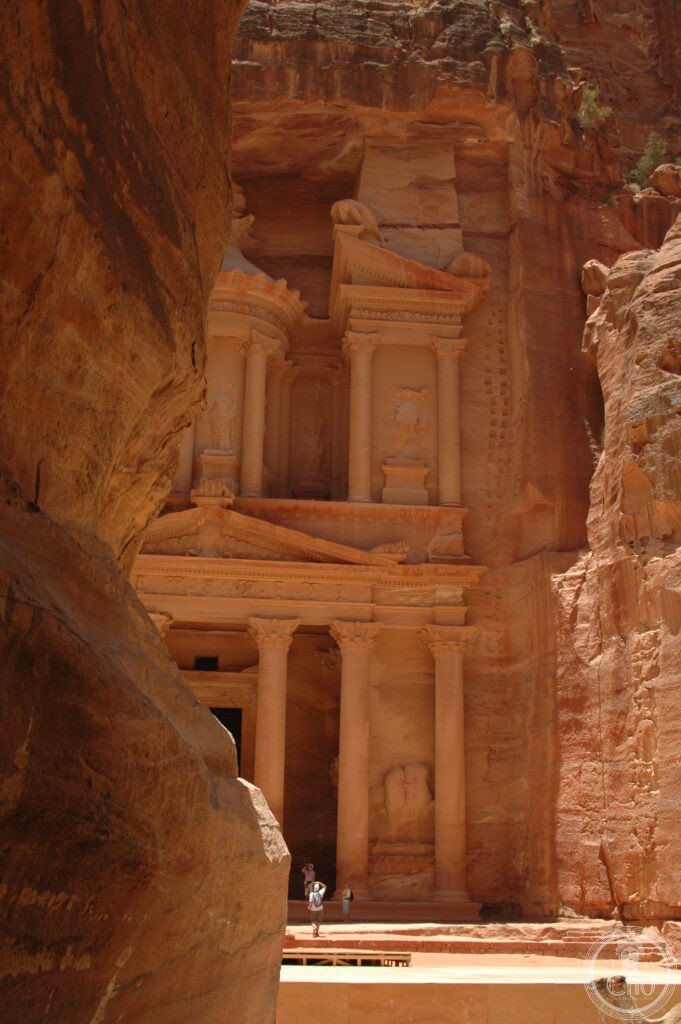
The Nabataeans carved an entire city into the rose-red sandstone of the Wadi Araba desert — temples, tombs, and theatres whose facades emerge full-scale from the solid rock, the most dramatic architectural reveal in the world reached through the narrow crack of the Siq gorge.
At a glance
Petra was the capital of the Nabataean Kingdom, a wealthy Arab trading state that controlled the incense routes between the Arabian Peninsula, Egypt, and the Mediterranean in the centuries around the turn of the common era. The site occupies a basin in the Wadi Musa, surrounded on all sides by rose-red sandstone cliffs; the Nabataeans carved the city’s most spectacular monuments directly into the cliff faces, supplementing carved architecture with free-standing buildings, a colonnaded street, temples, and an extraordinary hydraulic engineering system of channels, cisterns, and pipes. At its height in the 1st century AD, the city housed an estimated 20,000 people. Abandoned following an earthquake in 363 AD and the shift of trade routes, it was unknown to the Western world until the Swiss explorer Johann Ludwig Burckhardt visited it disguised as an Arab pilgrim in 1812. Petra was inscribed as a UNESCO World Heritage Site in 1985.
Key facts
- Builders: the Nabataean Arabs; kingdom flourished c. 4th century BC to 106 AD; annexed by Rome 106 AD
- The Treasury (Al-Khazneh): probably built as a royal tomb in the 1st century BC; 40 metres high; its name derives from a Bedouin legend that a pharaoh’s treasure is hidden in the urn at the top (it is solid stone)
- The Siq: a 1.2-kilometre natural gorge 2–5 metres wide leading to the Treasury; a Nabataean dam originally diverted the seasonal flash flood away from the gorge; the echo and narrowness create a dramatically sudden revelation of the Treasury facade
- Rose-red city: the sandstone of the Wadi Araba ranges from rose to purple to orange to yellow; the light changes its colour through the day, particularly at sunrise and sunset
- Scale: over 800 individual monuments spread across 264 km²; the core archaeological site covers about 15 km²
- Heritage: UNESCO World Heritage Site, inscribed 1985; one of the New Seven Wonders of the World (2007)
- GPS (Treasury): 30.3285° N, 35.4444° E
History
The Nabataeans were an Arab people who appear in historical sources from the 4th century BC. Their wealth came from controlling the overland trade routes that carried frankincense and myrrh from southern Arabia, spices from India, and silk from China toward the Mediterranean markets of Egypt and Rome. Their capital at Petra was ideally positioned to control these routes; the surrounding desert cliffs made it defensible, and the Nabataean engineers solved the water problem — the desert basin receives very little rainfall — by cutting hundreds of kilometres of channels and pipes to direct flash-flood water into cisterns carved into the rock.
The kingdom’s most active building period was from the 1st century BC to the 1st century AD, during the reigns of kings Aretas III and Aretas IV. The Treasury (Al-Khazneh), probably the tomb of Aretas III, is the most familiar monument; its two-storey facade in the Hellenistic Baroque style blends Classical Greek architectural elements with Nabataean decorative motifs. The Great Temple, the Colonnade Street, and the Street of Facades were built in the same period. The Nabataean kingdom was annexed by Rome in 106 AD without military resistance; Petra became the capital of the Roman province of Arabia Petraea and continued to prosper for another two centuries. The earthquake of 363 AD damaged the city significantly, and the subsequent decline of overland trade routes (increasingly replaced by sea routes) led to its gradual abandonment by the Byzantine period.
The rediscovery by Burckhardt in 1812 was followed by a succession of Western travellers and, eventually, systematic archaeological work by the German archaeologist Brünnow in the 1890s. Excavation has been ongoing since the 1950s; a large proportion of the site remains unexcavated. The 2003 film Indiana Jones and the Temple of Doom [sic — actually the 1989 Indiana Jones and the Last Crusade] used the Treasury as its exterior for the Holy Grail temple, bringing Petra to worldwide popular attention.
What you see
The approach through the Siq is the defining spatial experience of Petra. The 1.2-kilometre gorge narrows to two metres wide in places, its sandstone walls rising 80 metres above; the Nabataean water channels are cut into the walls on both sides, still visible. After 40 minutes of walking in near-darkness (the gorge is too narrow for direct sunlight except at noon), the first view of the Treasury’s columns appears in the slot of the gorge exit — a theatrical reveal that the Nabataeans certainly intended.
The Treasury facade, 40 metres high, presents two storeys of Corinthian columns with engaged half-columns, urns, reliefs of deities, and a round tholos at the centre of the upper storey. The interior is a square chamber with three tomb loculi — functional but not richly decorated. The outer face is what was intended to impress. Beyond the Treasury, the Street of Facades extends for another kilometre, lined with tomb facades carved directly into the rock; the Roman theatre carved from the hillside holds 4,000 seats. The Monastery (Ad-Deir), reached after an 850-step climb, is larger than the Treasury and slightly later in date; fewer visitors make the ascent, and the space at the top is consequently more intimate.
Practical information
- Entry: from the Visitor Centre at Wadi Musa town; tickets JOD 50 (1 day), JOD 55 (2 days), JOD 60 (3 days); the Jordan Pass (jordanpass.jo) includes Petra entry and visa fee and is good value
- Distance: the walk from the entrance to the Treasury is 2.4 km return through the Siq; to see the Monastery (Ad-Deir) adds another 8 km round trip with 850 steps; allow 6–8 hours for a complete visit
- Horses and carriages: horse rides into the Siq are included in the ticket price but optional; donkeys available for hire for the Monastery climb. Animal welfare concerns are legitimate — walking is preferable
- Petra by Night: Monday, Wednesday, Thursday evenings; 3,000 candles lighting the Siq and Treasury; atmospheric but crowded. Separate ticket JOD 17
- Best light: sunrise for the Treasury (east-facing, lit by morning sun); the Monastery faces west and is best in late afternoon
Getting there
The nearest town is Wadi Musa, adjacent to the Petra entrance. Aqaba (the nearest airport) is 100 km south; car hire and taxis available. Queen Alia International Airport in Amman is 220 km north; the Desert Highway takes 3 hours by car. JETT bus operates daily services from Amman. GPS: 30.3285, 35.4444.
Nearby
- Little Petra (Siq al-Barid) — a smaller Nabataean site 8 km north; free entry; excellent painted dining room in one of the carved chambers; far less crowded than the main site
- Wadi Rum — the extraordinary desert of orange and red sandstone monoliths, 60 km south; Lawrence of Arabia country; jeep tours, camel treks, overnight camps; also a UNESCO WHS
- Aqaba — Jordan’s only port city, 100 km south; Red Sea diving and snorkelling in one of the world’s richest coral reef systems
Sources
- Wikipedia, Petra, accessed June 2026
- Jordan Tourism Board: visitjordan.com
- UNESCO, Petra, WHS reference 326, inscribed 1985
- Judith McKenzie, The Architecture of Petra, British Academy Monographs in Archaeology, Oxford University Press, 1990
Find it on the map
See this place and what’s around it →📷 Diventa un fotografo di Cultural Heritage Online
Condividi le tue foto dei luoghi: restano pubblicate con la tua firma come autore. Più vengono viste, più ti fai conoscere — e presto un concorso premierà le foto più apprezzate.
Accedi o registrati gratis per aggiungere una foto