
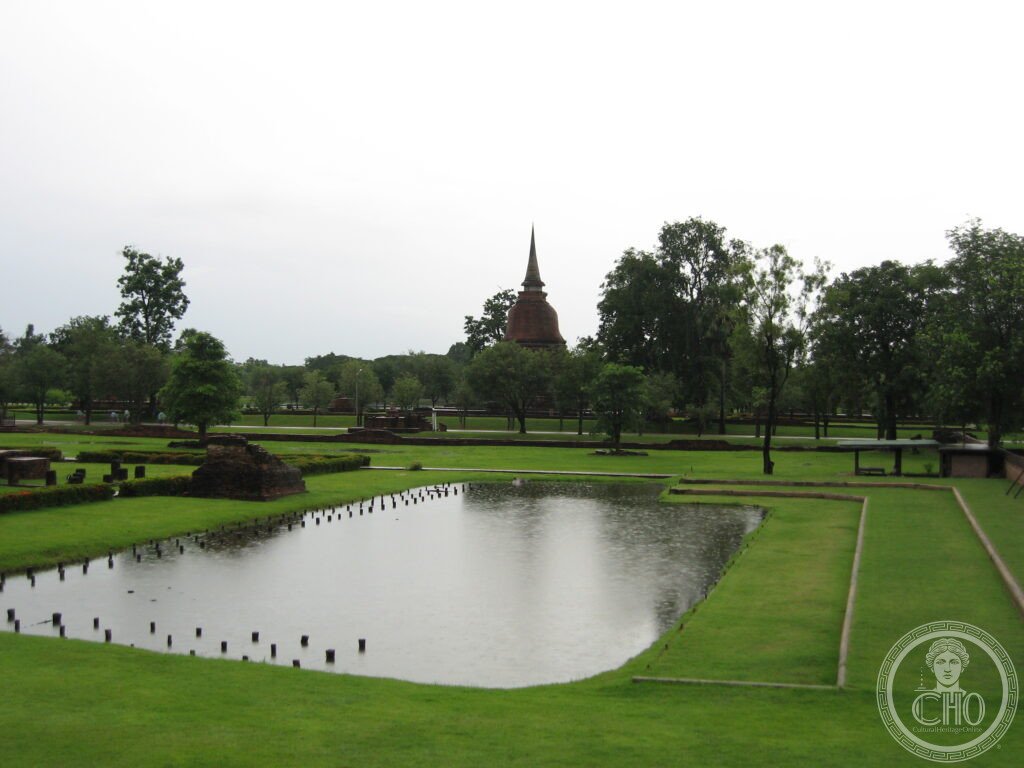
Sukhothai Historical Park
The first capital of an independent Thai state — where the distinctly Thai form of Buddhist temple architecture emerged and where King Ramkhamhaeng created the Thai alphabet in 1283 — its ruined temples reflected in lotus-covered ponds in a landscape so deliberately cultivated that the whole site reads as a meditation garden rather than an archaeological site.
At a glance
Sukhothai (Thai: สุโขทัย, “Dawn of Happiness”) was the first major capital of what is considered the first unified Thai state, located in the lower Ping River valley of north-central Thailand, approximately 450 km north of Bangkok and 250 km south of Chiang Mai. The kingdom flourished from approximately 1238 to 1438 AD, when it was gradually absorbed by the more powerful Kingdom of Ayutthaya to the south. The historical park encompasses approximately 70 sq km of ruins, with the core zone of 43 temples and monuments set within a formal walled city criss-crossed by channels and reservoirs. Sukhothai is considered by Thai national culture to be the birthplace of the Thai nation and the origin of Thai written language. The Sukhothai Historical Park is a UNESCO World Heritage Site, inscribed 1991, along with the associated parks of Si Satchanalai and Kamphaeng Phet.
Key facts
- Wat Mahathat: the central royal temple, the spiritual and geographical centre of the kingdom; its prang (Khmer-style tower) is surrounded by a moat and clusters of smaller chedis; the Buddha statues in the niches of the surrounding wall — seated in a characteristically Sukhothai elongated style — are among the finest surviving examples of Sukhothai Buddhist sculpture
- Walking Buddha image: the Sukhothai artistic style is most distinctive in its “walking Buddha” images — a figure in mid-stride with one foot raised, the right hand raised in the abhaya mudra (gesture of reassurance) — a form not found elsewhere in Buddhist art before the Sukhothai period and possibly derived from animist predecessor traditions; the best examples are at Wat Saphan Hin
- King Ramkhamhaeng’s stele: the Ramkhamhaeng Inscription (c. 1283 AD), attributed to King Ramkhamhaeng the Great (r. c. 1279–1298 AD), is the oldest known example of the Thai script; it describes the kingdom, its laws, and its social organisation in terms that have been central to Thai national identity since the inscription was rediscovered in 1833; the original is in the National Museum Bangkok
- Water management: the historical park’s layout is inseparable from its water infrastructure; the city was built around a grid of rectangular tanks (thaleh noi) and channels connected to the Yom River; the irrigation sustained both the rice agriculture of the surrounding plain and the aesthetic landscape of the city’s temple gardens; the tanks are still filled today
- Sukhothai ware: the kingdom produced a distinctive glazed pottery (Sangkhalok ware) in kilns at the nearby town of Si Satchanalai; the celadon and underglaze-black ceramics were traded throughout Southeast Asia; examples have been found in Japan, the Philippines, and Indonesia
- Heritage: UNESCO World Heritage Site, Historic Town of Sukhothai and Associated Historic Towns, inscribed 1991
- GPS: 17.0199° N, 99.8226° E
History
The region around Sukhothai was part of the Khmer empire from the 11th to the early 13th century; the distinctive Khmer prang architecture that underlies many Sukhothai temples reflects this period. Two Thai chieftains, Pho Khun Bang Klang Thao and Pho Khun Pha Mueang, overthrew the Khmer governor in c. 1238 and established the first independent Thai kingdom. The most celebrated of the Sukhothai kings was Ramkhamhaeng (r. c. 1279–1298 AD), who expanded the kingdom through diplomatic and military means to its maximum extent (covering most of modern Thailand and parts of Laos and Malaysia), established Theravada Buddhism as the state religion (inviting monks from Sri Lanka to reform the sangha), and is credited with creating the Thai script by adapting the Mon-Khmer script then in use.
The Sukhothai royal inscriptions describe a prosperous, paternalistic state in which the king was accessible to his subjects (“whoever has a grievance, whoever is in trouble, may go and ring the bell”), trade was free, and the state protected individual property rights. Whether this represents actual Sukhothai governance or the political ideology of later Thai monarchs is debated; but the image of Sukhothai as the “golden age” of Thai governance has been central to Thai political discourse ever since. After Ramkhamhaeng’s death, the kingdom contracted; by the mid-14th century it was a vassal of Ayutthaya; by 1438 it was formally incorporated.
The site was abandoned in the 15th century and the forest gradually overtook the brick structures. The rediscovery of the Ramkhamhaeng Inscription in 1833 by the future King Mongkut (Rama IV) triggered a scholarly and national interest in Sukhothai; systematic archaeological work began in the 1950s. The Fine Arts Department of Thailand undertook a major restoration and landscaping project in the 1970s–1980s that created the current park — its water features restored, its major temples partially reconstructed, and the surrounding ruins cleared — which received UNESCO inscription in 1991.
What you see
The historical park is best explored by bicycle (hired at the entrance, THB 30–50); the flat terrain and well-maintained paths make it ideal for cycling. The central zone (within the walled city) contains the main temples and can be covered in 2–3 hours; the outer zones (north, south, east, and west of the walls) require an additional 2–3 hours. At dawn and dusk, when the light hits the lotus-covered ponds and the brick ruins reflect in the still water, the landscape achieves an atmospheric quality — meditative, slightly melancholy, composed as a garden — that makes it very different from the dramatic scale of Ayutthaya or the formal grandeur of Angkor.
Wat Mahathat is the largest and most complex temple; Wat Si Chum (outside the north wall) has a massive mondop (square building) containing a seated Buddha image 15 metres wide that peers out through a narrow slit opening — the image known as “Phra Achana” is one of the most impressive single Buddhist images in Southeast Asia. The Ramkhamhaeng National Museum at the park entrance has the best collection of Sukhothai-period sculpture and Sangkhalok ware in Thailand.
Practical information
- Admission: THB 100 for the central zone; THB 100 each for the outer north, south, east, and west zones; bicycle hire THB 30–50 at the entrance
- Getting there: from Bangkok, there is no direct train to Sukhothai; take the train to Phitsanulok (5 hours from Hua Lamphong, or 3.5 hours from Ayutthaya) and then a bus to Sukhothai (1 hour); buses run from Bangkok Mo Chit bus terminal direct to Sukhothai (7 hours)
- When to go: the Loi Krathong Festival (October–November, full moon) is celebrated at the historical park with elaborate light and firework displays on the ponds; the most atmospheric occasion at the site; book accommodation months in advance
- Modern Sukhothai vs Old Sukhothai: the historical park is at “Old Sukhothai,” 12 km west of the modern town; accommodation is available in both locations; the road between them is flat and cyclable
Getting there
Sukhothai Airport (THS) has daily flights from Bangkok (1 hour). Alternatively, train to Phitsanulok from Bangkok (5 hours) then bus to Sukhothai (1 hour). The historical park is 12 km west of modern Sukhothai town; songthaew (shared pickup truck) or bicycle from town. GPS: 17.0199, 99.8226.
Nearby
- Si Satchanalai Historical Park — the second city of the Sukhothai kingdom, 55 km north; less visited than Sukhothai and more overgrown, with a more atmospheric “ruins in the forest” feeling; the Sangkhalok pottery kilns are nearby; UNESCO WHS (as part of the same inscription as Sukhothai)
- Phitsanulok — the regional capital, 60 km east; Wat Phra Si Rattana Mahathat houses the Phra Buddha Chinnarat — widely considered the most beautiful Buddha image in Thailand, a bronze masterpiece of the Sukhothai period; the night market on the river is one of the best in northern Thailand
- Chiang Mai — the cultural capital of northern Thailand, 250 km north; the Lanna Kingdom (13th–18th century) was a contemporary and rival of Sukhothai; the old city walled area has 30+ temples; good base for treks into the hill tribe villages of Chiang Mai Province
Sources
- Wikipedia, Sukhothai Historical Park, accessed June 2026
- UNESCO, Historic Town of Sukhothai and Associated Historic Towns, WHS reference 574, inscribed 1991
- David K. Wyatt, Thailand: A Short History, 2nd ed., Yale University Press, 2003
- Piriya Krairiksh, Art in Peninsular Thailand prior to the Fourteenth Century AD, Fine Arts Department, 1980
Find it on the map
See this place and what’s around it →📷 Diventa un fotografo di Cultural Heritage Online
Condividi le tue foto dei luoghi: restano pubblicate con la tua firma come autore. Più vengono viste, più ti fai conoscere — e presto un concorso premierà le foto più apprezzate.
Accedi o registrati gratis per aggiungere una foto