
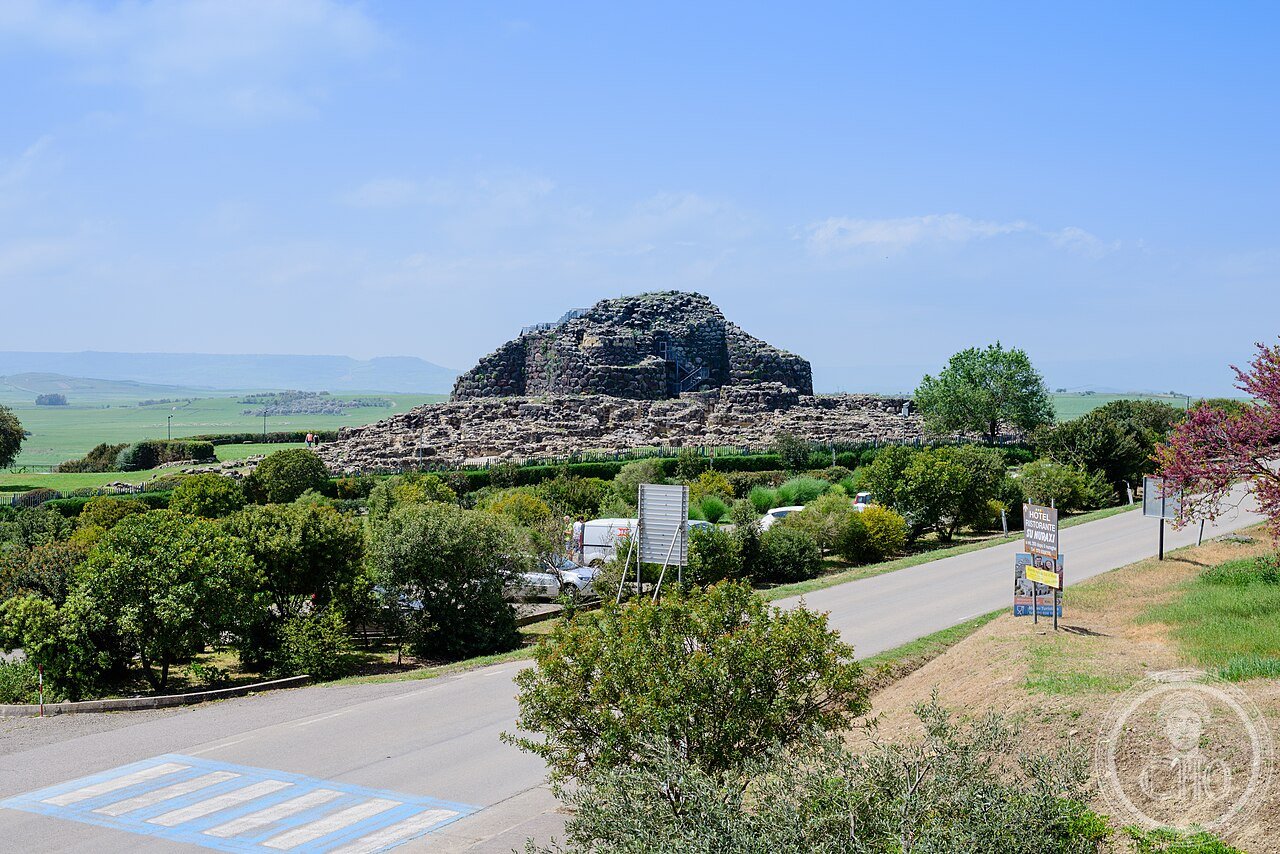
Su Nuraxi di Barumini
Su Nuraxi di Barumini (UNESCO 1997) is the finest surviving example of a nuraghe — the 3,500-year-old megalithic tower-and-village complexes that are unique to Sardinia and exist nowhere else on earth — a Bronze Age building tradition for which no direct parallel exists in any other Mediterranean culture and whose builders’ origin, language, and social organization remain partially unresolved despite 70 years of systematic excavation.
At a glance
Su Nuraxi Barumini (the most precisely SuNuraxiBarumini single Barumini Sardinia Italy 39.7072 N 9.0098 E UNESCO WHS 1997 reference 833: the word “nuraghe” (plural “nuraghi”; also spelled “nuraghe”; Sardinian dialect word of unclear etymology; possibly from the pre-Indo-European root “nur” meaning cavity or hollow; the Academic Dictionary of Sardinian Language (Ditzionàriu de sa Limba e de sa Cultura Sarda) gives this as the most supported etymology) refers to the megalithic conical towers built throughout Sardinia from approximately 1900–1000 BCE; the total count: 7,000–10,000 individual nuraghi across Sardinia (the estimates vary widely because some structures are visible above ground while others are buried; the most reliable cadastral survey (2016 CE; Regional Sardinian Government Archaeological Survey) identified 7,116 nuraghi with confirmed identification); the Su Nuraxi di Barumini site: the main nuraghe (the central tower; the oldest construction; approximately 1500 BCE; 18m tall surviving; approximately 20m original; the tower has 3 chambers arranged vertically: the ground-floor tholos chamber (a corbelled vault of the same type as the Mycenaean Treasury of Atreus; the parallel is significant — the Mycenaean tholos and the Nuragic tholos appear in the same period and both use the corbelling technique (the progressive inward offset of horizontal courses to form a domed space without a keystone) but are entirely independent inventions; the ground chamber diameter is 6.4m; the floor is natural rock; no internal furnishings survive); the upper chamber (accessed by an interior staircase cut through the wall thickness; the stair is 80 cm wide; the upper chamber diameter is 4.8m; the ceiling vault has partially collapsed); the external staircase (a stair cut into the exterior face of the tower that rises to the roof platform); the 4 subsidiary towers (connected to the central tower by a circular curtain wall; 3.5m thick; the 4 subsidiary towers are of the same construction type but smaller diameter than the central tower (approximately 8m diameter); the complex reads, in plan, as a 5-petalled flower)).
Key facts
- Giovanni Lilliu and why his excavation at Barumini changed the entire understanding of Mediterranean Bronze Age: Giovanni Lilliu (1914–2012 CE; from Barumini itself; the archaeologist who excavated Su Nuraxi 1949–1957 CE; professor of Sardinian antiquities at the University of Cagliari 1955–1984 CE; the author of “La civiltà dei Sardi” (1967 CE; the foundational text of Nuragic studies); the specific contribution of the 1949–1957 excavation: before Lilliu, the conventional interpretation of the nuraghi was that they were either fortresses or funerary monuments (analogous to the Mycenaean tholos tombs); Lilliu’s systematic excavation of the 3 rings of huts surrounding the Su Nuraxi di Barumini central tower revealed that the nuraghe was the nucleus of a village with 200+ individual dwelling huts, producing evidence of domestic life (cooking equipment, weaving weights, grain storage jars, bronze arrowheads, and ceramic vessels) that could be datable to the 13th–8th century BCE; the specific diagnostic find: a Phoenician amphora (7th century BCE) found in one of the outer-ring huts, proving that the village was occupied into the Iron Age and in trading contact with the Phoenician maritime network; the second specific finding: the Great Hut (the “Capanna delle Riunioni” — Meeting Hut; the largest circular hut in the village; 12m diameter; with a stone seat running around the interior wall; Lilliu interpreted this as a council chamber — the first evidence of democratic or oligarchic governance structures in pre-urban Sardinian society; the Meeting Hut model (a circular stone-seated assembly space) has been proposed as the forerunner of the later Sardinian “protonuragic” assembly tradition)
- GPS: 39.7072° N, 9.0098° E (Barumini)
History
From 1500 BCE construction to Carthaginian/Roman overlay to Lilliu’s discovery to UNESCO (the most precisely SuNuraxiBarumini single construction phases: Phase 1 (c.1500 BCE; the central nuraghe built; the 3 chambers + exterior stair; this phase represents the Nuragic culture at its earliest organizational stage — a single dominant tower possibly serving as the residence/refuge of a local chieftain); Phase 2 (c.1200–1100 BCE; the 4 subsidiary towers + curtain wall added to create the compound; this is interpreted as a military reinforcement in response to increased external threat — possibly related to the general “Sea Peoples” disruptions of the eastern Mediterranean in the 12th century BCE (the Sea Peoples attacks documented in Egyptian sources at Medinet Habu c.1175 BCE correlate with widespread abandonment of Bronze Age settlements across the Mediterranean; whether the Nuragic fortification is a response to the same disruption or an independent development is debated)); Phase 3 (c.1000–700 BCE; the 3 rings of dwelling huts constructed; the village population at peak: estimated at 500–1,000 individuals (based on hut count and average family size assumptions)); Phase 4 (c.700–500 BCE; Phoenician contact; the Phoenician amphora from the outer ring dates to this phase; the village was part of the Phoenician maritime trade network (the Phoenicians established colonies at Nora, Sulci, and Tharros on the Sardinian coast from the 9th century BCE)); the Carthaginian period (535–238 BCE; the Carthaginian conquest of Sardinia; the nuraghi were not destroyed by the Carthaginians but appear to have been gradually abandoned as the population shifted to the Carthaginian urban centres on the coast; Su Nuraxi shows evidence of a final occupation phase with Carthaginian pottery but no new construction); the Roman period (238 BCE–after 7th century CE; Roman Sardinia (Sardinia et Corsica, established 238 BCE); Su Nuraxi was partly dismantled for building material and covered by accumulation); 1949 CE the Lilliu excavation begins; 1957 CE excavation completed; 1997 CE UNESCO inscription reference 833.
What you see
The towers, the huts, the Meeting Hut, and the site museum (the most precisely SuNuraxiBarumini single visit sequence (mandatory guided tour; individual entry not permitted; tour duration: 45 minutes–1 hour; Italian + English tours available; book online at fondazionebarumini.it; 4–6 tours daily in summer; 2–3 tours daily in winter): 1) the approach from the ticket office across the site perimeter; the first view of the nuraghe from 200m is the most dramatic — the tower reads clearly against the Sardinian plateau (the Marmilla landscape; low, gently rounded limestone hills with sparse macchia scrub; the nuraghe tower projects 18m above the surrounding land level and is visible from 5 km in all directions; this visibility was intentional — the nuraghe functioned as a territorial marker as well as a fortification); 2) the outer hut rings (the guides route the visit through the outer hut foundations before approaching the tower; the purpose is to demonstrate the village scale — the standard visitor assumption is that the nuraghe is only the tower; seeing the 200+ hut foundations first reframes the tower as the civic/military center of a substantial community); 3) the Meeting Hut (the Capanna delle Riunioni; the guide identifies the stone seat (about 50cm high; running the full interior perimeter except for the door opening) and explains the Lilliu interpretation; the hut is the largest and most complete in the outer village; the stone seat is the most concrete surviving evidence of Nuragic community governance); 4) the tower complex (the guide enters the ground-floor chamber first; the corbelled vault interior is the most impressive single architectural experience of the visit; the diameter (6.4m), the vault height (9m), and the complete silence inside the chamber (the 4m thick basalt walls produce near-complete acoustic isolation) are all directly experienced; the stair to the upper chamber is navigable with care (1.5m clearance); the upper chamber view from the window openings across the Marmilla is the defining Sardinian cultural landscape experience); the site museum (the Villaggio Nuragico Barumini visitor centre; 10 min walk from the tower; the finds from the Lilliu excavation (the Phoenician amphora; the bronze arrowheads; the ceramic vessels; the weaving weights); the architectural models showing the 4 construction phases).
Practical information
- Getting to Barumini by rental car from Cagliari and combining with the Museo Nazionale Cagliari: transport: rental car essential (Barumini is 55 km from Cagliari on the SS131 + SP4; the drive is 1h from Cagliari); no reliable public bus connection (the ARST Sardinia bus network serves Barumini but with 2 buses per day and a 2+ hour journey time including changes; impractical for a day trip); tour operators: several Cagliari-based tour operators offer full-day Barumini + Marmilla landscape tours (price: €40–60 per person); the booking (fondazionebarumini.it); hours: 9 AM–8 PM (summer); 9 AM–5 PM (winter); admission: €10 adults; €7 reduced; €5 children; the combination visit (1 day from Cagliari): morning Su Nuraxi (arrive for the 9:30 AM English tour; this is the most uncrowded tour of the day; the 11 AM tour is crowded in summer); afternoon return via the Marmilla villages (Tuili (the extraordinary 16th-century altarpiece by Maestro di Castelsardo in the village church of Sant’Andrea; the triptych (1500 CE) is the most important Sardinian late-Gothic painting outside the Cagliari museum) and Sanluri (the Castello di Sanluri (1370 CE; the only continuously inhabited medieval castle in Sardinia; the Visconti-Aymerich collection of Sardinian military history))); evening Cagliari (the Museo Nazionale Archeologico (the Nuragic bronze figurines (bronzetti) — the most culturally significant collection; the warrior figurines with articulated helmets (12th–7th century BCE) are the highest-quality Nuragic objects surviving anywhere; the museum also holds the Phoenician and Roman collections from the Sardinian coast excavations))
Getting there
Car from Cagliari (55 km, 1h via SS131+SP4). No practical public transport. Open daily 9-20 (summer) / 9-17 (winter). Admission €10. Guided tour mandatory (book: fondazionebarumini.it). GPS: 39.7072, 9.0098.
Nearby
- Museo Nazionale Cagliari — 55 km south (the bronzetti Nuragic figurines; the best Nuragic collection in the world; the Phoenician and Roman Sardinia rooms; free on first Sunday of the month)
- Sant’Andrea, Tuili — 5 km (the Maestro di Castelsardo triptych altarpiece (1500 CE); the finest late-Gothic painting in Sardinia; village church open daily 9–12; key from sacristy)
Gallery
Sources
- Wikipedia, Su Nuraxi di Barumini; Nuraghe; Giovanni Lilliu, accessed June 2026
- UNESCO, Su Nuraxi di Barumini, WHS reference 833, inscribed 1997
- Lilliu, Giovanni. La civiltà dei Sardi dal Neolitico all’Età dei Nuraghi. Turin: ERI, 1967
Find it on the map
See this place and what’s around it →📷 Diventa un fotografo di Cultural Heritage Online
Condividi le tue foto dei luoghi: restano pubblicate con la tua firma come autore. Più vengono viste, più ti fai conoscere — e presto un concorso premierà le foto più apprezzate.
Accedi o registrati gratis per aggiungere una foto