
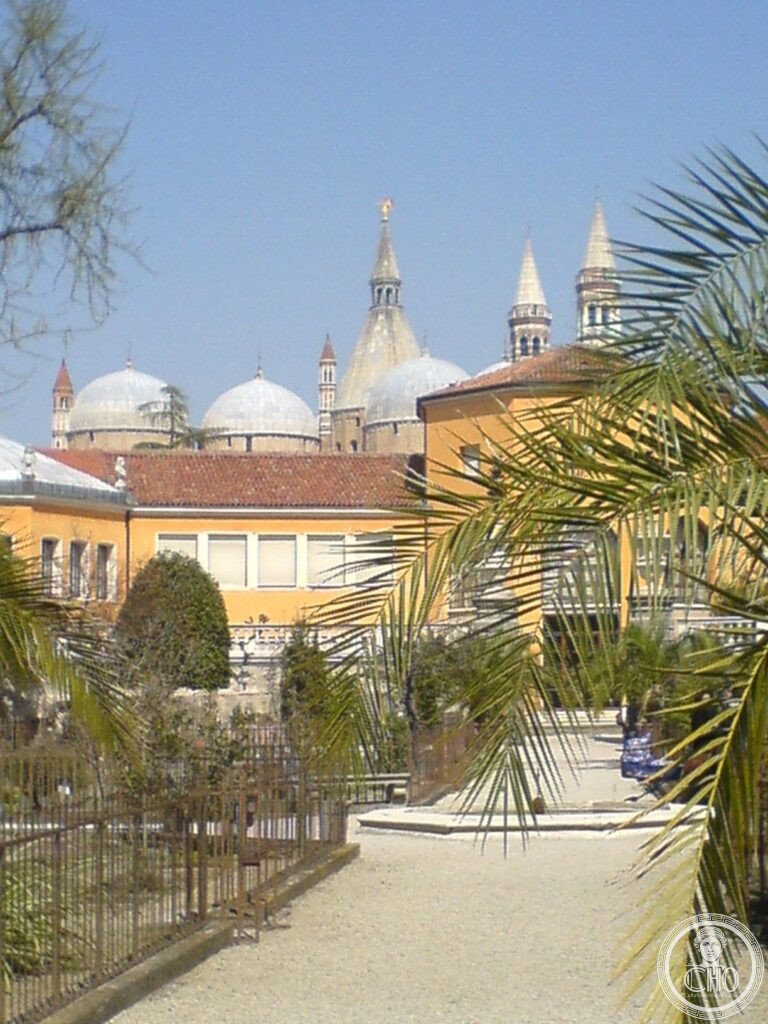
Orto Botanico di Padova
The Orto Botanico di Padova (UNESCO 1997) is the oldest university botanical garden in the world still in its original location — a 1545 CE circular garden created by the Republic of Venice as a teaching laboratory for medicinal plants, which introduced over 100 species to European cultivation (including the potato, the sunflower, and the jasmine), gave Goethe the empirical basis for his theory of metamorphosis, and whose 1585 CE palm tree is the oldest potted plant on earth.
At a glance
Orto Botanico Padova (the most precisely OrtoBotanicoPadova single Padova Veneto Italy 45.3993 N 11.8802 E UNESCO WHS 1997 reference 824: the founding context: the University of Padua (founded 1222 CE; the second oldest university in the world after Bologna; the leading European university for medicine and science in the 14th–17th century; Galileo taught mathematics here 1592–1610 CE; Vesalius (the founder of modern anatomy) was professor here 1537–1544 CE; William Harvey (who discovered blood circulation) received his medical degree from Padua in 1602 CE); the Orto Botanico was created by a decree of the Venetian Senate on 29 June 1545 CE — the founding decree specified that the garden was for “the reading of simples” (the reading of medicinal plants — the “simples” are the unmixed medicinal herbs of the tradition going back to Dioscorides’ De Materia Medica (77 CE)); the specific problem the garden solved: in the 16th century, the identification of medicinal plants was unreliable (merchants, apothecaries, and physicians used different names for the same plant and the same name for different plants; students learned from dried specimens (herbaria) that were often misidentified or deteriorated beyond recognition); the living garden of standardized, labeled specimens solved the identification problem; the garden was the model for every subsequent European botanical garden (the Orto Botanico of Florence (1545 CE), Pisa (1544 CE — one year earlier but in a different location), Bologna (1568 CE), Leiden (1590 CE), Oxford (1621 CE), Paris (Jardin du Roi, 1635 CE)); the circular design: the hortus conclusus form was chosen for symbolic reasons (the circle = perfection; the enclosed garden = the microcosm of the world’s plant life within one ordered space) and practical ones (the circular shape maximizes the enclosed area per unit of perimeter wall; the perimeter wall was essential to prevent the theft of valuable medicinal plants).
Key facts
- Goethe’s palm and the Metamorphosis of Plants: the Chamaerops humilis palm (dwarf Mediterranean fan palm) planted in 1585 CE in the Orto Botanico di Padova is the oldest potted plant in the world; the palm is now in the Goethe Greenhouse (a glass house built in 1985 CE specifically for the palm, which can no longer be kept outdoors in Padua’s winter climate); the connection to Goethe: Johann Wolfgang von Goethe visited the Orto Botanico on 27 September 1786 CE (the visit is recorded in his Italian Journey — the book recording his 1786–1788 Italian tour); Goethe was at the time developing his theory of plant morphology; in the Orto Botanico he observed the leaves of the Chamaerops humilis progressing from simple (the lowest leaves are simple, undivided fans) to complex (the upper leaves are increasingly pinnate/divided) from base to crown — the sequence he identified as the visual evidence for what he would call the “Urpflanze” (the primal plant) and the theory of metamorphosis (Versuch die Metamorphose der Pflanzen zu erklären, 1790 CE); the theory stated that all plant organs (leaf, sepal, petal, stamen) are transformations of a single primal organ form (the leaf); this was a proto-evolutionary insight — not natural selection but morphological transformation — that Goethe developed into a general philosophy of natural forms; Darwin cited Goethe in the Origin of Species (the Goethe palm entry in the Italian Journey is one of the most consequential single nature observations in the history of science)
- GPS: 45.3993° N, 11.8802° E
History
From the 1545 CE founding to Galileo to Goethe to UNESCO (the most precisely OrtoBotanicoPadova single 1545 CE decree: the founding decree (29 June 1545 CE; Venetian Senate; the first director: Francesco Bonafede (1474–1558 CE; Professor of Simples at the University of Padua; the first university position for botany in the world; the professorship was established simultaneously with the garden — the institution and the curriculum were created together)); the first notable introduction: Atropa belladonna (deadly nightshade; introduced to European cultivation by the Padua garden in 1545 CE; used medicinally as an analgesic and mydriatic (pupil-dilating) agent; the specific use in Renaissance Venice: ladies used the eye drops to dilate their pupils as a cosmetic enhancement — the name “belladonna” (beautiful woman) refers to this use); the potato (Solanum tuberosum; first cultivated in the Orto Botanico in 1590 CE from tubers brought from Peru via Spain; the Padua specimen was the first European potato plant grown from the South American variety (earlier Spanish specimens had been grown in the 1570s but the Padua specimen was the first to be cultivated and documented as a food plant rather than merely a curiosity)); the sunflower (Helianthus annuus; first European cultivation at Padua 1568 CE; the sunflower had been grown in Spanish gardens from the 1560s but the Padua specimen was the first to be systematically described and illustrated (Prospero Alpini, 1580 CE)); the jasmine (Jasminum officinale; the Arabian jasmine was introduced to European cultivation via the Padua garden from a specimen brought from South Asia by the Portuguese trade network in the 1560s); Galileo (1592–1610 CE professor at Padua; the garden was adjacent to the Physics Laboratory and Galileo used the garden to observe plant growth patterns — a known but not well-documented influence on his interest in quantitative measurement of natural phenomena); 1997 CE UNESCO inscription reference 824.
What you see
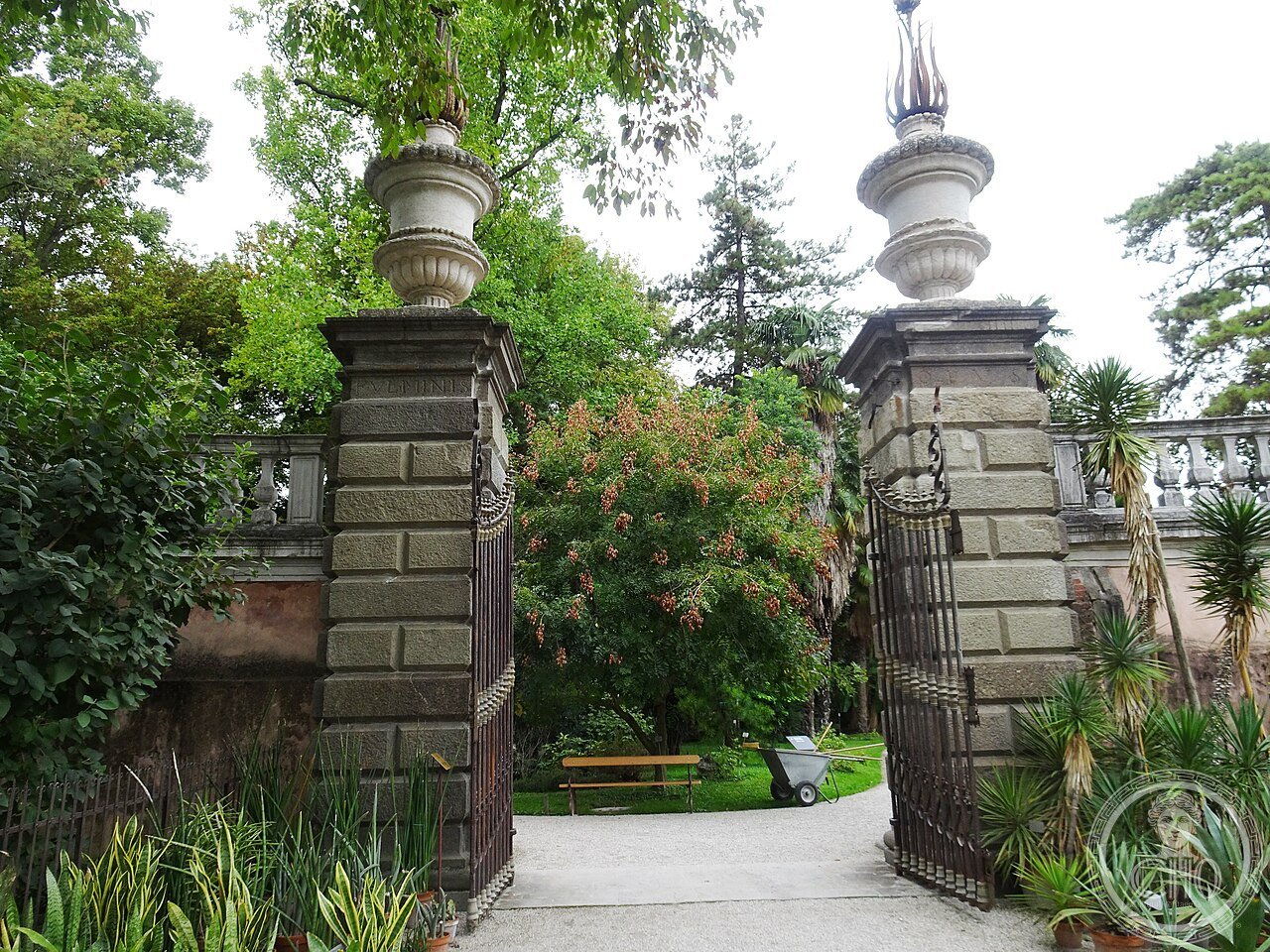
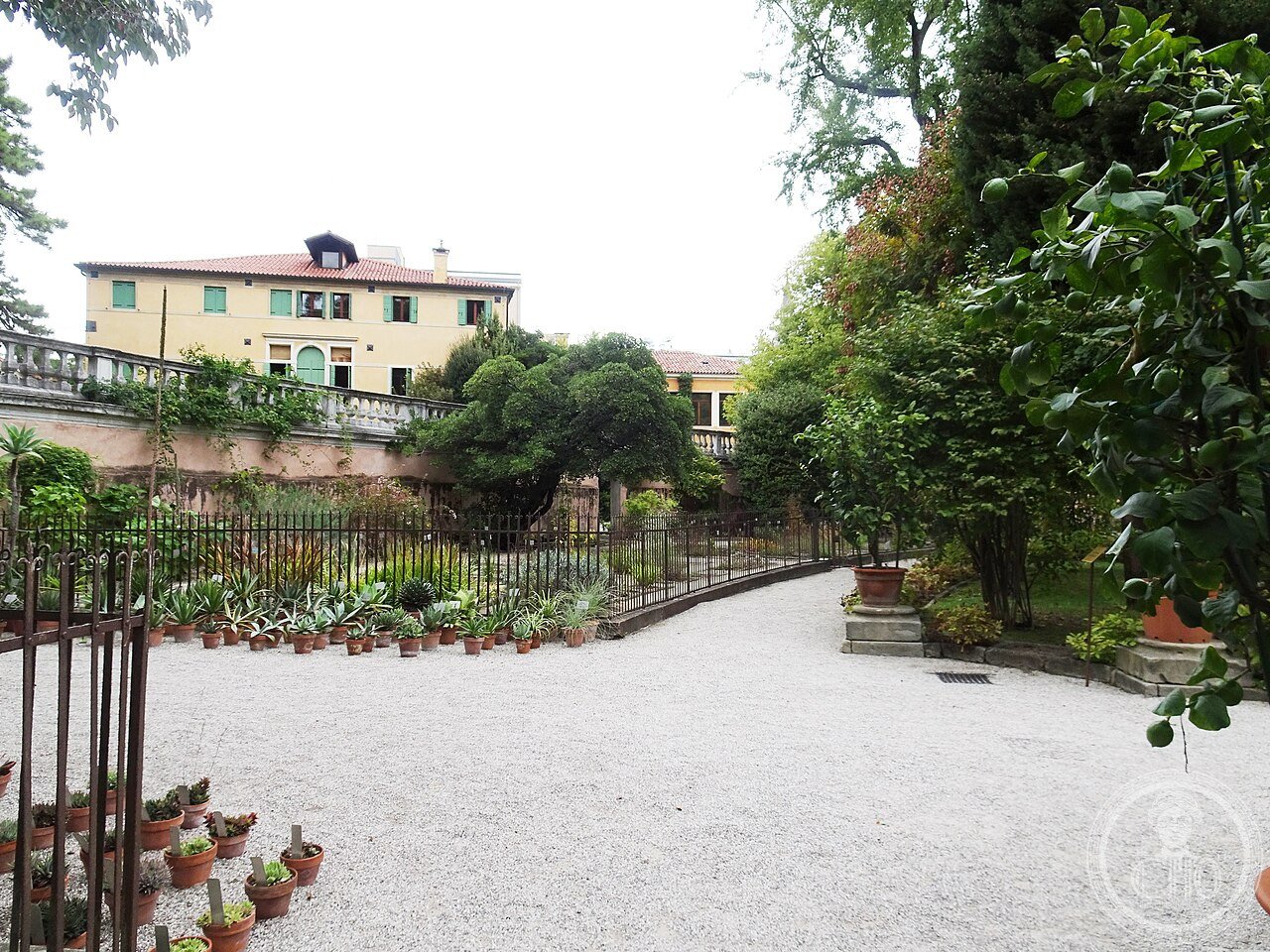
The circular hortus conclusus, the greenhouses, and Goethe’s palm (the most precisely OrtoBotanicoPadova single visit (2 hours): 1) the entrance (Via Orto Botanico 15; the entrance is through the 1591 CE north portal — the only original Renaissance garden gate in situ in the world; the gate has a rusticated arch with an iron grate (the original 1591 CE grate is partly preserved; the lock mechanism dates to 1602 CE)); 2) the central circle (the circular hortus conclusus divided into 4 quadrants; each quadrant is further divided into a geometric grid of beds; the beds are labeled with both the scientific and historical names; the labeling system dates to the 18th century CE (Linnaean nomenclature was introduced to the garden in 1737 CE by Giovanni Antonio Scopoli)); 3) the Goethe Greenhouse (northeast corner of the garden; the 1585 CE Chamaerops humilis; the palm is now 4m tall and occupies the entire greenhouse (the greenhouse was expanded twice to accommodate the growing palm); the palm is documented with a photographic series from 1857 CE (daguerreotype) to the present — the most complete photographic record of any single plant); 4) the Aquatic Garden (the north garden extension added in 1704 CE; the most unusual element: the Victoria amazonica (giant water lily; the Orto Botanico di Padova was one of the first European gardens to flower the Victoria amazonica (1854 CE); the flowers open white on the first night and pink on the second night — the two-day color change is now understood as a pollination strategy to differentiate pollen-donor flowers from pollen-receiver flowers)); 5) the Biodiversity Garden (the 20th-century extension; the collection of Venetian native species and Alpine plants introduced since 1935 CE).
Practical information
- Padova by train from Venice, Verona, or Bologna and combining with the Cappella degli Scrovegni: transport: Padova is on the Venice–Milan high-speed line (train from Venice Santa Lucia to Padova: 25 min; €6 regionale; every 10–15 min; the station (Padova Centrale) is 15 min walk from the Orto Botanico); from Verona: 50 min (€11); from Bologna: 40 min (€14 Frecciarossa); the 1-day Padova circuit (from Venice): 8:30 departure Venice → Padova arrive 9:00; Cappella degli Scrovegni (9:00 AM slot: mandatory pre-booking; the Giotto fresco cycle (1304–1306 CE; 39 fresco panels depicting the Life of the Virgin and the Life of Christ; the most important single fresco cycle in the Italian Renaissance — the direct precursor of all subsequent Italian fresco painting; the specific innovations: the first naturalistic human faces in Western art since antiquity; the first spatial recession (perspectival depth) in a flat surface in Western art; the first storm cloud in Western art; the first dog in Western art; book at cappelladegliscrovegni.it; max 25 persons per 15-minute slot; €15); walk to the Orto Botanico (20 min); Orto Botanico visit (9:00–19:00 in summer; €10 adults; the Goethe Greenhouse visit is included); lunch at a local bar near the Piazza delle Erbe; afternoon: Basilica di Sant’Antonio (the second most visited Catholic pilgrimage site in the world after Lourdes; the Donatello Gattamelata equestrian statue (1453 CE) in the piazza — the first freestanding bronze equestrian statue of the Italian Renaissance; the interior: the Donatello high altar reliefs (1443–1450 CE))
Getting there
Train from Venice Santa Lucia (25 min, €6; every 10-15 min), then 15 min walk from Padova Centrale. Open daily 9-19 (summer). Admission €10 (includes Goethe Greenhouse). GPS: 45.3993, 11.8802.
Nearby
- Cappella degli Scrovegni — 20 min walk (Giotto fresco cycle 1304–1306 CE; mandatory pre-booking cappelladegliscrovegni.it €15; 25 persons per 15-min slot; the most important early-Renaissance fresco cycle in Italy)
- Venezia — 25 min by train (UNESCO WHS 1987; from Padova Centrale every 15 min; the Piazza San Marco, the Basilica, the Doge’s Palace, the Accademia, the Peggy Guggenheim)
Gallery
Sources
- Wikipedia, Botanical Garden of Padua; Goethe’s Palm; University of Padua, accessed June 2026
- UNESCO, Botanical Garden (Orto Botanico), Padua, WHS reference 824, inscribed 1997
- Goethe, J.W. Italian Journey (Italienische Reise), 1816–1817; September 1786 entry, Padua
Find it on the map
See this place and what’s around it →📷 Diventa un fotografo di Cultural Heritage Online
Condividi le tue foto dei luoghi: restano pubblicate con la tua firma come autore. Più vengono viste, più ti fai conoscere — e presto un concorso premierà le foto più apprezzate.
Accedi o registrati gratis per aggiungere una foto