
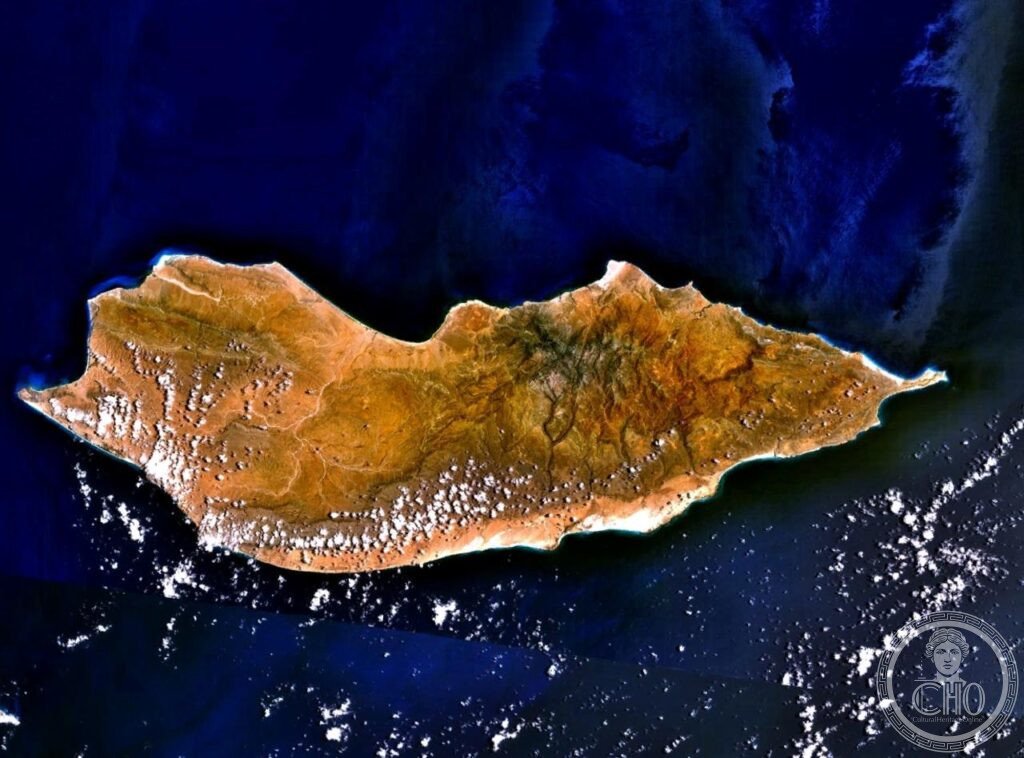
Separated from mainland Arabia for some six to seven million years, Socotra has evolved a flora and fauna found nowhere else on Earth. Its dragon blood trees, spreading like inverted umbrellas across the Dixam plateau, give the island a landscape unlike any other in the Middle East.
At a glance
Socotra is the largest island of the Socotra Archipelago, lying in the Gulf of Aden off the coast of Yemen, of which it forms the Socotra Governorate. Its long isolation from the Arabian Peninsula, dating back to the break-up of Gondwana, allowed plant and animal life to evolve independently, producing one of the highest rates of endemism of any island in the world. Roughly 37% of its vascular plant species and around 90% of its reptile species occur nowhere else.
The island is best known for the Dragon Blood Tree, Dracaena cinnabari, whose flat, umbrella-shaped crown and dark red resin have made it the emblem of Socotra. Other notable endemics include the bottle-trunked Desert Rose, the tree-sized Cucumber Tree, and several species of frankincense tree.
Key facts
- Location: Socotra Governorate, Yemen, in the Gulf of Aden
- Status: UNESCO World Heritage Site, inscribed 2008
- Endemism: around 37% of plant species and roughly 90% of reptile species found only on Socotra
- Signature species: Dragon Blood Tree (Dracaena cinnabari), Desert Rose, Cucumber Tree, Frankincense Tree
- Language: Soqotri, an unwritten South Semitic language related to the Modern South Arabian languages of Oman and Yemen
- Coordinates: 12.4622° N, 54.0088° E
History
Socotra appears in ancient trade records as a source of luxury goods, among them aloe, dragon’s blood resin and frankincense. The Periplus Maris Erythraei, a Greek merchant’s guide to Indian Ocean trade written around the 1st century CE, describes the island as home to Arab, Indian and Greek traders, and Alexander the Great is said to have sent a Greek colony there to grow aloe for his armies.
The Portuguese held a brief foothold on the island in the early 16th century as part of their bid to control Indian Ocean trade routes, after which the Mahra Sultanate of South Arabia took control. Socotra became a British protectorate within the Aden Protectorate in the late 19th century, and joined independent Yemen in 1967.
What you see
Before the Yemeni civil war disrupted travel, a visit to Socotra typically took in the town of Hadibo, with its market and small airport, and the Dixam plateau, reached by four-wheel drive, where dragon blood trees cover a rocky limestone landscape. Arher, on the northern coast, combines white sand dunes, beach and dragon blood trees in a single view and was the island’s most photographed spot. The Detwah Lagoon, on the western tip, draws flamingos, ospreys and sea turtles and offers calm, clear water for snorkelling.
Tourism on Socotra has been severely curtailed since the war began in 2014, even though conditions on the island itself have generally remained more stable than on the Yemeni mainland.
Practical information
- Access: travel to Socotra is difficult and subject to sudden change; check current advisories before planning any visit
- Flights: Socotra Airport, near Hadibo, has historically had intermittent connections to Abu Dhabi and Dubai, with services depending on the security situation
- Safety: Yemen as a whole is widely classified as unsafe for travel; the situation specific to Socotra should be checked separately and continually
- Specialist access: researchers, conservationists and journalists have arranged visits through NGOs and established operators with advance planning
Getting there
The only air link to Socotra runs through its small airport at Hadibo, with occasional flights from Abu Dhabi or Dubai when conditions allow. Given the ongoing civil war in Yemen, anyone considering a visit should consult official travel advisories and check the current flight situation directly with carriers before making arrangements.
Nearby
- Abd al Kuri Island — around 130 km west, the most isolated of the archipelago’s four main islands, thought to be the ‘island of the fish-eaters’ described by ancient Greek geographers, with its own endemic sparrow and reptiles, and almost no tourist access
- Dhofar, Oman — roughly 300 km northeast across the Arabian Sea, where the summer monsoon known as the khareef turns the mountains green and where frankincense trees of the same genus found on Socotra grow; the Land of Frankincense there is inscribed as a UNESCO World Heritage Site
Sources
- Wikipedia, Socotra
- Wikipedia, Dragon blood tree
- Wikipedia, Soqotri language
- UNESCO, Socotra Archipelago, World Heritage List reference 1263
Find it on the map
See this place and what’s around it →📷 Become a Cultural Heritage Online photographer
Share your photos of places: they stay published under your name as the author. The more they're seen, the more you get noticed — and soon a contest will reward the most appreciated photos.
Log in or sign up free to add a photo