
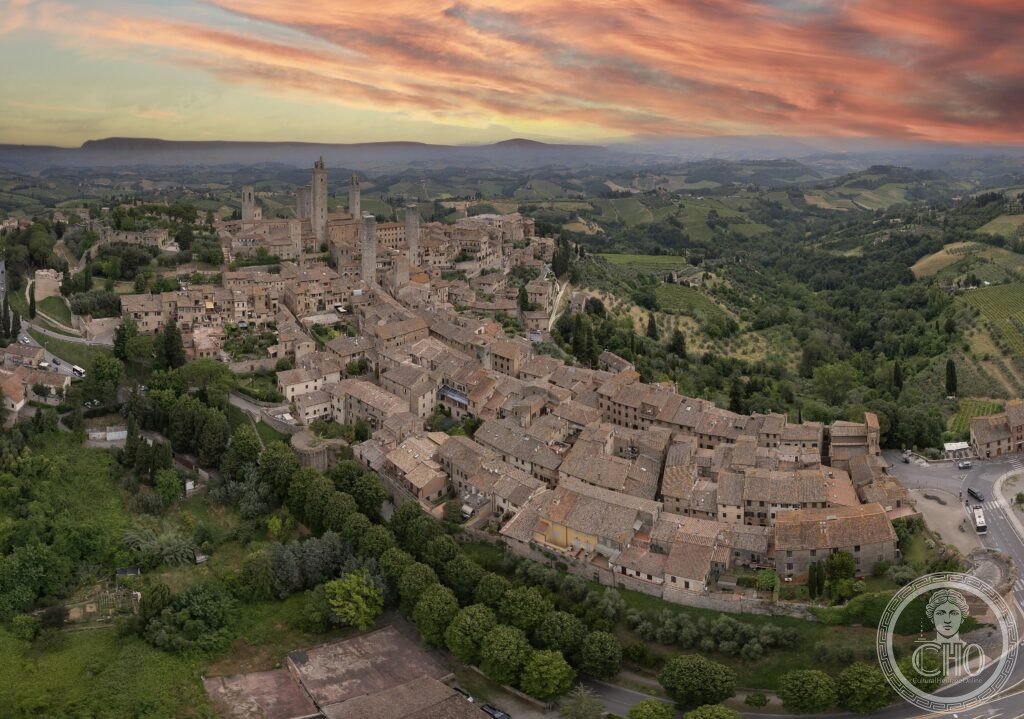
San Gimignano
The best-preserved medieval hilltop walled town in Italy and the most visually distinctive skyline in all of Tuscany — San Gimignano, whose competing noble families built 72 towers as visible declarations of wealth and power in the 12th and 13th centuries, preserves 14 of those towers intact today, producing a medieval “Manhattan” silhouette above the Val d’Elsa that has been unchanged since Dante visited in 1300.
At a glance
San Gimignano (UNESCO WHS 1990; “Historic Centre of San Gimignano”; population of the municipality approximately 7,500; the walled historic centre approximately 2,500 permanent residents; located on a hilltop in the Val d’Elsa, 56 km south of Florence and 38 km north-west of Siena; the town is entirely surrounded by its medieval walls (13th–14th century; 11 original gates, 4 of which are still in use); the historic centre is pedestrian and can be walked in its entirety in 2–3 hours) grew wealthy in the medieval period as a waystation on the Via Francigena (the main pilgrim road from northern Europe to Rome; passing directly through San Gimignano; the town’s income from pilgrims, combined with its role in the banking and saffron trade (saffron — crocus sativus — was grown in the surrounding Val d’Elsa and was one of the most valuable commodities in medieval Europe, used as a dye, a medicine, and a flavouring; San Gimignano’s saffron trade with Genoa, Venice, and the Hanseatic cities was the primary source of the wealth that funded the tower-building competition), produced the tower-house culture that defines the town’s skyline today; each great family built a tower higher than its rivals; the maximum height was eventually regulated by the town government (the Torre Grossa, the civic tower, established the legal maximum at 54 metres; no private tower could exceed the height of the civic tower; the Torre Grossa is the tallest surviving tower and is open to climbers for the best view of the surrounding Val d’Elsa)
Key facts
- The towers: the only surviving medieval tower-house skyline in Italy — the 14 surviving towers (out of approximately 72 built between the 10th and 14th centuries; the majority were demolished after the plague of 1348 reduced the population dramatically and after the town surrendered to Florence in 1353 — the surviving towers represent those that were incorporated into palaces or civic buildings and so escaped demolition) give San Gimignano a skyline profile that appears essentially unchanged since the 14th century (the same view appears in Benozzo Gozzoli’s fresco of 1465 in the Cappella dei Magi in Florence; the towers are individually named and all have been the subject of structural studies; the Torre Grossa (54 m; the civic tower; climbable; 218 steps; the best 360° view of the Val d’Elsa available from any point) is in the Palazzo del Popolo, currently the Pinacoteca Civica)
- The Collegiata: the cathedral of San Gimignano and its cycles of fresco painting — the Collegiata di Santa Maria Assunta (the main church; Romanesque nave with Gothic extensions; the most important monument inside San Gimignano’s walls; three major fresco cycles cover the interior: the Old Testament cycle on the north wall (Bartolo di Fredi, 1367; 26 scenes including a virtuoso Noah cycle with an unusual scene showing the vineyard-planting after the flood); the New Testament cycle on the south wall (Lippo Memmi, 1333; 22 scenes of the Passion cycle); and the Chapel of Santa Fina (the town’s patron saint; Domenico Ghirlandaio, 1475; two panels; the best Renaissance frescoes in San Gimignano; the scene of the Announcement of Fina’s Death (St. Gregory appearing to the dying girl in a vision) is a masterpiece of psychological restraint); the cycle of Luca Signorelli’s Last Judgment (on the lunette above the main entrance; dramatically original in its treatment of the damned))
- Vernaccia di San Gimignano: the first Italian white wine to receive official quality classification — Vernaccia di San Gimignano (the first Italian white wine to receive DOC (Denominazione di Origine Controllata) classification in 1966; the wine was described by Dante (who visited San Gimignano in 1300 as an ambassador of Florence) as “smemora” (unforgettable); described by Pope Martin IV in the 14th century as a wine he “immodestly loved”; a dry, mineral white wine made from the Vernaccia grape variety, which is grown only around San Gimignano; the wine has a characteristic bitter almond finish; the best producers are in the hills immediately around the town; the Museo del Vino (wine museum) and the enotecas around the Piazza della Cisterna are the best places to taste)
- Heritage: UNESCO World Heritage Site, Historic Centre of San Gimignano, inscribed 1990
- GPS: 43.4677° N, 11.0430° E
History
Etruscan settlement on the hilltop; Roman period; the town takes its name from the Bishop of Modena, Sant’Agostino Gimignano, whose relics were believed to have protected the town from Attila the Hun in 450 AD; independent commune from the 10th century; the tower-building period (11th–13th centuries); the plague of 1348 killed approximately half the population and ended the medieval prosperity; San Gimignano voluntarily submitted to Florentine rule in 1353 (preserving its local statutes in exchange for protection from Siena); Dante Alighieri visited as Florentine ambassador in 1300; the town stagnated economically from the 15th century onward (a fact that inadvertently preserved it — no 19th or 20th-century development replaced the medieval fabric); UNESCO WHS 1990; the town now receives approximately 3.5–4 million tourists per year — an extraordinary number for a walled hilltop town of 2,500 residents.
What you see
The town is small enough (approximately 1 sq km inside the walls) that everything is within 10 min walk of everything else: the Porta San Giovanni (the main entrance gate from the south; the first gate through which most visitors enter; the Via San Giovanni leads from here directly to the Piazza della Cisterna (the central square; the herringbone-brick pavement; the 13th-century cistern (well) in the centre; the triangular plan caused by the confluence of two streets; the towers of the Ardinghelli and Salvucci families visible on three sides) and the adjacent Piazza del Duomo (the civic square; the Collegiata; the Palazzo del Popolo with the Torre Grossa; the Palazzo del Podestà); the San Matteo gate leads north to the old pilgrim route (the Via Francigena); the Church of Sant’Agostino (in the north of the walled town; 13th century; the apse frescoes of the Life of Saint Augustine by Benozzo Gozzoli (1465; 17 scenes; one of the finest fresco cycles of the 15th century in Tuscany)).
Practical information
- Getting there and timing: San Gimignano has no railway station; the closest stations are Poggibonsi (9 km; local bus connection in 20–30 min) and Certaldo (12 km; bus connection); from Florence: Busitalia bus from the main Florence bus station (next to the SMN train station; approximately 1h 15 min to San Gimignano, usually requiring a change at Poggibonsi; approximately EUR 6–8; runs hourly 8am–8pm); from Siena: bus to Poggibonsi then connecting bus to San Gimignano (1h 30 min total; approximately EUR 6–8); by car from Florence: the SR2 via Poggibonsi (56 km; 50 min); the town is entirely pedestrian inside the walls — parking is available outside the walls; the town is extremely crowded on summer weekends and in high season (July–August); the best time to visit is a weekday morning in May–June or September–October; arriving before 9am (when the town is almost entirely occupied by sleeping tourists rather than day-trippers) is a completely different experience from the midday crowds
- San Gimignano gelateria: a genuine claim to world-class status — the Gelateria Dondoli in the Piazza della Cisterna (the Gelateria di Piazza; owned by Sergio Dondoli; multiple winner of the World Gelato Championship; the flavours include traditional and experimental variants; the saffron gelato (the town’s historical product in a modern form) is the most famous; the queue is visible at any hour of the day in summer; arrive at opening (9am) to avoid it)
- Accommodation: staying overnight in San Gimignano — the town changes completely after 6pm when the day-trippers depart; the towers are floodlit; the alleys are quiet; the wine bars (the enotecas in the streets between the two piazze) are occupied by overnight guests rather than tourist groups; the setting sun turns the sandstone of the towers golden and the surrounding Val d’Elsa olive-grey; a night in an agriturismo in the surrounding hills, with the tower silhouette visible from the terrace, is one of the finest accommodation experiences in Tuscany
Getting there
Bus from Florence (1h 15 min) or Siena (1h 30 min) via Poggibonsi. No direct trains. Car from Florence (56 km). GPS: 43.4677, 11.0430.
Nearby
- Volterra — 30 km west of San Gimignano (40 min by road); the most dramatically sited Etruscan city in Tuscany — Volterra (a city of approximately 10,000 on a high plateau surrounded by deeply eroded clay ravines (biancane); the Etruscan walls (5th–4th century BC; among the best-preserved Etruscan fortifications in Italy; the Porta all’Arco (one of the great Etruscan city gates; built approximately 3rd century BC; three archaic stone heads on the outer face, the identity of which has never been agreed); the Guarnacci National Etruscan Museum (one of the three most important Etruscan museums in Italy; the collection of approximately 600 funerary urns covers every aspect of Etruscan religious and mythological imagery; the Ombra della Sera (Shadow of the Evening; a long, attenuated bronze votive figure of extraordinary modernity — it resembles a Giacometti, but was made in the 3rd century BC); the alabaster workshops (Volterra has been the primary centre of alabaster carving in Italy since the Etruscan period; the stone is still quarried nearby; the workshops in the historic centre can be visited)
- Certaldo — 12 km north of San Gimignano (20 min by road); the birthplace of Giovanni Boccaccio and a perfectly preserved medieval hilltop town — Certaldo Alto (the upper walled town; accessible by funicular railway from Certaldo Bassa; entirely built of red brick; the Casa del Boccaccio (the house — largely rebuilt — of Giovanni Boccaccio, the author of the Decameron (1353; the collection of 100 novelle told by ten nobles sheltering from the Black Death; the most influential work of Italian prose before Dante’s Commedia in its vernacular Tuscan; the text that launched the tradition of vernacular fiction in Western literature); the church of Santi Jacopo e Filippo (the tomb of Boccaccio))
- Monteriggioni — 25 km south-east of San Gimignano (30 min by road); the most perfectly preserved medieval ring-wall fortification in Tuscany — Monteriggioni (a tiny medieval fortified village; the circular wall (1219; 570 metres in circumference; 14 towers; the shape is extraordinarily regular for a medieval fortification; Dante compared the giants in his Inferno to the towers of Monteriggioni (Inferno XXXI, 40–45); the settlement inside the walls consists of a small piazza, a Romanesque church, a few houses, a wine enoteca, and the administrative offices; the towers can be walked during summer months (April–October) on a walking circuit inside the walls)
Sources
- Wikipedia, San Gimignano; Vernaccia di San Gimignano; Collegiata di Santa Maria Assunta (San Gimignano), accessed June 2026
- UNESCO, Historic Centre of San Gimignano, WHS reference 550, inscribed 1990
- Duccio Balestracci, San Gimignano: A Medieval Tuscan Town, Pacini Editore, 2014
Find it on the map
See this place and what’s around it →📷 Diventa un fotografo di Cultural Heritage Online
Condividi le tue foto dei luoghi: restano pubblicate con la tua firma come autore. Più vengono viste, più ti fai conoscere — e presto un concorso premierà le foto più apprezzate.
Accedi o registrati gratis per aggiungere una foto