
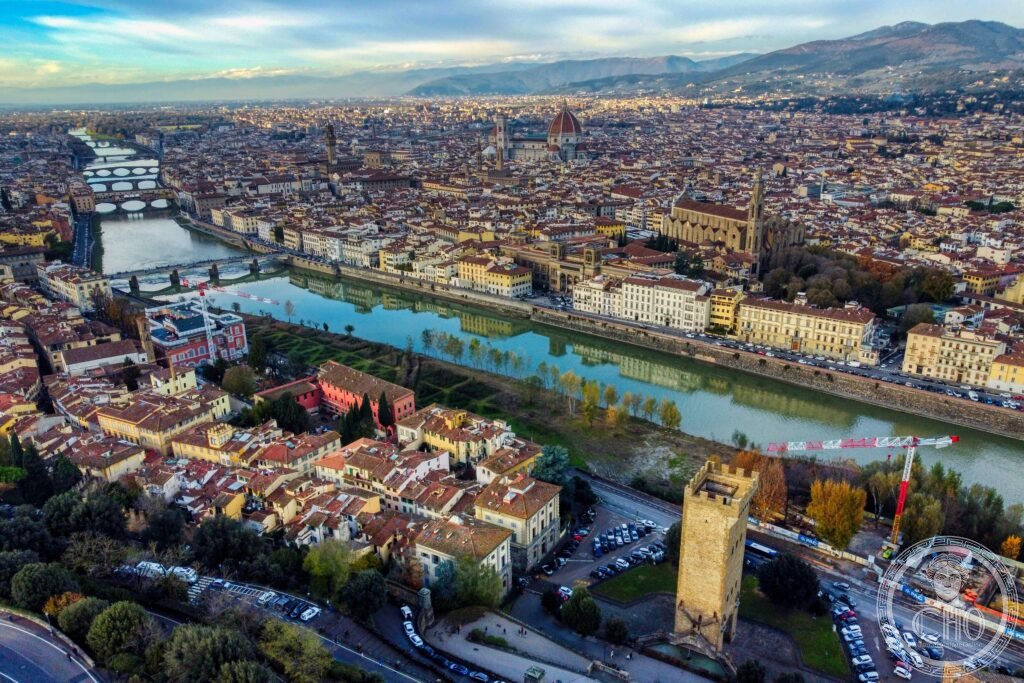
Historic Centre of Florence
The cradle of the Italian Renaissance and the city where the visual and intellectual culture of the modern world was invented — Florence, capital of the Medici banking dynasty whose wealth paid for Botticelli, da Vinci, Michelangelo, and Raphael, remains the single densest concentration of Renaissance art, architecture, and sculpture in the world, in a historic centre whose medieval and Renaissance fabric is still essentially intact after 800 years.
At a glance
The Historic Centre of Florence (UNESCO WHS 1982; the historic urban fabric enclosed within the Viali di Circonvallazione (the 19th-century ring boulevards built on the line of the demolished medieval walls); approximately 5 sq km; the most important concentration of Italian Renaissance art and architecture in the world) was the capital of the Florentine Republic (1115–1532) and then of the Medici Duchy of Florence (1532–1737); the Medici family (merchants and bankers from the Mugello who became the dominant political and financial power in Florence from approximately 1400 onwards under Cosimo de’ Medici, “Pater Patriae”; continued under his grandson Lorenzo de’ Medici, “il Magnifico”, 1449–1492, the greatest patron of arts in European history) commissioned or directly sponsored the majority of the canonical works of the Early and High Renaissance; the Medici bank (at its peak in the 1460s–1480s, the wealthiest financial institution in Europe, with branches in Rome, Venice, Milan, Naples, Geneva, Lyon, Bruges, and London) provided the financial resources that paid for the transformation of Florence into the most artistically important city in Christendom; approximately 15 million tourists visit Florence per year, making it the most visited city in Italy per square kilometre of historic centre.
Key facts
- Brunelleschi’s dome: the most important single work of architecture in the Italian Renaissance and a technical achievement still not fully explained — the Dome of Santa Maria del Fiore (Filippo Brunelleschi, construction 1420–1436; the problem that Brunelleschi solved was one of the most daunting in the history of architecture: the nave of the cathedral had been built with an octagonal crossing of 45 metres in diameter, deliberately designed to require a dome of unprecedented scale — but no one knew how to build it; the competition held in 1418 received proposals from all over Europe; Brunelleschi won with a radical proposal to build the dome in two shells (the inner load-bearing shell and the outer visible shell), using a herringbone pattern of brickwork and a system of self-supporting rings that allowed the dome to be built without the timber centering (the scaffolding structure from which conventional masonry domes were cast) that would have been impossible to build at this scale; the dome took 16 years to build; the exact structural mechanism by which it stays up has never been fully reproduced by computer modelling; it is the largest masonry dome in the world (larger than the Pantheon (Rome) or St. Peter’s (Rome), both of which post-date it); the lantern (1436–1461; the white marble summit structure; the final top of the dome is 116 m above the cathedral floor) was completed after Brunelleschi’s death by Michelozzo; the cupola can be climbed (463 steps; between the inner and outer shells of the dome; the view from the base of the lantern is the finest panoramic view in Florence)
- The Baptistry of San Giovanni and Ghiberti’s Gates of Paradise: the most important sculptural commission of the 15th century — the Florence Baptistry (an octagonal Romanesque building of approximately 1059–1128; the oldest building in the historic centre; the mosaics on the ceiling (13th century; the Christ in Majesty and the Last Judgment; the largest mosaic programme in a Florentine building) are the most important medieval mosaic ensemble in Tuscany; the three pairs of bronze doors are the most important commission in Florentine sculpture history: the South Doors (Andrea Pisano, 1336; the first of the three; representing the Life of John the Baptist in 28 panels), the North Doors (Lorenzo Ghiberti, 1403–1424; Ghiberti won the competition aged 23 over Filippo Brunelleschi and Donatello), and the East Doors (Lorenzo Ghiberti, 1425–1452; 10 large panels representing scenes from the Old Testament; each panel contains multiple narrative scenes in single composition using the new technique of perspective relief (rilievo schiacciato); Michelangelo called them “the Gates of Paradise” — a name that has stuck; the originals (the copies visible on the Baptistry are replicas installed 1990–1996) are in the Museo dell’Opera del Duomo)
- The Uffizi Gallery: the most important collection of Italian Renaissance painting in the world — the Galleria degli Uffizi (the Giorgio Vasari U-shaped building (1560–1580; originally the administrative offices — uffizi — of the Medici government; adapted as a gallery by Francesco I de’ Medici in the 1580s; one of the first public museums in the world; the collections were bequeathed to the city of Florence by Anna Maria Luisa de’ Medici in 1743 with the stipulation that they must never leave Florence — one of the most important acts of cultural philanthropy in history); the permanent collection includes: Cimabue’s Maestà (1280; the beginning of the naturalistic tradition in Italian painting), Giotto’s Maestà (c. 1310; a quantum leap forward in spatial naturalism), Botticelli’s Primavera (c. 1478; the most complex allegorical painting of the Renaissance; probably painted for Lorenzo di Pierfrancesco de’ Medici) and La nascita di Venere (c. 1484; The Birth of Venus; the first large-scale nude female figure in Italian painting since antiquity), Leonardo da Vinci’s Annunciation (c. 1476; possibly his earliest surviving painting) and Adoration of the Magi (1481; unfinished; one of the most studied works in the history of art), Michelangelo’s Doni Tondo (c. 1507; his only surviving panel painting), Raphael’s portraits, and Caravaggio’s Medusa (c. 1597))
- Heritage: UNESCO World Heritage Site, Historic Centre of Florence, inscribed 1982
- GPS: 43.7731° N, 11.2560° E
History
Roman Florentia founded as a military colony 59 BC; medieval commune from the 11th century; the Florentine Republic (1115–1532) — one of the earliest and most successful experiments in urban self-governance in medieval Europe; the Medici family rose to commercial and then political dominance from the 1420s; the Early Renaissance (c. 1400–1490: Brunelleschi (architecture), Donatello (sculpture), Masaccio (painting) — the three founders of Renaissance art, all active in Florence simultaneously in the 1420s–1430s); the High Renaissance (Leonardo da Vinci, 1452–1519; Michelangelo, 1475–1564; Raphael worked in Florence c. 1504–1508 before moving to Rome); the Pazzi Conspiracy (1478; an assassination attempt on Lorenzo de’ Medici; his brother Giuliano was killed in the Cathedral; Lorenzo survived wounded; the political shock transformed the Medici from first-among-equals to effective lords of Florence); the execution of Girolamo Savonarola in the Piazza della Signoria (1498; the Dominican friar who expelled the Medici and ran a theocratic republic for 4 years, burning art, books, and luxuries in the “bonfires of the vanities”; his execution in the same square where the bonfires were held is one of the great reversals in Renaissance political history); the Duchy of Florence (1532) and Grand Duchy of Tuscany (1569); capital of unified Italy (1865–1871); UNESCO WHS 1982; the 1966 Arno flood (4 November 1966; the worst flood in the city’s history; 14,000 artworks damaged; the international rescue operation (the “mud angels”) was the first major international emergency conservation effort in history).
What you see
The walk from the Duomo to the Ponte Vecchio (the main axis of Florentine tourism; 15 min on foot; covers: the Cathedral, Baptistry, and Campanile (Bell Tower; Giotto designed the base; Andrea Pisano and Francesco Talenti built the rest; accessible to the public; 414 steps; the most accessible elevated viewpoint in Florence after the dome) → the Piazza della Signoria (the main civic square; the Palazzo Vecchio (1299–1314; the seat of Florentine government; still the Florence city hall; the decorated rooms open as a museum; the Salone dei Cinquecento (1494; the largest civic room in Italy; 54 × 23 metres; painted for Cosimo I de’ Medici by Vasari) → the Uffizi (allow 3h minimum; pre-book months in advance for summer) → the Ponte Vecchio (the medieval bridge; rebuilt in its current form 1345; the only surviving medieval bridge across the Arno; the Vasari Corridor (a private elevated walkway built for Cosimo I de’ Medici in 1565 to allow the Duke to walk from the Palazzo Vecchio to the Palazzo Pitti without descending to street level; closed for renovation 2016–2023; check current status); the jewellers’ shops on the bridge (the butchers who previously occupied the bridge were expelled in 1593 by order of the Grand Duke who objected to the smell — replaced by goldsmiths whose shops are still there today)).
Practical information
- Museum booking: advance booking is essential for all major museums in summer — the Uffizi (book at uffizi.it; peak season timed entry; approximately EUR 20; popular windows sell out months in advance; the Uffizi is open Tuesdays–Sundays; in July–August, arrive at your booked time precisely; the audio guide (EUR 6) is recommended for first-time visitors); the Galleria dell’Accademia (book at galleriaaccademia.it; approximately EUR 16; the David requires a timed-entry booking; the museum is smaller than the Uffizi — the David, Michelangelo’s unfinished Prisoners, and a small collection of Byzantine and Renaissance paintings); the dome climb (book at ilgrandemuseodelduomo.it; approximately EUR 30; timed entry; 463 steps; the most physical experience in Florence; the view from between the dome shells looking up at Vasari’s Last Judgment fresco and out through the drum windows toward the city is unique)
- Getting there: Florence Santa Maria Novella railway station (the arrival point for most visitors; the station building itself is a masterpiece of Italian Rationalist architecture (Michelucci, 1932–1935; a low, horizontal building in local pietra serena stone that deliberately defers to the adjacent Basilica of Santa Maria Novella; regarded as the best train station in Italy); high-speed Frecciarossa from Rome (1h 30 min; approximately EUR 30–80; runs every 30 min); from Milan (1h 45 min; EUR 30–80); from Venice (2h; EUR 30–60); from Paris by Thello night train (discontinued 2021) or by TGV + Italian high-speed (9h+); the historic centre is approximately 10 min walk from the station, through the Piazza Santa Maria Novella (the Renaissance church and its stunning inlaid marble façade, 1456–1470) to the Duomo
- Florence in depth: beyond the tourist centres — the Oltrarno (the “other side of the Arno”; the south bank; less visited than the north bank; the Palazzo Pitti (the largest palace in Florence; the Boboli Gardens (behind the Pitti; the most important Italian Renaissance garden in Italy; terraced hillside with fountains, grottoes, and sculptures from the 16th century); the Brancacci Chapel (in the Carmine church; the frescos (1425–1427) by Masaccio (the Expulsion of Adam and Eve from Paradise; the Tribute Money) that taught Michelangelo, Raphael, Leonardo, and every subsequent Renaissance painter how to represent the human body under the influence of emotion and gravity — the single most influential small room in the history of Western art); the Piazzale Michelangelo (a 19th-century terrace on the south bank; the classic sunset panoramic view of Florence with the Duomo and Campanile; open 24h; free; crowded; worth it)
Getting there
Frecciarossa from Rome (1h 30 min), Milan (1h 45 min), Venice (2h). Florence SMN station 10 min walk to the Duomo. GPS: 43.7731, 11.2560.
Nearby
- San Miniato al Monte — 1 km south of the Ponte Vecchio (15 min walk from the Piazzale Michelangelo); the most beautiful Romanesque church in Tuscany and the oldest building in Florence after the Baptistry — San Miniato al Monte (founded c. 1000 on the site of an early Christian martyrium on the hill south of the city; the façade of white Carrara and green Prato marble in geometric panels — the inlaid marble pattern that influenced the design of every major Florentine church including Santa Croce and Santa Maria Novella — is the finest Romanesque marble façade in Italy; the interior (11th–13th century; the crypt with its 33 finely carved columns; the marble intarsia pavement in the nave with zodiac signs and symbolic animals; the Chapel of the Cardinal of Portugal (1461–1466; a fully integrated Renaissance interior designed by Antonio Rossellino with one of the most beautiful ceilings in Florence — the 5 glazed terracotta ceiling roundels by Luca della Robbia); open daily; free; best visited in the late afternoon when the light comes through the upper windows)
- Fiesole — 8 km north-east of Florence (20 min by bus 7 from the San Marco bus stop in Florence; the oldest continuously inhabited settlement in the Florence area — Fiesole (Etruscan Faesulae; 3rd century BC; the most important Etruscan settlement in the upper Arno valley; the Roman theatre (1st century BC; still used for summer performances of classical theatre and concerts in the Teatro Romano; the view from the theatre terrace across the cypress-dotted hills toward Florence is one of the finest in Tuscany); the Fiesole Archaeological Museum; the town centre (Piazza Mino da Fiesole; the Cathedral; quiet, local, dramatically cooler than Florence in summer); the walk down from Fiesole to Florence via Borgunto and Costa San Giorgio (2h; through medieval farmhouses and olive groves) is the most beautiful walk near Florence)
- Siena — 75 km south of Florence (1h 30 min by bus or 1h by car; no direct high-speed train); the most complete medieval city in Italy and the primary rival of Florence in the history of Italian art — Siena (the Campo (Piazza del Campo; the finest medieval civic square in Italy; shell-shaped; divided into 9 sectors by white marble ribs (representing the Council of Nine, the medieval government); the Palazzo Pubblico (c. 1297–1342; the most important Gothic civic building in Italy; the Sala dei Nove (Hall of the Nine; the Allegory of Good and Bad Government (Ambrogio Lorenzetti, 1338–1339; the most important secular fresco cycle of the 14th century; a detailed depiction of the effects of wise government (a prosperous, bustling city) and tyrannic government (desolation and ruins); the most politically meaningful painting in medieval Italy)); the Palio (the bareback horse race run twice a year in the Campo (2 July and 16 August) by the 17 contrade (city wards) of Siena; the most dramatic and most violent civic festival in Europe; the race lasts approximately 90 seconds; the preparation, negotiations, and political manoeuvring last the entire year; the winning contrada celebrates for months))
Sources
- Wikipedia, Florence; Florence Cathedral; Uffizi Gallery, accessed June 2026
- UNESCO, Historic Centre of Florence, WHS reference 174, inscribed 1982
- Gene Brucker, Florence: The Golden Age 1138–1737, University of California Press, 1998
Find it on the map
See this place and what’s around it →📷 Diventa un fotografo di Cultural Heritage Online
Condividi le tue foto dei luoghi: restano pubblicate con la tua firma come autore. Più vengono viste, più ti fai conoscere — e presto un concorso premierà le foto più apprezzate.
Accedi o registrati gratis per aggiungere una foto