San Gimignano: Centro Storico

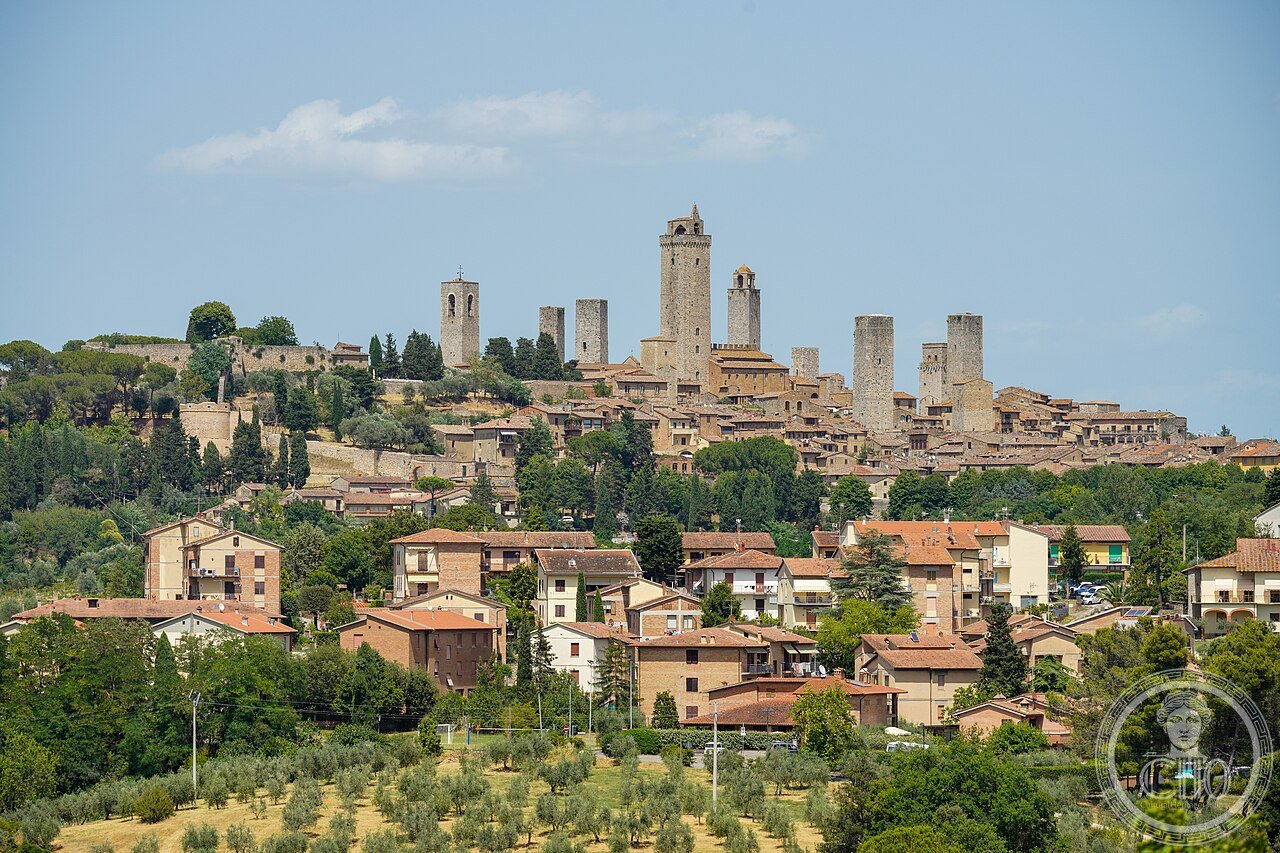
San Gimignano 14 torri medievali Vernaccia DOCG zafferano DOP Via Francigena Toscana UNESCO 1990
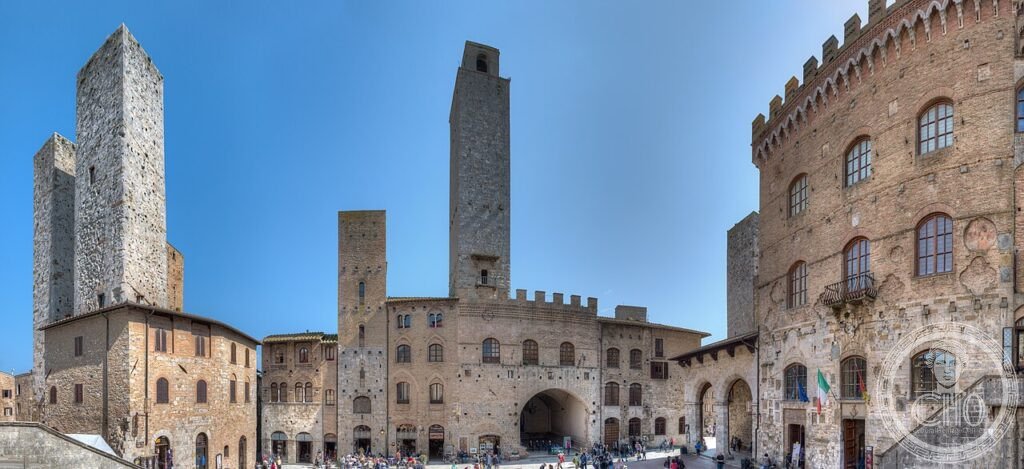
San Gimignano, Piazza della Cisterna, Siena Province, Toscana, Italia. Le 14 torri gentilizie medievali di San Gimignano skyline: da sinistra la Torre del Diavolo (51 m; la più alta; il nome dalla leggenda del proprietario Ardinghelli che la trovò più alta al suo ritorno da un viaggio — “il diavolo l’aveva costruita di notte”); al centro le torri della famiglia Salvucci (2 torri gemelle; il segno di potere delle grandi famiglie era costruire la torre il più alta possibile; un ordinamento del 1255 CE limitò le torri a 50 braccia (35 m); le torri più alte furono abbassate — o così dicono le cronache); la Piazza della Cisterna (la piazza dei pozzi: la cisterna ottagonale al centro, 1237 CE; il punto di raccolta dell’acqua per tutto il borgo e per i pellegrini della Via Francigena). UNESCO World Heritage Site 1990 (riferimento 550: Historic Centre of San Gimignano). Foto via Wikimedia Commons.
San Gimignano, Province of Siena, Toscana, Italia · 72 torri al picco del XII sec. (14 oggi); Vernaccia di San Gimignano DOCG (la prima DOCG in Italia, 1966); Zafferano di San Gimignano DOP; Ghirlandaio (Cappella di Santa Fina 1475); Via Francigena; UNESCO WHS 1990 (rif. 550)

San Gimignano: Centro Storico

San Gimignano (UNESCO 1990) è il borgo medievale più riconoscibile al mondo per il suo skyline di 14 torri gentilizie superstiti (di 72 originarie, 1150–1300 CE) — lo spazio urbano verticale che le famiglie nobiliari costruivano come gara di potere, stoccaggio di grano, rifugio militare, e status symbol, e che rimangono in piedi perché la Peste Nera del 1348 CE uccise il 50% della popolazione e congelò il borgo nel suo aspetto trecentesco senza mai permettere la ristrutturazione che cancellò le torri a Firenze e a Siena.

At a glance

San Gimignano centro storico (the most precisely San Gimignano zone San Gimignano Toscana Italy 43.4677 N 11.0430 E UNESCO WHS 1990 reference 550: the tower economy (the 72 original towers of San Gimignano: the number 72 appears in medieval sources (the Cronica Villani of Giovanni Villani (c.1280–1348 CE) mentions “more than 70 towers” in San Gimignano; the archaeological survey of Niccolai (1974 CE) identified 73 tower bases in the existing historic fabric, plus 15 locations where towers are documented in written sources but no archaeological evidence survives; the specific function: the towers of San Gimignano served multiple simultaneous purposes: (1) military: in case of intra-city factional violence (the Guelph/Ghibelline conflicts of the 13th century CE affected San Gimignano as deeply as every Tuscan city; the specific San Gimignano factional division: the Ardinghelli family (Guelph) vs the Salvucci family (Ghibelline); their towers face each other across the Piazza della Cisterna (the Ardinghelli twin towers on the east side; the Salvucci twin towers on the west side); (2) storage: grain and other agricultural products were stored in the tower floors (the narrow plan of the towers (typically 8 m × 10 m) meant that grain stored in the upper floors was dry and well-ventilated; (3) status: the height of a family’s tower was the most visible index of their wealth and power; the specific height competition (a 1255 CE ordinance attempted to cap tower height at 50 braccia (the Florentine braccio = 0.583 m; 50 braccia = 29.15 m); the Cap was systematically ignored; the Torre del Diavolo (54 m) and the Torre Rognosa (51 m) are both taller than the cap); the Vernaccia di San Gimignano (the most important historical wine of Tuscany before Chianti: a white wine produced from the Vernaccia grape (a variety documented in San Gimignano since at least 1276 CE: the earliest surviving written reference is a sale document of that date recording “vernaccia wine” from San Gimignano vineyards); the specific milestones: (a) the first white wine to receive DOC status in Italy (1966 CE); (b) the first wine to be upgraded to DOCG status in Italy (1993 CE); the flavor profile: high acidity, mineral, flinty, with a slightly bitter finish (the “mandorla amara” (bitter almond) aftertaste that the DOCG specification requires to be present in the final impression)).

Key facts

  • La Cappella di Santa Fina nella Collegiata di San Gimignano (Ghirlandaio, 1475 CE) e perché è la più perfetta cappella del Quattrocento fuori di Firenze: the chapel (the Cappella di Santa Fina (the Chapel of St Fina): the right transept of the Collegiata (the Pieve di Santa Maria Assunta; the Romanesque church on the Piazza del Duomo; built on the site of the original parish church of San Gimignano (8th–9th century CE); the current Romanesque nave: 12th century CE; the facade: 1239 CE + 1818 CE Ionic portico); the Domenico Ghirlandaio frescoes (1475 CE: the 2 narrative scenes of the life of St Fina (Seraphina of San Gimignano (1238–53 CE; the most local of all Italian medieval saints: born in San Gimignano, died at age 15; the specific miracle (the legend): on the day of her death (12 March 1253 CE), the church bells of San Gimignano rang themselves without human hands; the towers of the town were found covered in yellow violets (which in early spring was impossible without divine intervention)); the specific Ghirlandaio innovation: the 2 scenes (the Annunciation of Death (the scene in which St Gregory the Great appears to Fina to announce her death; Ghirlandaio has placed this scene in a loggia that opens onto a view of the real Piazza della Cisterna of San Gimignano (the towers visible in the background are identifiable as the actual towers of the piazza at the time of painting)); the Funeral (the crowd of mourners; the townspeople of San Gimignano shown as contemporary 1475 CE Florentine gentlemen in doublets and hose); the specific color (the orange-vermillion of the angel Gabriel’s robe in the Annunciation scene is the most intense vermillion in any Ghirlandaio fresco (the color has not faded because the chapel has always been south-facing with limited direct light exposure))
  • GPS (Piazza del Duomo): 43.4677° N, 11.0430° E

History

Dalla Via Francigena alla gara di torri alla Pest Nera all’UNESCO 1990 (the most precisely San Gimignano zone history: the Via Francigena (the road: the Via Francigena (the pilgrim and trade route from Canterbury to Rome; in Tuscany it descended from the Cisa Pass (1039 m; the Apennines crossing between Lunigiana and the Po Valley) to Siena via Lucca, Pisa (alternative route), Fucecchio, San Gimignano, Poggibonsi; the specific San Gimignano section: the Via Francigena entered San Gimignano from the north gate (Porta San Matteo) and exited from the south gate (Porta San Giovanni); the pilgrim traffic was the primary economic base of San Gimignano in the 11th–13th centuries CE; the hostelries along the Via delle Fonti (the street parallel to the Via Francigena inside the walls) specialized in pilgrim accommodation); the saffron trade (the specific San Gimignano trade: Zafferano di San Gimignano (the local saffron variety: Crocus sativus L.; the corm was introduced to San Gimignano from the eastern Mediterranean in the 14th century CE; the Datini company of Prato (Francesco di Marco Datini, the “merchant of Prato” (1335–1410 CE; the largest medieval Italian merchant company with branches in Barcelona, Valencia, Majorca, Paris, Avignon, London, and Bruges)) traded San Gimignano saffron to Flanders in quantities documented in the Datini archive (the most complete medieval commercial archive in the world: 152,000 letters + 500 account books; preserved in the Archivio di Stato di Prato; the saffron entries show a 40-year price series for San Gimignano saffron delivered to Bruges 1375–1415 CE)); the Plague (1348 CE: the Black Death killed approximately 5,000–7,000 of San Gimignano’s 13,000 inhabitants (38–54%); the town never fully recovered its pre-plague population; in 1353 CE, struggling with taxes, conflicts and reduced commerce, San Gimignano surrendered its independence to Florence (losing its medieval commune status); the submission was accepted by the Florentine representatives sent to negotiate — one of whom was a young Florentine notary named Giovanni Boccaccio, who is said to have composed part of the Decameron in San Gimignano (not verified)); 1990 CE UNESCO inscription reference 550.

What you see

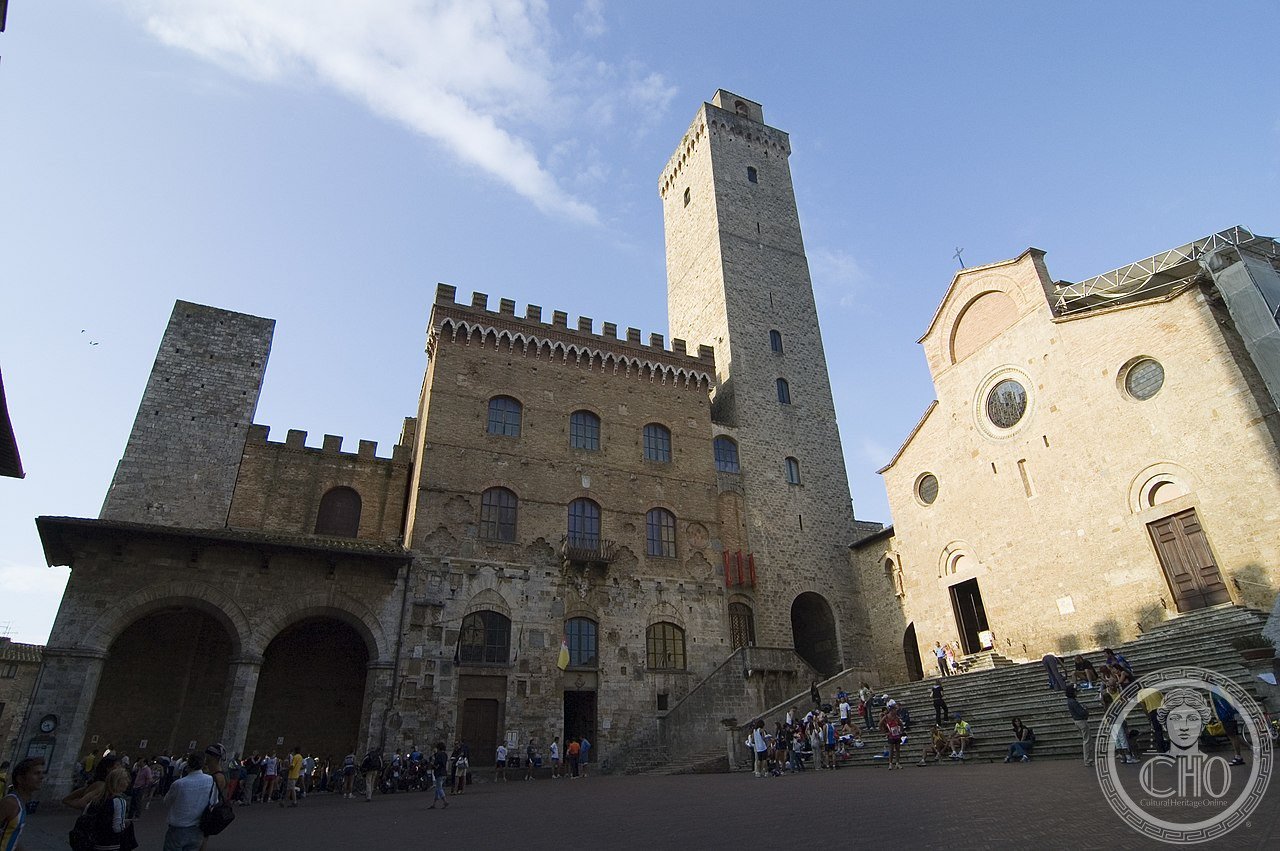
Le piazze (Cisterna e Duomo), le torri, la Collegiata (Ghirlandaio), e la degustazione di Vernaccia (the most precisely San Gimignano zone visit (3–4 hours): the 2 piazze (the Piazza della Cisterna (the well square; the 13th-century CE cistern at the center; the 8-sided wellhead: the original brick construction (1237 CE); the 14 families’ towers visible from the square: the Ardinghelli twin towers (northeast corner), the Salvucci twin towers (northwest), the Torre del Diavolo (southeast)); the Piazza del Duomo (the cathedral square; immediately north of the Piazza della Cisterna through an arch: the Collegiata on the left (the west side); the Palazzo del Podestà (1239 CE; the civic palace) on the right (east side)); the Collegiata (the frescoes: the Old Testament scenes on the north wall (attributed to Bartolo di Fredi, c.1367 CE: 26 scenes of Genesis and Exodus; the Creation of Eve; the crossing of the Red Sea; the nave walls are completely frescoed — every available surface above the arches is painted); the Last Judgment (Taddeo di Bartolo, 1393 CE: the south end wall; the most complete Dante-illustrated Last Judgment in existence (the individual circles of Hell, Purgatory, and Paradise are labeled with the corresponding canto references from the Commedia)); the Cappella di Santa Fina (Ghirlandaio, 1475 CE; see facts section)); the Tower Museum (Torre Grossa; the tallest accessible tower (54 m; 218 steps; open daily 9:30 AM–7 PM (summer); €6)); the Vernaccia (Denominazione di Origine Controllata e Garantita: the best tasting rooms are those of Panizzi (Via Santa Fina 85; family estate 7 km from San Gimignano; the Vernaccia Riserva 2021 is the benchmark wine; available by the glass €7)); the gelato (Gelateria Dondoli (Piazza della Cisterna 4; Sergio “Gelatiere del Mondo” Dondoli: the 2000 CE World Gelato Champion; the Vernaccia sorbet is the house specialty: the wine-sorbet balance maintains a 4% alcohol residual which makes the texture different from all commercial sorbets; the Crema di Santa Fina (saffron gelato) uses local Zafferano DOP)).

Practical information

  • Come raggiungere San Gimignano da Siena e Firenze ed evitare l’affollamento estivo: da Siena: bus Tiemme (1h; €4.30; da Piazza Gramsci; 7 corse/gg lun-sab; 4 corse dom); da Firenze: bus Tiemme da Piazza della Stazione (1h15; €7.50 via Poggibonsi con cambio; o direct bus in estate); da San Miniato (Trenitalia da Firenze 35 min €5.60; poi taxi €25 (13 km) o bus locale scarso); la gestione folla (San Gimignano è il borgo medievale italiano più visitato in proporzione alla superficie: 3.4 milioni di visitatori/anno su 0.3 km² di centro storico; la densità estiva (luglio-agosto; 10 AM–6 PM) rende le piazze difficilmente percorribili; la soluzione: pernottare (i B&B costano il 40% di Siena o Firenze; la luce delle torri al tramonto e all’alba è incomparabilmente migliore); oppure arrivare prima delle 9 AM (l’accesso al centro è sempre libero; la Collegiata apre alle 10 AM; la Torre Grossa alle 9:30 AM; i bus di gruppo arrivano tra le 10:30 AM e le 11 AM))

Getting there

Bus Tiemme da Siena (1h, €4.30, 7 corse/gg); da Firenze (1h15, €7.50, con cambio Poggibonsi). Parcheggio P1 (Porta San Giovanni, €2/ora) + navetta gratuita. GPS Piazza Duomo: 43.4677, 11.0430.

Nearby

  • Volterra: Città Etrusca — 25 km ovest (Museo Etrusco Guarnacci (800 urne cinerarie); Porta all’Arco (3 sec. a.C.); alabastro; Palazzo dei Priori 1208; bus Tiemme da San Gimignano 1h10 €3.80)
  • Monteriggioni: Borgo Murato Medievale — 15 km sud (14 torri intatte; il borgomedievo più compatto d’Italia; la Divina Commedia (Inf. XXXI 40-45: “come su la cerchia tonda / Montereggion di torri si corona”); bus Tiemme da San Gimignano 30 min €2.60)

Sources

  • Wikipedia, San Gimignano; Vernaccia di San Gimignano; Collegiata di San Gimignano; Zafferano di San Gimignano, accessed June 2026
  • UNESCO, Historic Centre of San Gimignano, WHS reference 550, inscribed 1990
  • Duby, Georges. L’art et la société. Moyen Âge, XXe siècle. Paris: Gallimard, 2002 (the Ghirlandaio discussion in the chapter on 15th-century patronage)

Hero image: San Gimignano, torri medievali, Toscana, Italy, Wikimedia Commons. Editorial text © Cultural Heritage Online, 2026.

📷 Diventa un fotografo di Cultural Heritage Online

Condividi le tue foto dei luoghi: restano pubblicate con la tua firma come autore. Più vengono viste, più ti fai conoscere — e presto un concorso premierà le foto più apprezzate.

Accedi o registrati gratis per aggiungere una foto
📋 Copy & share on social
Scroll to Top