

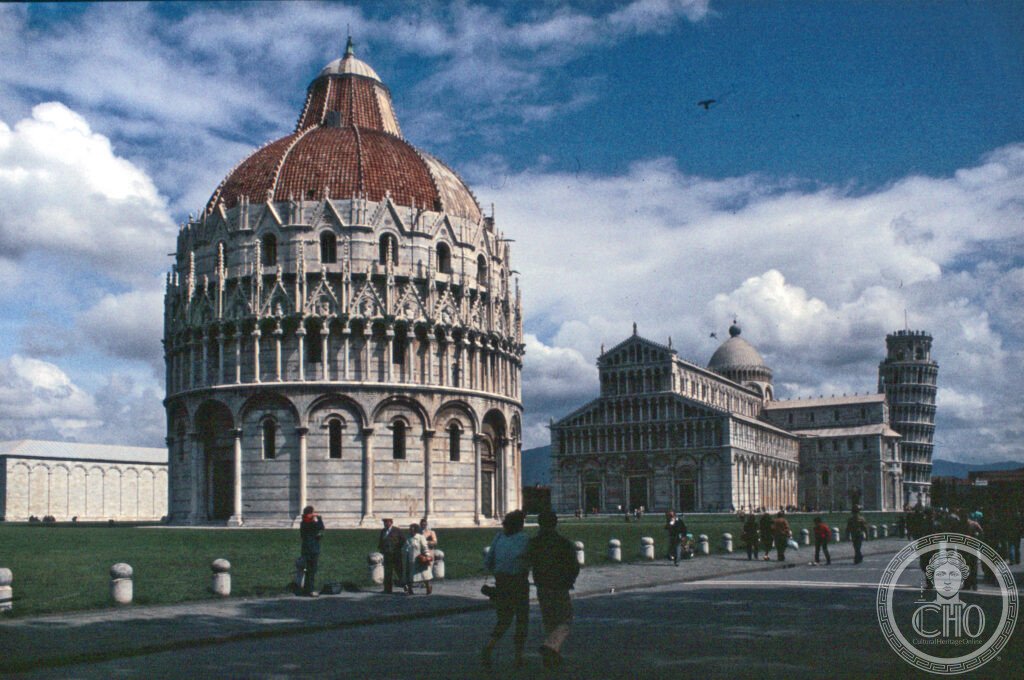
Four white marble buildings stand on a green lawn at the edge of Pisa: a cathedral, a baptistery, a leaning bell tower and a walled cemetery. Together they form the largest concentration of Romanesque architecture in Italy and one of the most recognisable skylines in the country.
At a glance
The Piazza dei Miracoli, also called the Campo dei Miracoli, brings together the Duomo di Santa Maria Assunta, the Battistero di San Giovanni, the Torre Pendente and the Camposanto on a single stretch of lawn kept closely mown. The buildings were raised over roughly three centuries, from the mid eleventh to the mid fourteenth century, and their white Carrara marble stands out sharply against the grass.
The complex is inscribed on the UNESCO World Heritage List, under the name Piazza del Duomo, Pisa, reference 395, since 1987.
Key facts
- Duomo: begun 1063 by Buscheto di Giovanni, continued by Rainaldo, construction extending beyond 1350
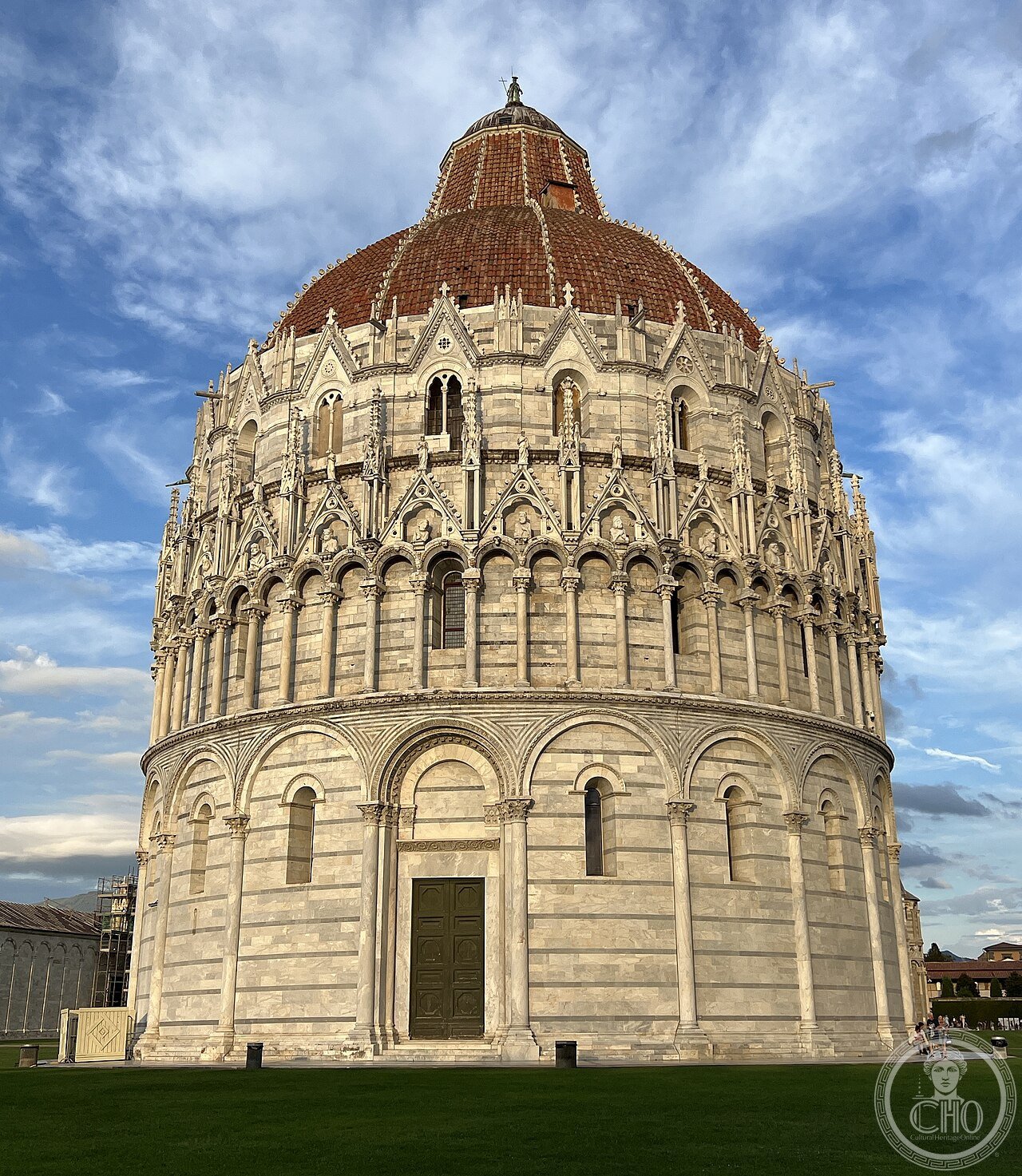
- Battistero: built 1152–1363, designed by Diotisalvi and continued by Nicola and Giovanni Pisano; the largest baptistery in Italy, with a diameter of 54.7 metres
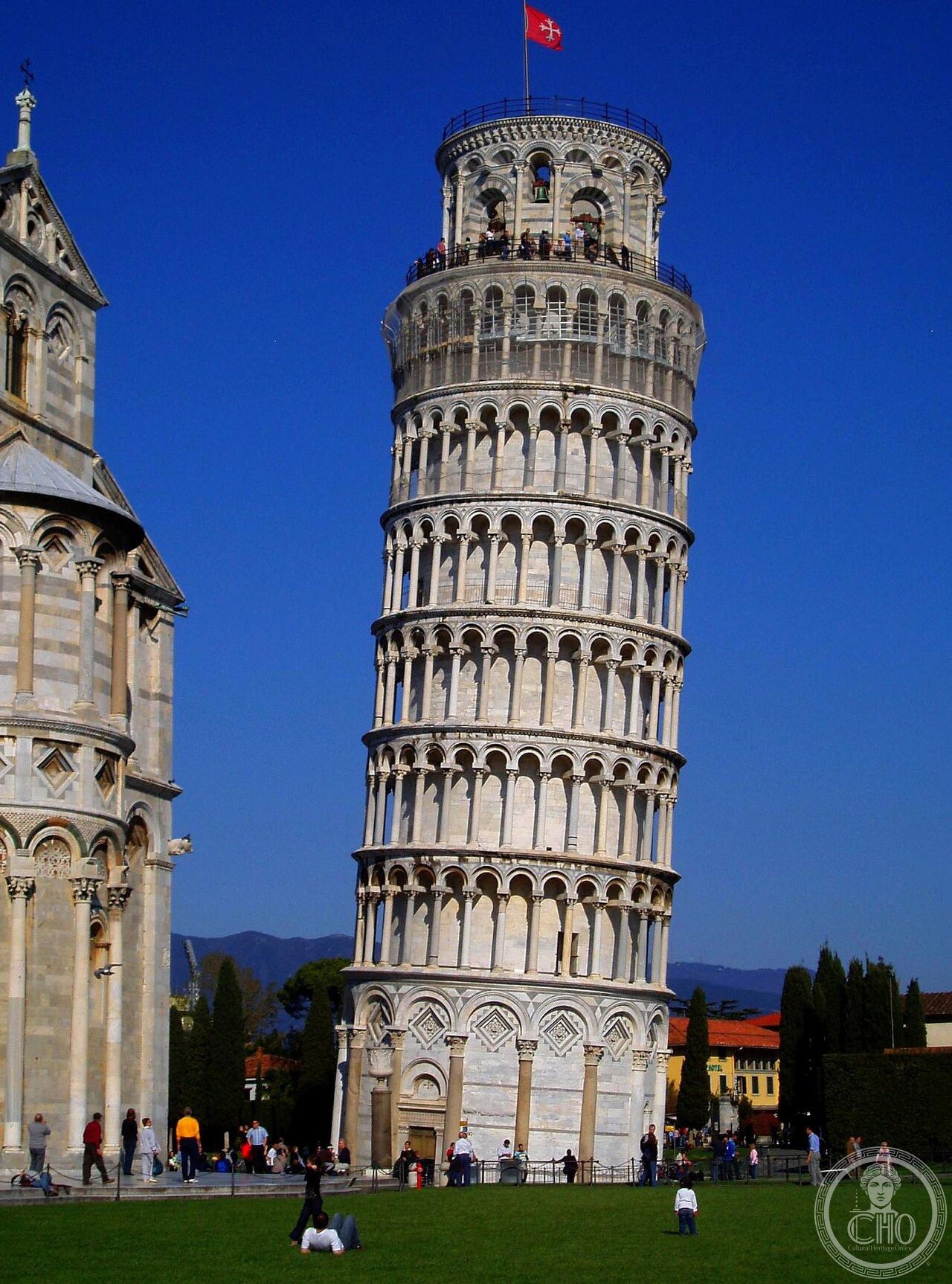
- Torre Pendente: built 1173–1350, current height 56 metres, current inclination 3.99 degrees following the 1990–2001 restoration
- Camposanto: walled cemetery standing north of the Duomo, said to contain earth brought from Golgotha
- UNESCO status: inscribed 1987 as Piazza del Duomo, Pisa, reference 395
History
Pisa was one of the four Italian Maritime Republics, alongside Genoa, Venice and Amalfi, and reached its height in the eleventh and twelfth centuries, when it controlled Sardinia and Corsica and held trading posts in the Levant and North Africa. The Duomo was begun in 1063, immediately after a Pisan victory over Saracen forces at Palermo, and the marble for its construction was paid for with the spoils of that campaign. Its architect, Buscheto di Giovanni, developed what became known as the Pisan Romanesque style, marked by blind arcading on the west front, alternating bands of dark and light marble inside, arcaded galleries above the colonnades, and bronze doors, a style that later spread through Tuscany, Sardinia and Corsica.
Pisan naval power was broken at the Battle of Meloria in 1284, when the Genoese fleet destroyed the Pisan fleet and took a large number of prisoners, including the Pisan admiral. Pisa never recovered its maritime standing and fell increasingly under the economic influence of Florence and Genoa. In 1406 Florence purchased Pisa from Gabriele Maria Visconti, bringing the republic’s independence to an end.
The astronomer and mathematician Galileo Galilei was born in Pisa in 1564 and later taught mathematics at the University of Pisa. Tradition holds that a swinging chandelier in the Duomo, observed in 1583, gave him the idea of the isochronous pendulum, the principle that the period of a swing is independent of its width for small oscillations.
What you see
The Battistero is the largest baptistery in Italy. Its roof shows two different finishes: the left half retains the original medieval tiling, while the right half was recovered in white lead during the Renaissance, a contrast that can be seen clearly from the top of the Tower. Inside stands the pulpit carved by Nicola Pisano in 1260, the first pulpit in medieval Italy to be signed and dated by its sculptor. It carries five relief panels on the life of Christ, and one figure, the Virgin Mary in the Presentation in the Temple, is drawn almost directly from a Roman sarcophagus relief now in the Camposanto, an early instance in Italian art of a sculptor copying an ancient model so closely.
The Torre Pendente is the campanile of the Duomo. Building began in 1173 under Bonanno Pisano, and the lean was already visible by 1178, after the third storey was finished, because the ground beneath the south side is softer than beneath the north. Work stopped for decades and resumed only in 1272, with the tower finally completed in 1350, when the bell chamber was added at a slight counter-lean intended to offset the tilt, a modification that in fact raised the tower’s centre of mass and made it less stable. By 1990 the lean had reached its maximum and the tower was closed to the public as a collapse risk. A ten-year operation removed soil from beneath the north foundation using soil augers, gradually correcting the tilt to its present 3.99 degrees, a figure engineers regard as more stable than the tower has been since the nineteenth century.
The Camposanto is a walled cloister-cemetery standing behind the Duomo, said in tradition to contain earth shipped from Golgotha in the twelfth century. Its walls once carried an extensive cycle of frescoes, including the Triumph of Death, usually attributed to Buonamico Buffalmacco, though the cycle was heavily damaged by Allied bombing in 1944. The preparatory red-earth drawings for the frescoes, known as sinopie, were detached afterwards and are now displayed in a dedicated museum.
Practical information
- Tickets: the Duomo, Battistero, Camposanto and museums are covered by combined ticket options sold at the Museo delle Sinopie box office or through the official Opera della Primaziale Pisana website; the Tower climb is sold and booked separately
- Tower access: visits to the Torre Pendente are limited to small groups on a timed schedule and advance booking is strongly recommended, particularly in the busier months
- The climb: the tower is ascended by 294 steps across seven floors, with the degree of lean visible in the alignment of the columns on each level
- Official information: current opening times, prices and booking should be checked on the Opera della Primaziale Pisana’s own website
Getting there
The Piazza dei Miracoli lies on the northern edge of the historic centre of Pisa, within walking distance of the city’s rail station and easily reached on foot from the surrounding streets.
Nearby
- Museo delle Sinopie — houses the detached preparatory drawings for the Camposanto frescoes
- Museo dell’Opera del Duomo — displays sculpture and treasures from the cathedral complex
- Historic centre of Pisa — the university city built around the Arno, a short walk from the piazza
Sources
- UNESCO
- Opera della Primaziale Pisana
- Giorgio Vasari, Lives of the Artists
Gallery
Find it on the map
See this place and what’s around it →
📷 Become a Cultural Heritage Online photographer
Share your photos of places: they stay published under your name as the author. The more they're seen, the more you get noticed — and soon a contest will reward the most appreciated photos.
Log in or sign up free to add a photo