
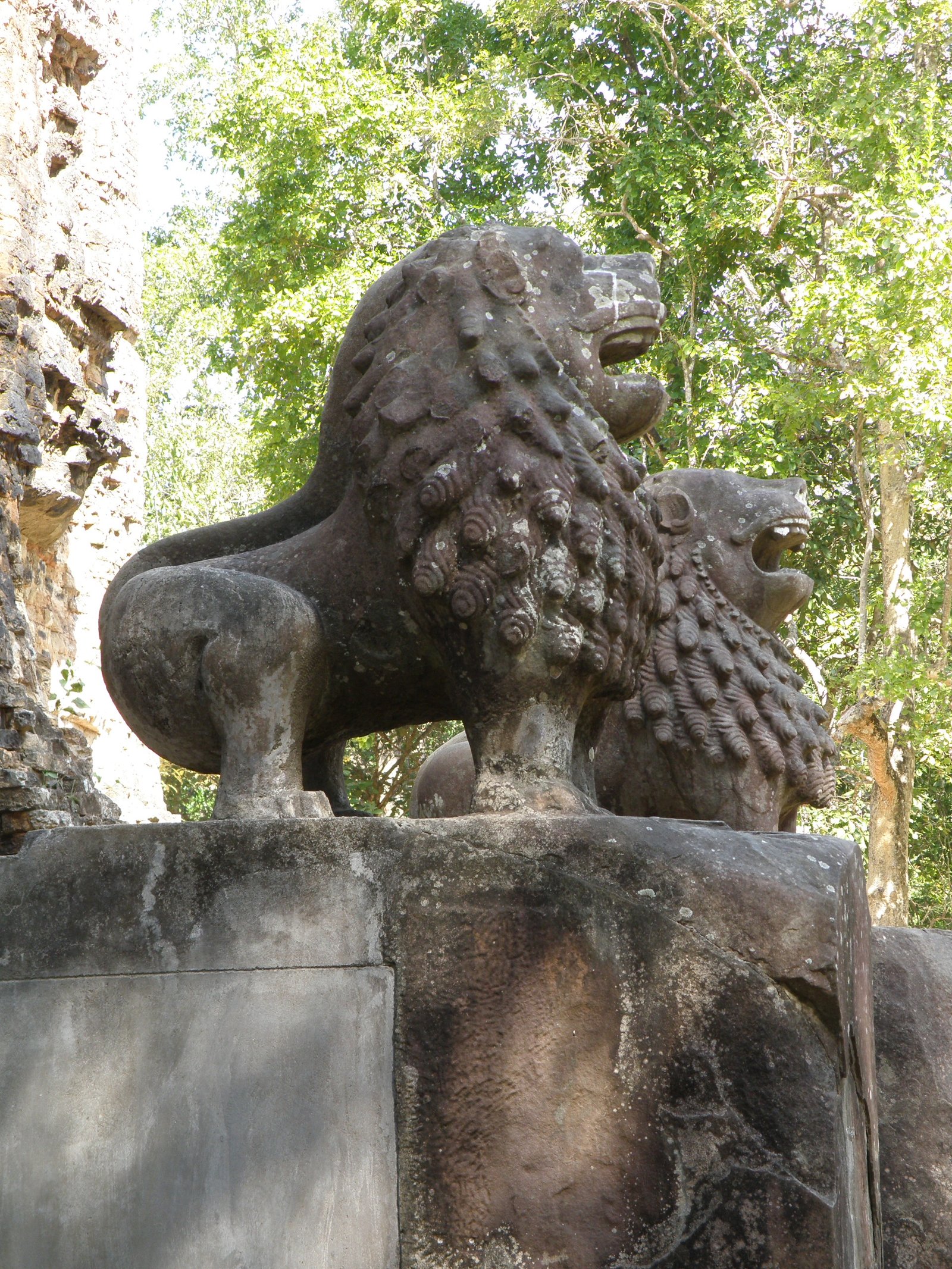
The most complete surviving complex of pre-Angkor Khmer architecture in the world — a UNESCO World Heritage Site (2017) where brick towers embraced by ancient strangler figs preserve the earliest known forms of the architectural tradition that would culminate in Angkor Wat.
At a glance
In Kampong Thom Province in central Cambodia, approximately 30 km north of the provincial capital, Sambor Prei Kuk (“the temple in the richness of the forest” in Khmer) preserves more than 100 brick towers, temples, and sanctuaries across three principal temple groups. This is the most complete surviving complex of pre-Angkor Khmer architecture in the world, dating to the Chenla period (c. 550–800 AD) and representing the direct architectural antecedent of the Angkor temples. It was inscribed as a UNESCO World Heritage Site in 2017 as the outstanding example of early Khmer civilisation.
Key facts
- Name meaning: “The temple in the richness of the forest” (Khmer)
- Period: Chenla kingdom / Ishanapura, c. 550–800 AD; peak under King Isanavarman I (r. c. 616–637 AD)
- Scale: More than 100 brick towers across three principal sanctuary groups
- Significance: First unified Khmer capital; birthplace of distinctive Khmer architectural elements (octagonal towers, enclosed sanctuary compounds, elaborated carved lintels)
- UNESCO WHS: Inscribed 2017 as the outstanding example of the Chenla period
- Signature feature: Towers embraced by roots of 12-century-old strangler fig trees (Ficus religiosa)
- Distance from Siem Reap: Approximately 185 km southeast — reachable as a day trip or via overnight stay in Kampong Thom
History
Sambor Prei Kuk was the capital of Ishanapura, the Khmer kingdom whose ruler Isanavarman I (r. c. 616–637 AD) first unified the previously fragmented Khmer polities into a centralised state. This was a fundamental step in the political history of mainland Southeast Asia: Isanavarman’s Ishanapura created the administrative, religious, and architectural precedents that the later Angkor kings would inherit and elaborately expand. The site continued to be occupied and expanded by successive Chenla rulers through the 8th century, before the political centre gradually shifted toward what would become Angkor.
The brick construction techniques at Sambor Prei Kuk, the layout of enclosed sanctuary compounds, the distinctive octagonal tower form (unique in Cambodian archaeology), and the increasingly elaborate carved sandstone lintels depicting Hindu mythological scenes — all of these appear here in their earliest known forms, several generations before the great stone temples of Angkor. Studying Sambor Prei Kuk is therefore essential for understanding the deep roots of Khmer architectural genius. The site was partially excavated and studied by French scholars in the early 20th century but received limited international attention until its UNESCO nomination process, completed in 2017.
What you see
The site is divided into three main temple groups — the northern group (Prasat Sambor), central group (Prasat Tao), and southern group (Prasat Yeay Poan) — spread through forest and connected by dirt paths. The towers are built in brick using a construction technique (using a vegetable compound as mortar, now largely dissolved) that gives the brick faces their characteristic “carved” appearance, as the decorative elements were applied directly to the dried brick surface. Among the most distinctive features are the octagonal sanctuary towers, which appear nowhere else in Cambodian temple architecture and mark a unique experimental phase in the evolution of Khmer design.
The jungle atmosphere is exceptional. Many towers are embraced by the roots of enormous strangler fig trees whose aerial roots have grown down over the brick walls over twelve centuries, creating tree-and-temple compositions directly comparable to the famous tree-roots of Ta Prohm at Angkor — but here encountered in a site that receives only a tiny fraction of Angkor’s visitors, making for a more intimate and meditative experience. The carved lintels, where they survive in situ, depict scenes from the Ramayana and Mahabharata that show the early Sambor Prei Kuk style developing toward the mature Angkor idiom.
Practical information
- Opening hours: Approximately 7:00 am – 5:30 pm daily
- Admission: Separate ticket from the Angkor Pass; current fees available from the site authority or local tour operators
- Best time to visit: November to April (dry season); paths can become muddy in the wet season (May–October)
- Guides: Local guides available at the entrance; strongly recommended for the satellite temples and carved lintels
- Facilities: Basic food and drink stalls at the entrance; bring water
- Photography: Permitted throughout; the tree-root towers are the most photogenic feature
Getting there
Sambor Prei Kuk is approximately 30 km north of Kampong Thom town and about 185 km southeast of Siem Reap via National Road 6. Most visitors arrive by hired car or motorbike from Kampong Thom (30–45 minutes on a sealed road) or as a day trip from Siem Reap (2.5–3 hours). Kampong Thom is served by buses and shared taxis on the Phnom Penh – Siem Reap route, making an overnight stay there the most practical option for visitors coming by public transport. Phnom Penh is approximately 160 km to the south.
Nearby
- Kampong Thom town — the provincial capital 30 km south, base for visiting the site; the Kampong Thom Museum holds artefacts from Sambor Prei Kuk
- Angkor Archaeological Park — the culmination of the Khmer architectural tradition that began at Sambor Prei Kuk, 185 km northwest at Siem Reap
- Koh Ker — the 10th-century jungle capital of the Khmer Empire, approximately 170 km to the northwest, also a UNESCO World Heritage Site (2023)
Sources
- UNESCO World Heritage List, “Sambor Prei Kuk, Archaeological Site of Ancient Ishanapura,” inscribed 2017. whc.unesco.org
- Boisselier, Jean. Le Cambodge. Paris: Picard, 1966.
- Albanese, Marilia. Angkor: Splendours of the Khmer Civilization. White Star, 2006.
- Ministry of Culture and Fine Arts, Cambodia. Sambor Prei Kuk conservation documentation.
- Wikipedia, “Sambor Prei Kuk.” en.wikipedia.org/wiki/Sambor_Prei_Kuk
Find it on the map
See this place and what’s around it →📷 Become a Cultural Heritage Online photographer
Share your photos of places: they stay published under your name as the author. The more they're seen, the more you get noticed — and soon a contest will reward the most appreciated photos.
Log in or sign up free to add a photo