

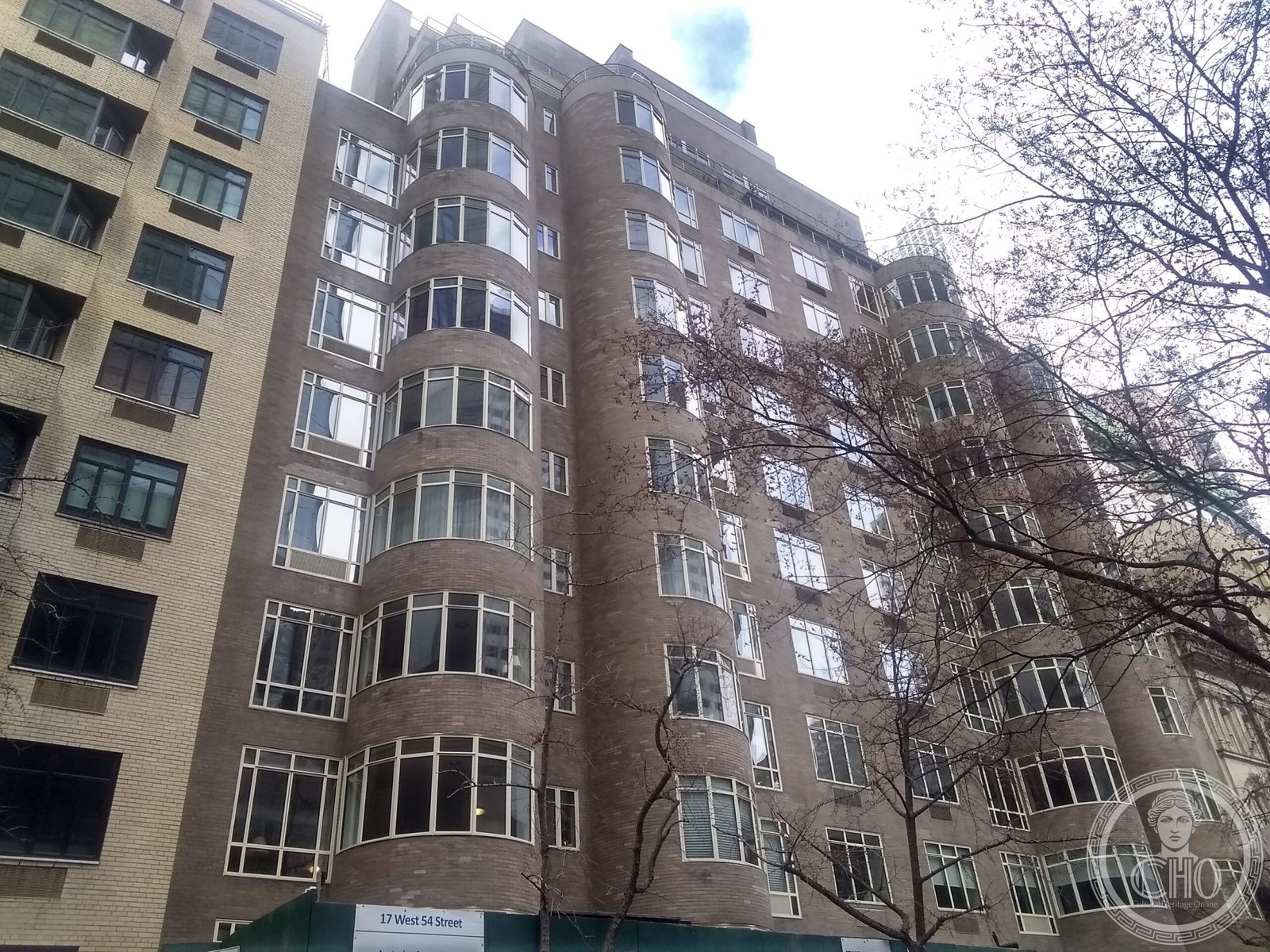
Designed by Wallace Harrison and André Fouilhoux in 1936 for the Rockefeller family’s own use, the Rockefeller Apartments at 17–19 West 54th Street represent the moment when New York’s interwar residential architecture pivoted from the ornamental verticals of Art Deco toward the stripped horizontals of the International Style.
At a glance
The Rockefeller Apartments occupy two adjacent midblock buildings at 17 and 19 West 54th Street, between Fifth and Sixth Avenues, directly north of the Museum of Modern Art. Designed by Harrison & Fouilhoux — the architects who would later complete Rockefeller Center and design the United Nations headquarters — and completed in 1936, the buildings are a low-rise (approximately thirteen stories) residential complex that was built for the Rockefeller family’s own household and for tenants associated with their cultural interests. The spare brick facades, horizontal banding, and restrained ornament place the building at the threshold between the outgoing Art Deco tradition and the incoming European Modernism that the Museum of Modern Art had been promoting since its founding in 1929. The buildings are listed on the National Register of Historic Places as a contributing resource within the Rockefeller Center area.
Key facts
- Completed: 1936
- Address: 17–19 West 54th Street, between Fifth and Sixth Avenues, Midtown Manhattan
- Architects: Harrison & Fouilhoux (Wallace K. Harrison and André Fouilhoux)
- Developer: Rockefeller family
- Height: Approximately 13 stories
- Style: Late Art Deco / proto-International Style — horizontal brick banding, minimal ornament, flat roof
- Setting: One block north of the Museum of Modern Art (MoMA)
- Designation: National Register of Historic Places (contributing to Rockefeller Center area)
History
The Rockefeller Apartments were built as a private residential project by the Rockefeller family on land adjacent to their Rockefeller Center development, which had been under construction since 1930 and would be largely complete by the mid-1930s. Wallace Harrison had become the Rockefeller family’s primary architect through his work on Rockefeller Center, which he designed in a consortium of firms under the overall direction of the Rockefeller organization. The 54th Street apartment buildings were a more personal commission: housing for the family and for people connected to the cultural and artistic circles the Rockefellers cultivated — most notably through their proximity to the Museum of Modern Art, which had opened in 1929 and moved to its permanent 53rd Street location (next block south) in 1939.
The design Harrison produced with André Fouilhoux represents a striking departure from the ornamental verticality of their contemporary Rockefeller Center work. The 54th Street buildings have almost no surface ornament; the facades are organized by horizontal courses of brick that emphasize the floor-by-floor horizontal rather than the overall tower’s vertical thrust. The windows are grouped in horizontal bands with minimal spandrel decoration. This programmatic restraint reflected both the influence of the European Modernism that MoMA was actively promoting through its exhibitions — the International Style exhibition of 1932 had made the case for ornament-free functionalism — and Harrison’s own evolving position within the New York architectural establishment.
Harrison & Fouilhoux would go on to design the master plan for the 1939 World’s Fair in Flushing Meadows and later complete the United Nations Headquarters (1952) and Lincoln Center (1962–1969), making their position in mid-century American institutional architecture central. The Rockefeller Apartments represent their residential mode: smaller in scale and quieter in ambition than the institutional commissions, but architecturally significant as a document of the transitional moment between Deco and International Style.
What you see
The Rockefeller Apartments buildings on West 54th Street are easily mistaken for ordinary midblock residential buildings, and their architectural significance lies in what they do not have rather than what they do: there is almost no ornament, no setback profile, no vertical emphasis of any kind. The brick facades are laid in a consistent horizontal pattern with continuous window sills as belt courses; the windows are large relative to the wall area; the building tops with a plain flat parapet without any decorative crown. This is the anti-Deco — a residential building contemporary with the Rockefeller Center towers but compositionally opposed to them.
Standing on 54th Street between Fifth and Sixth Avenues and looking at the buildings in context, the contrast with the Rockefeller Center towers one block west (particularly 30 Rockefeller Plaza, which rises behind) makes the architectural argument visible: where the Center’s limestone towers use verticality and ornament as civic expression, the 54th Street apartments use horizontality and plainness as domestic restraint. The block as a whole — the 54th Street buildings, the Rockefeller Center campus, and the garden spaces the Rockefellers maintained behind their 53rd and 54th Street properties — represents one of the most concentrated examples of a single patron’s architectural vision in any American city.
Practical information
- Access: Private residential building; no public interior access
- Best view: From West 54th Street looking south toward the buildings; the relationship with Rockefeller Center behind is best appreciated from the corner of 54th and Sixth Avenue
- Combine with: Walk one block south to MoMA (11 West 53rd Street) and one block west to 30 Rockefeller Plaza for a complete survey of the Rockefeller family’s 1930s architectural patronage in this area
Getting there
The Rockefeller Apartments are at 17–19 West 54th Street, between Fifth and Sixth Avenues. The nearest subway station is 47–50th Streets–Rockefeller Center (B/D/F/M trains, Sixth Avenue), about three blocks south and one block east. The E/M trains at Fifth Avenue–53rd Street are two blocks south and at the corner of 53rd and Fifth. From Times Square, take the B/D/F/M trains two stops to 47–50th Streets–Rockefeller Center, then walk north on Sixth Avenue to 54th Street. MoMA is immediately one block south at 11 West 53rd Street; 30 Rockefeller Plaza (the GE Building) is one block west on 50th Street and Sixth Avenue.
Nearby
- Museum of Modern Art (MoMA) — one block south at 11 West 53rd Street; the Rockefellers were founding patrons of MoMA (1929) and the museum’s proximity to the 54th Street apartments reflects the family’s integrated cultural geography in Midtown
- 30 Rockefeller Plaza (1933) — the 70-story Art Deco centerpiece of Rockefeller Center, one block west and south; home to 30 Rock observation deck, NBC Studios, and the Rainbow Room on the 65th floor
- St. Patrick’s Cathedral (1879) — the Gothic Revival cathedral on Fifth Avenue between 50th and 51st Streets, two blocks south and one block east; an important counterpoint to the Rockefeller Center commercial architecture across the avenue
- The University Club (1899) — McKim, Mead & White’s Beaux-Arts palazzo at 1 West 54th Street (the corner of 54th and Fifth), at the east end of the same block as the Rockefeller Apartments; the juxtaposition of the 1899 Florentine-palace facade with the 1936 apartment buildings is one of 54th Street’s quiet architectural contrasts
Sources
- Newhouse, Victoria. Wallace K. Harrison, Architect. Rizzoli, 1989.
- National Register of Historic Places, Rockefeller Center Area nomination records.
- Stern, Robert A.M., Thomas Mellins, and David Fishman. New York 1930. Rizzoli, 1994.
- Museum of Modern Art. The International Style (exhibition catalog, 1932).
Find it on the map
See this place and what’s around it →📷 Become a Cultural Heritage Online photographer
Share your photos of places: they stay published under your name as the author. The more they're seen, the more you get noticed — and soon a contest will reward the most appreciated photos.
Log in or sign up free to add a photoIs this page about you?
This page is read by travellers and heritage enthusiasts who find it on Google. Tell us how you are connected to this place and we will take it from there.