
Ravenna
For most of the 5th century this was the capital of the Western Roman Empire. Eight buildings survive from that age, lined in mosaic, and Dante is buried among them.
At a glance
Ravenna sits a few kilometres inland from the Adriatic, in the flat country east of Bologna. It was founded around 500 BC, but its great age came late: Emperor Honorius moved the capital of the Western Roman Empire here in 401, and the city stayed central as power passed to the Ostrogoths and then to Byzantium. Out of those two and a half centuries came a set of churches, baptisteries and mausolea whose interiors are sheathed in early Christian and Byzantine mosaic. Eight of them carry a joint UNESCO listing. Dante Alighieri died here in 1321 and was buried in the city he chose for his exile.
Key facts
- Region: Emilia-Romagna, eastern Italy, near the Adriatic coast
- Founded: around 500 BC
- Capital of the Western Roman Empire: from 401 AD, through most of the 5th century, until 476
- Later capitals: Ostrogothic Kingdom (493–540), then the Byzantine Exarchate of Ravenna
- UNESCO World Heritage: “Early Christian Monuments of Ravenna”, inscribed 1996, reference 788
- Eight listed monuments: San Vitale, Sant’Apollinare Nuovo, Sant’Apollinare in Classe, the Mausoleum of Galla Placidia, the Orthodox (Neonian) and Arian Baptisteries, the Archiepiscopal Chapel, and the Mausoleum of Theodoric
- Dante Alighieri: died here in 1321, buried beside the Basilica of San Francesco
History
The decision that made Ravenna was practical. In 401 Honorius shifted the imperial seat away from exposed Milan to a town ringed by marsh and lagoon, hard to besiege and close to the fleet base at Classe. For most of the 5th century it held the title of capital of the Western Roman Empire, down to the deposition of the last western emperor in 476. The court drew artists and money, and the marshes that protected the city also helped its early buildings survive.
Power changed hands without erasing what came before. The Ostrogothic king Theodoric ruled from Ravenna between 493 and 540 and built for his own Arian faith; the Mausoleum of Theodoric, dated to 520, is roofed by a single stone slab quarried in Istria. When Byzantine forces took the city in 540, it became the seat of the Exarchate of Ravenna, the western outpost of Constantinople. The Basilica of San Vitale (548) and Sant’Apollinare in Classe (549) belong to this Byzantine phase, and the famous portraits of Justinian and Theodora in San Vitale date from these years.
The empire receded, but the city kept its weight as a religious centre. Centuries later Dante Alighieri, exiled from Florence, settled here under the protection of the Da Polenta family. He finished the Divine Comedy in Ravenna and died in 1321. His tomb, beside the Basilica of San Francesco, remains in the city; Florence has asked for his remains and never received them.
What you see
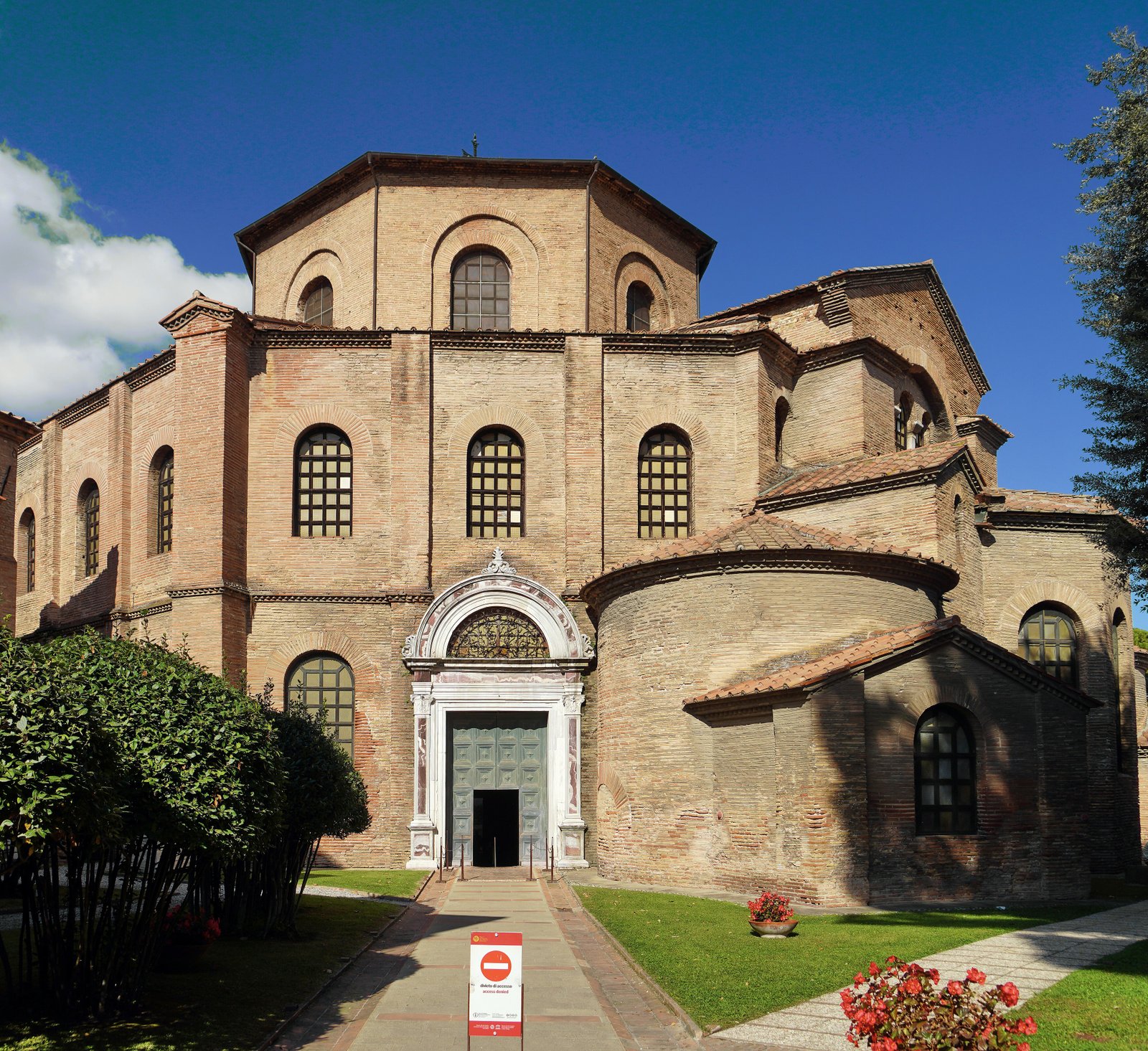
- Basilica of San Vitale (548) — an octagonal church whose apse glows green and gold, with the imperial panels of Justinian and Theodora facing each other across the presbytery.
- Mausoleum of Galla Placidia (c. 430) — a small cross-shaped building with a deep-blue vault scattered with hundreds of gold stars.
- Basilica of Sant’Apollinare Nuovo (c. 500) — long mosaic processions of saints and virgins running the length of both nave walls, begun under Theodoric.
- Sant’Apollinare in Classe (549) — outside the centre, near the old port, with a great apse mosaic of a green meadow, sheep and a jewelled cross.
- Mausoleum of Theodoric (520) — a two-storey stone tomb capped by one monolithic dome of Istrian limestone, unlike anything else in the city.
Practical information
- Time needed: a full day covers the central monuments comfortably; two days if you add Classe and Theodoric’s mausoleum without rushing.
- Getting around: the core sites — San Vitale, Galla Placidia, the baptisteries, Sant’Apollinare Nuovo and Dante’s tomb — are within walking distance in the old centre.
- Tickets: several of the central monuments share a combined entry ticket; check current arrangements before you go.
- When to go: spring and autumn are mildest. Summer is hot and humid on the Adriatic plain.
Getting there
Ravenna is on the regional rail line from Bologna, roughly an hour and a quarter by train, with onward connections toward Rimini and Ferrara. The nearest large airports are Bologna and Rimini; Sant’Apollinare in Classe lies a few kilometres south of the centre and is reached by local bus or train toward Rimini.
Nearby
- Ferrara — the Este city to the north, also a UNESCO site, about an hour away.
- Classe — the ancient port district just south, home to Sant’Apollinare in Classe.
- Bologna — the regional capital and rail hub, around an hour and a quarter west.
Sources
Find it on the map
See this place and what’s around it →Historical events at this place (6)
- 2021 Incontro a Dante - Percorsi guidati alla scoperta della Ravenna del Sommo Poeta-Speciale Live tours
- 2021 Dante Live Tours
- 2021 La Ravenna dantesca di ieri e di oggi
- 2021 Ravenna. Appuntamenti di - Incontro a Dante - da Ognissanti a Natale
- 2023 Incontro a Dante - percorsi guidati alla scoperta della Ravenna del Sommo Poeta
- 2023 Incontro a Dante - Percorsi guidati alla scoperta della Ravenna del Sommo Poeta
📷 Diventa un fotografo di Cultural Heritage Online
Condividi le tue foto dei luoghi: restano pubblicate con la tua firma come autore. Più vengono viste, più ti fai conoscere — e presto un concorso premierà le foto più apprezzate.
Accedi o registrati gratis per aggiungere una foto