
Como
A Roman silk town at the foot of its lake, Como produced Alessandro Volta and his battery, and twenty centuries after its founding it gave Italy one of the boldest buildings of European modernism. Romanesque stone, lake light and Rationalist concrete sit within a few streets of each other.
At a glance
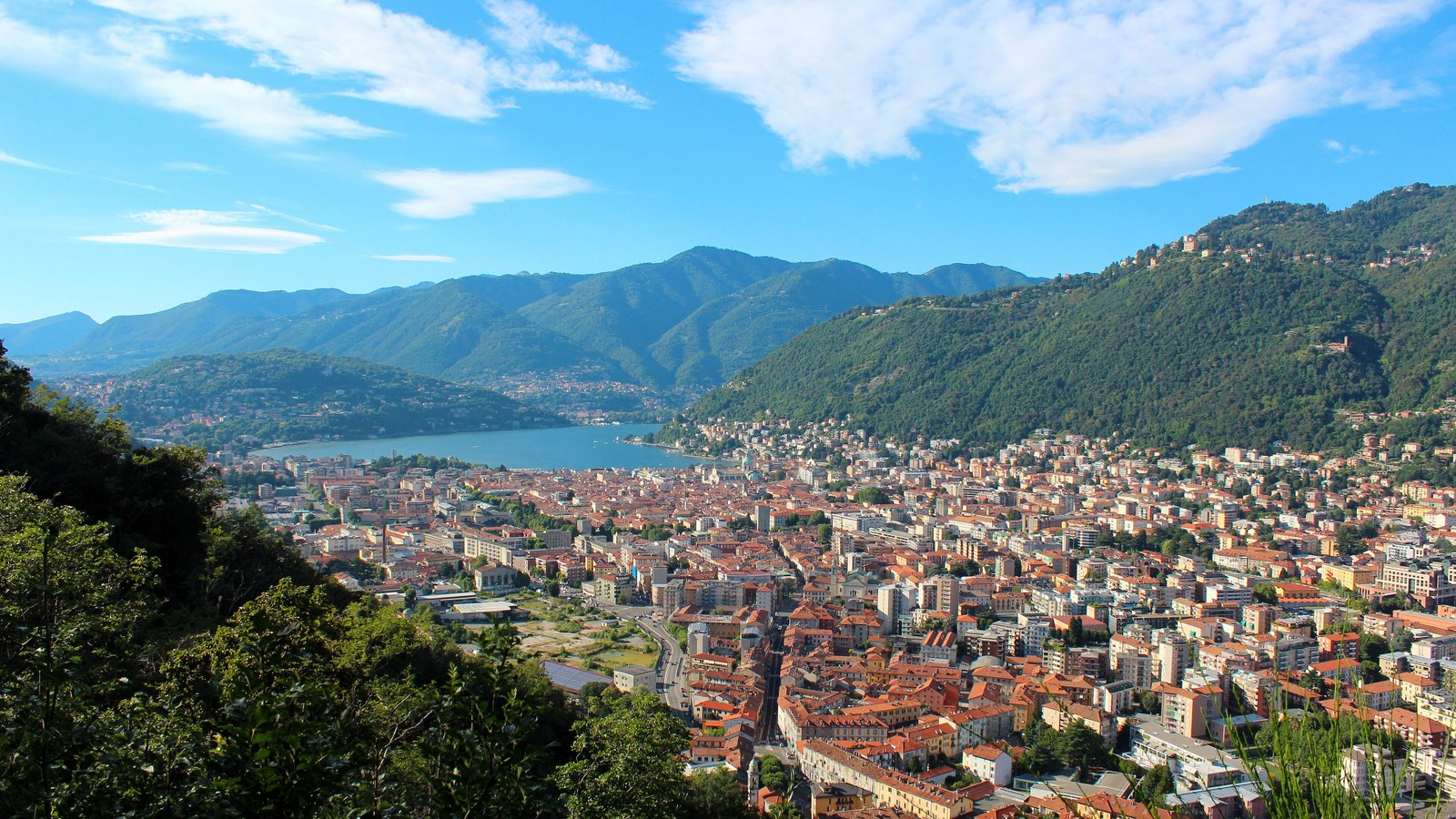
Como sits at the southern end of the south-western arm of Lake Como, about 40 kilometres north of Milan. Julius Caesar refounded it as Novum Comum in the first century BC. The Roman writers Pliny the Elder and Pliny the Younger are counted among its sons.
The city built its fortune on silk. By the early 1970s its output is reported to have surpassed that of China and Japan combined. The thread also runs the other way through time: Alessandro Volta, born here in 1745, gave the world the electric battery, and in the 1930s the architect Giuseppe Terragni made Como a landmark of the Modern Movement.
Key facts
- Region: Lombardy, Italy
- Position: southern tip of the south-western arm of Lake Como, ~40 km north of Milan
- Roman name: Novum Comum, refounded by Julius Caesar (1st century BC)
- Famous citizens: Pliny the Elder, Pliny the Younger, Alessandro Volta (1745–1827)
- Coordinates: 45.8167° N, 9.0833° E
History
The Roman settlement of Novum Comum took shape in the first century BC on the lake’s southern shore. From it came two of antiquity’s most quoted writers, the naturalist Pliny the Elder and his nephew Pliny the Younger.
In the Middle Ages Como walled itself in stone, and stretches of those walls still stand. Silk weaving turned the city into one of Europe’s textile capitals; the trade held through the twentieth century, when Como cloth dressed the fashion houses of Milan and Paris, before competition from Asia thinned it after the mid-1990s.
Como also marked the history of science. Alessandro Volta, born in the town in 1745, built the voltaic pile in 1799 and reported it to the Royal Society the following year. The unit of electric potential, the volt, carries his name. He died in 1827.
What you see
- Como Cathedral (Duomo). Begun in 1396 and finished only in 1740, it carries Gothic, Renaissance and Baroque work in one façade, banded in grey and white marble.
- Basilica di Sant’Abbondio. A Romanesque church consecrated in 1095, austere in stone, with twin bell towers rising over a single tall nave.
- Broletto. The medieval town hall beside the Duomo, its arcaded front striped in coloured marble, once the seat of the comune.
- Casa del Fascio. Giuseppe Terragni’s Rationalist building of 1932–1936, a glazed concrete cube of severe geometry, regarded as an early landmark of modern European architecture.
- Tempio Voltiano. A lakeside museum dedicated to Alessandro Volta, holding instruments tied to the inventor of the electric battery.
Practical information
The historic centre is compact and walkable; the Duomo, the Broletto and the lakefront stand within a few minutes of one another. The Tempio Voltiano sits on the waterfront promenade. Opening hours and admission for churches and museums change with the season, so check before a visit.
Getting there
Como lies about 40 kilometres north of Milan and is reached by frequent regional trains, terminating at Como San Giovanni or Como Lago. Drivers arrive on the A9 motorway from Milan. The lake itself is served by public ferries from the central piers.
Nearby
The lake opens north into the Alps, with shoreline towns reachable by ferry. Milan, with its own cathedral and museums, lies within an hour by train. The Swiss border at Chiasso is a short distance to the north.
Sources
Find it on the map
See this place and what’s around it →Historical events at this place (5)
📷 Diventa un fotografo di Cultural Heritage Online
Condividi le tue foto dei luoghi: restano pubblicate con la tua firma come autore. Più vengono viste, più ti fai conoscere — e presto un concorso premierà le foto più apprezzate.
Accedi o registrati gratis per aggiungere una foto