
Puglia, Italy
Lecce
A whole city carved from one soft golden limestone into the most exuberant Baroque in Italy, with a Roman amphitheatre still sitting in its main square. Stonemasons cut the pietra leccese while it was fresh, then watched it harden in the air, and the result is a downtown that swarms with grotesques, saints and stone vines.
At a glance
Lecce is the principal city of the Salento peninsula, the heel of the Italian boot. Its old centre is built almost entirely from pietra leccese, a fine-grained limestone soft enough to carve like wood when first quarried. From 1630 the city filled with Baroque churches and palaces so dense that it earned the names “the Florence of the South” and “the Lady of Baroque”. Beneath the modern square, a Roman amphitheatre that once held more than 25,000 people remains half-excavated, a reminder that the town is far older than its carved facades suggest.
Key facts
- Region: Puglia (Apulia), Salento peninsula
- Founded: attributed to the Messapians as a town called Sybar; conquered by Rome in the 3rd century BC and renamed Lupiae
- Building stone: pietra leccese, a soft golden limestone
- Baroque era: from 1630
- Coordinates: 40.350° N, 18.167° E
History
The Messapians are credited with founding a town here called Sybar at the time of the Trojan War. Rome took it in the third century BC and renamed it Lupiae. Under the emperor Hadrian, in the second century AD, the settlement was renamed and moved about three kilometres to the northeast, and it was in the Roman period that the great amphitheatre was cut into the ground near today’s main square.
Lecce passed through Byzantine, Norman and later Spanish hands. The city’s transformation came under Spanish rule in the seventeenth century. Starting in 1630 it was enriched with Baroque monuments, and the abundance of soft local stone meant that almost every church and palace front could be carved with extravagant detail. That single building material is why the whole centre reads as one continuous work of sculpture.
What you see
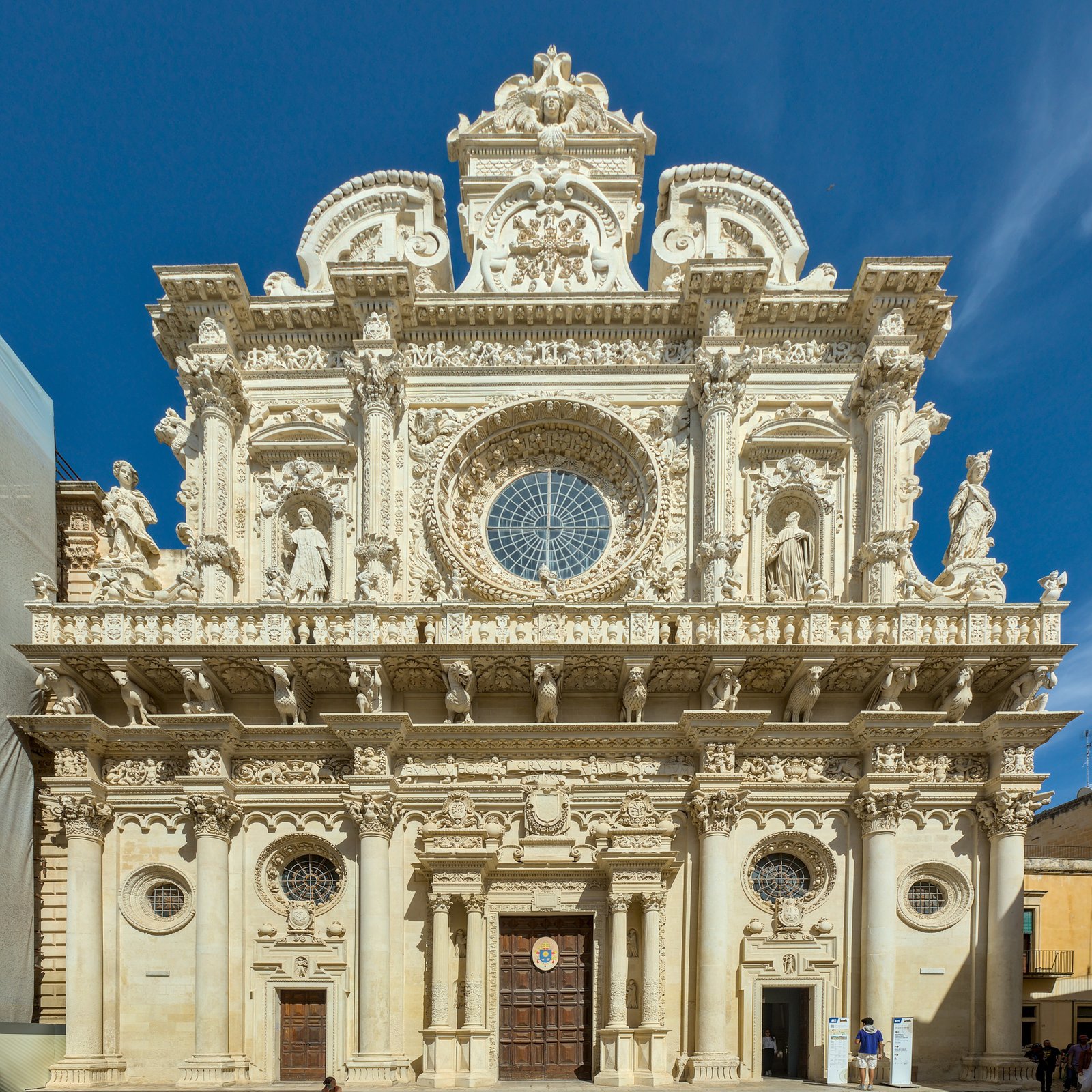
Basilica di Santa Croce — begun in 1549, completed in 1695. Its facade is the masterpiece of Lecce Baroque: six smooth columns carry an entablature crowded with animals, grotesque figures and vegetables, beneath a large rose window. Cesare Penna completed the upper front and the rose window; Giuseppe Zimbalo worked on the upper facade. The atlantes straining under the balcony are said to represent Turkish prisoners from the Battle of Lepanto.
Piazza del Duomo and the Cathedral — the Cathedral was first built in 1144, rebuilt in 1230, then wholly restored between 1659 and 1670 by Giuseppe Zimbalo. The square is one of the few enclosed cathedral piazzas in Italy, entered through a single monumental gateway.
Roman Amphitheatre — the surviving arena at Piazza Sant’Oronzo could seat more than 25,000 spectators. Only part has been excavated; the rest still lies under the surrounding buildings.
Piazza Sant’Oronzo — the city’s social heart, named for the patron saint whose column rises at its edge. The Roman amphitheatre opens directly onto it, so antiquity and the everyday share the same pavement.
Porta Napoli — a triumphal gate erected in 1548 in honour of Charles V, marking the old road toward Naples and the northern edge of the historic centre.
Practical information
The historic centre is compact and best explored on foot; the major squares and churches sit within a short walk of one another. Lecce stone glows a warm honey colour in the late afternoon, so the hour before dusk is the best time to read the carving on the Santa Croce facade. Several churches keep limited opening hours, so it is sensible to check times locally before visiting.
Getting there
Lecce sits at the southern end of the main Adriatic rail line and is the terminus of frequent trains from Bari and Brindisi. The nearest airport is Brindisi, roughly forty kilometres to the north, with connecting trains and buses to Lecce station. From the station, the old centre is about a fifteen-minute walk.
Nearby
The Salento peninsula stretches south toward Santa Maria di Leuca, where the Adriatic and Ionian seas meet. Otranto, on the east coast, holds a cathedral famous for its twelfth-century mosaic floor. To the west, the Baroque town of Nardò echoes Lecce’s golden stonework on a smaller scale.
Sources
Find it on the map
See this place and what’s around it →Historical events at this place (4)
📷 Diventa un fotografo di Cultural Heritage Online
Condividi le tue foto dei luoghi: restano pubblicate con la tua firma come autore. Più vengono viste, più ti fai conoscere — e presto un concorso premierà le foto più apprezzate.
Accedi o registrati gratis per aggiungere una foto