
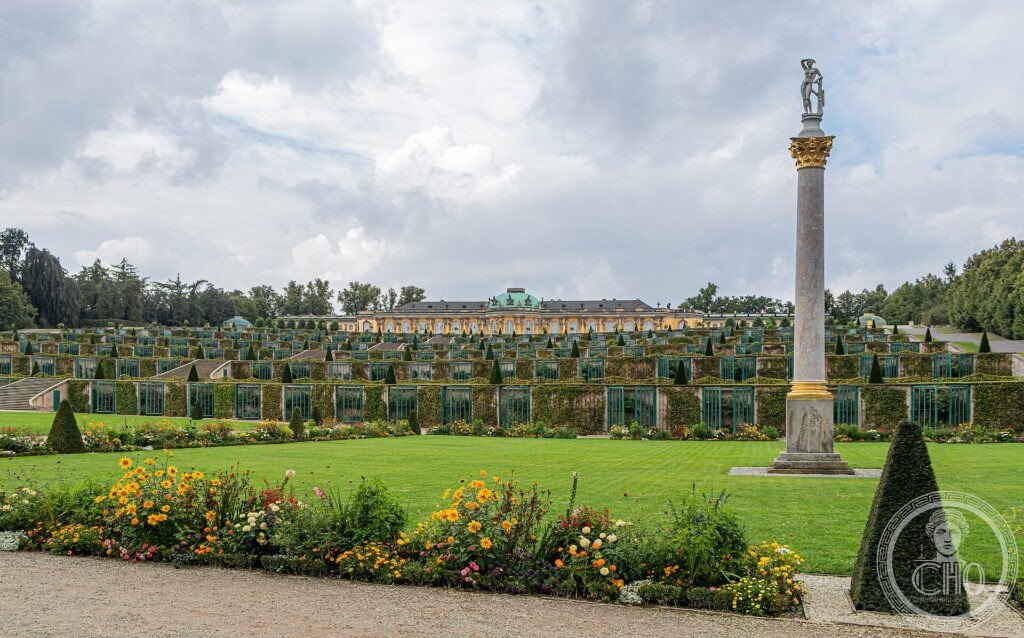
“Sans souci” — without cares. Frederick II of Prussia wanted a private retreat here rather than a royal palace: a single-storey pavilion looking out over six vineyard terraces, where he played the flute and talked with Voltaire. Today it is the heart of a vast landscape of palaces and parks.
At a glance
Sanssouci was the summer retreat of Frederick the Great, built between 1745 and 1747 to his own sketches by the architect Georg Wenzeslaus von Knobelsdorff. A single-storey Rococo pavilion, it sits at the head of six curving vineyard terraces, deliberately intimate rather than grand. Over the following century it grew into an ensemble of palaces, gardens and follies stretching across Potsdam. The Palaces and Parks of Potsdam and Berlin were inscribed by UNESCO in 1990, with later extensions in 1992 and 1999.
Key facts
- UNESCO: World Heritage since 1990 (extended 1992 and 1999)
- Architect: Georg Wenzeslaus von Knobelsdorff, to designs by Frederick II
- Built: 1745–1747
- Vineyard terraces: six curved glazed terraces descend from the palace
- Name: “Sans souci” — French for “without worries”
- Ensemble: part of a vast park including the New Palace, Charlottenhof and the Orangery
History
Frederick II of Prussia, a soldier-king with a private passion for music, philosophy and French culture, conceived Sanssouci as a place to escape the formality of the Berlin court. He sketched the plan himself and had Knobelsdorff realise it in 1745–47. The result was a one-storey pleasure house, low and unguarded, where the king dined with Voltaire and other thinkers of the Enlightenment.
Successive Prussian rulers added to the park. Frederick William IV in the 19th century created the Orangery and remodelled gardens in an Italianate spirit. Frederick the Great had asked to be buried at Sanssouci beside his greyhounds; his wish was finally honoured in 1991, when his remains were reinterred on the terrace.
What you see
The palace presents a long, sun-yellow garden front animated by exuberant Rococo caryatids. Inside, a sequence of intimate rooms — the Marble Hall, the Concert Room, the Voltaire Room — glows with gilded ornament and silk. The terraced vineyard falls away in front, its glazed niches once sheltering fig and vine.
Beyond stretch the avenues of the park, leading to the colossal New Palace, the Chinese House and the Orangery — a landscape best explored on foot or by bicycle.
Practical information
- Entry: the palace charges timed admission; the park is free
- Tickets: a combined ticket (sanssouci+) covers several palaces
- Time needed: half a day to a full day for the wider park
- Note: palace visitor numbers are capped; book ahead in summer
Getting there
Potsdam adjoins Berlin to the south-west and is reached in about 40 minutes by S-Bahn or regional train from the city centre. From Potsdam station, trams and buses serve the park, or it is a pleasant walk through the old town. GPS: 52.4042° N, 13.0389° E.
Nearby
- Cecilienhof Palace — site of the 1945 Potsdam Conference
- Dutch Quarter — red-brick gabled houses in central Potsdam
- Berlin — the German capital, a short train ride away
Sources
- UNESCO World Heritage Centre — “Palaces and Parks of Potsdam and Berlin” (ref. 532)
- Stiftung Preussische Schlösser und Gärten Berlin-Brandenburg — official foundation
- Encyclopaedia Britannica — Sanssouci; Frederick II of Prussia
Find it on the map
See this place and what’s around it →📷 Become a Cultural Heritage Online photographer
Share your photos of places: they stay published under your name as the author. The more they're seen, the more you get noticed — and soon a contest will reward the most appreciated photos.
Log in or sign up free to add a photoIs this page about you?
This page is read by travellers and heritage enthusiasts who find it on Google. Tell us how you are connected to this place and we will take it from there.