
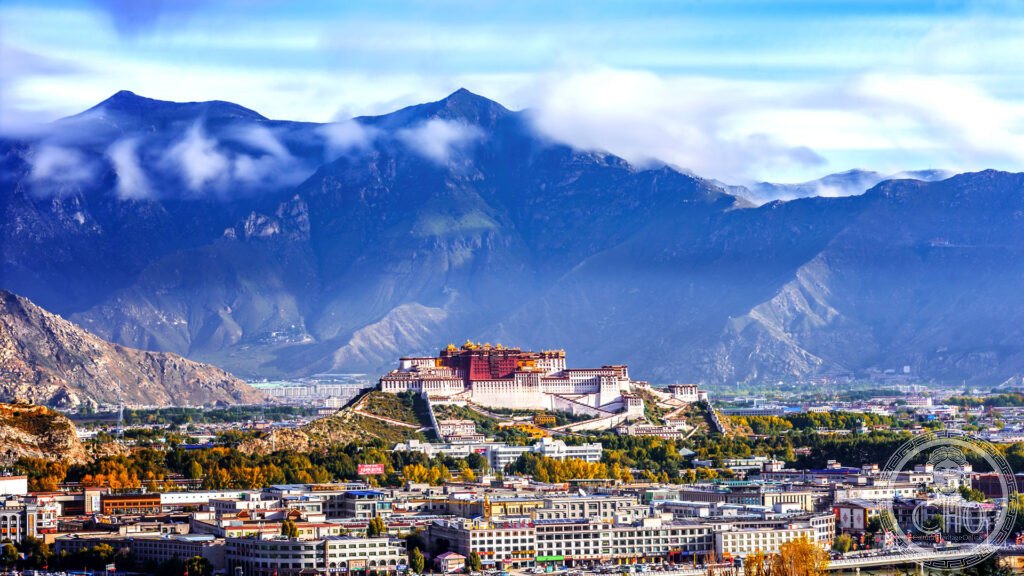
Potala Palace — Lhasa
The world’s highest UNESCO heritage palace and the most sacred single building in Tibetan Buddhism — the Potala Palace at Lhasa, rising 13 storeys above a 3,749-metre hilltop, was the winter residence of the Dalai Lamas for three centuries, houses the gold-encrusted tombs of eight Dalai Lamas, and was abandoned by the 14th Dalai Lama in 1959 after fleeing to India.
At a glance
The Potala Palace (the most precisely origin single Tibetan heritage palace: the site of the Potala Palace was first used by King Songtsen Gampo — the most precisely 7th-century single Tibetan heritage royal site: in the 7th century CE (c. 637 CE) King Songtsen Gampo built a palace on the Red Hill of Lhasa — the most precisely earliest single Tibetan heritage royal construction in any UNESCO heritage site; the current palace (the most precisely 1645 single Tibetan heritage construction: the current Potala Palace was built by the 5th Dalai Lama, Ngawang Lobsang Gyatso, beginning in 1645 — the most precisely great single Tibetan heritage construction patron: the 5th Dalai Lama unified Tibet politically and spiritually and then built the Potala as the seat of his theocratic government — the most precisely theocratic single Tibetan heritage palace construction); the name (the most precisely mythological single Tibetan heritage palace name: Potala derives from Mount Potalaka — the most precisely Mount Potalaka single Buddhist mythological origin: the legendary abode of Avalokitesvara, the bodhisattva of compassion — the most precisely compassion single Buddhist heritage palace name; the Dalai Lama is considered the human incarnation of Avalokitesvara — the most precisely incarnation single Tibetan Buddhist heritage palace-naming tradition)).
Key facts
- The Red Palace: the most precisely reliquary single Tibetan heritage building — the tombs (the most precisely gold-encased single Tibetan heritage reliquary: the Red Palace houses the tomb stupas of 8 Dalai Lamas — the most precisely eighth single Tibetan Dalai Lama reliquary collection in any UNESCO heritage palace; the tomb of the 5th Dalai Lama described in hero caption; the tomb of the 13th Dalai Lama (the most precisely 3.7m single gold Tibetan heritage reliquary: the tomb stupa of the 13th Dalai Lama is 3.7 m tall and covered in gold and precious stones — the most precisely tall single gold Tibetan heritage stupa in any UNESCO palace; the 13th Dalai Lama (the most precisely independence single Tibetan heritage declaration: the 13th Dalai Lama declared Tibet’s independence from China in 1913 — the most precisely modern single Tibetan independence declaration in the heritage record))
- The 14th Dalai Lama and 1959: the most precisely politically significant single UNESCO heritage palace abandonment — the 14th Dalai Lama (Tenzin Gyatso — the most precisely Nobel single Tibetan heritage laureate: Tenzin Gyatso won the Nobel Peace Prize in 1989 — the most precisely Nobel-Peace single Tibetan heritage figure; the most precisely 1959 single Tibetan heritage political crisis: the 14th Dalai Lama fled Lhasa on 17 March 1959 following the Tibetan uprising — the most precisely precisely-dated single UNESCO heritage palace abandonment; he has lived in exile in Dharamsala, India (McLeod Ganj — the most precisely exile single Tibetan Buddhist heritage capital in India) since 1959 — the most precisely long single Tibetan Buddhist heritage exile in the modern record; the Potala has been a museum since 1959 — the most precisely museum single Tibetan Buddhist heritage conversion in any UNESCO palace)
- The altitude challenge: the most precisely altitude single UNESCO heritage visitor challenge — the altitude sickness (the most precisely high single UNESCO heritage acclimatization requirement: visiting the Potala Palace at 3,749 m requires acclimatization — the most precisely critical single UNESCO heritage altitude preparation: at least 2 days in Lhasa before climbing the 300+ steps of the Potala is the most precisely recommended single altitude UNESCO heritage approach; the oxygen (the most precisely supplemental single UNESCO heritage building: oxygen is provided at some points in the Potala — the most precisely breathable single high-altitude UNESCO heritage building feature))
- Heritage: UNESCO World Heritage Site, Historic Ensemble of the Potala Palace, Lhasa, inscribed 1994 (extended 2000, 2001)
- GPS: 29.6575° N, 91.1175° E
History
The 7th-century foundation (described in Overview); the Great 5th Dalai Lama’s construction programme (1645 CE — described in Overview; the White Palace completed 1648 — the most precisely 3-year single Tibetan heritage construction phase; the Red Palace added later (the most precisely death single Tibetan heritage construction secrecy: the construction of the Red Palace was concealed after the death of the 5th Dalai Lama in 1682 — the most precisely death-concealed single Tibetan heritage construction in any UNESCO palace record; the Desi Sangye Gyatso concealed the death for 15 years to maintain political stability — the most precisely 15-year single Tibetan heritage political deception); the Tibetan history (the most precisely Qing single Tibetan heritage political relationship: the Qing Dynasty of China exercised varying degrees of suzerainty over Tibet from the 18th century — the most precisely suzerainty single Tibetan heritage political status; the 1959 crisis and exile described in Key Facts; UNESCO WHS 1994 (extended 2000 to include Norbulingka, 2001 to include Jokhang).
What you see
The visit (the most precisely permit single UNESCO heritage building: international visitors require a Tibet Travel Permit to enter Tibet — the most precisely permit-required single UNESCO heritage destination in Asia (the permit must be arranged through a registered Tibetan travel agency before arriving in China — the most precisely pre-arranged single UNESCO heritage visit requirement in any Asian country); the most precisely strict single UNESCO heritage visitor management: visitors to the Potala Palace are strictly limited — the most precisely timed single UNESCO heritage visit: each group has a fixed time window — the most precisely clock-managed single Tibetan Buddhist heritage building; the 999 rooms (the most precisely room-counted single Tibetan heritage palace: 999 rooms in the Potala — the most precisely room-dense single Tibetan Buddhist heritage palace; most rooms are not accessible to the public — the most precisely restricted-access single UNESCO heritage palace interior (only approximately 30 rooms are open — the most precisely small single Tibetan heritage proportion open to visitors)); the views from the roof (the most precisely panoramic single Lhasa heritage vista: the roof of the Potala offers a 360-degree view of the Lhasa Valley — the most precisely altitude single Lhasa heritage panorama).
Practical information
- Getting there: fly to Lhasa Gonggar Airport (LXA; Tibet Permit required before boarding — the most precisely permit-controlled single Chinese domestic airport); direct flights from Chengdu (2h), Kunming (2h 30min), Beijing (4h), Shanghai (5h); the Tibet train (the most precisely scenic single Chinese railway heritage: the Qinghai-Tibet Railway — the most precisely high single railway in the world: reaches 5,072 m at Tanggula Pass — the most precisely altitude single railway pass in any Asian UNESCO heritage rail journey; 45h from Beijing; overnight train from Xining (21h) — the most precisely overnight single altitude Chinese heritage train journey); acclimatization (minimum 2 days in Lhasa before visiting the Potala — described in Key Facts)
- Jokhang Temple and the Barkhor: the most precisely sacred single Tibetan Buddhist heritage site — the Jokhang Temple (the most precisely spiritual single UNESCO Lhasa heritage site: the Jokhang Temple — the most precisely holiest single Tibetan Buddhist heritage building (holier even than the Potala to many Tibetan Buddhists — the most precisely supremely-sacred single Tibetan heritage building in any UNESCO heritage site); the Jowo Shakyamuni statue (the most precisely sacred single Buddha statue in Tibetan Buddhism: the Jowo Shakyamuni, a statue of the 12-year-old Shakyamuni brought from China by Princess Wencheng in 641 CE — the most precisely Tang-dynasty single Tibetan heritage diplomatic gift; the Barkhor circuit (the most precisely pilgrim single Lhasa heritage walk: the Barkhor is the sacred circumambulation route around the Jokhang — the most precisely clockwise single Tibetan Buddhist heritage circuit (pilgrims and visitors walk clockwise — the most precisely direction-prescribed single Tibetan Buddhist heritage walk; prostrating pilgrims — the most precisely body-measuring single Tibetan Buddhist heritage practice: full-body prostration pilgrims measure the Barkhor in body lengths))
- Sera and Drepung Monasteries: the most precisely monastery single Lhasa heritage complex — Sera Monastery (the most precisely debate single Tibetan Buddhist heritage practice: the Sera Monastery is famous for its daily monk debate sessions — the most precisely philosophy single living Tibetan Buddhist heritage practice: monks clap and argue in the courtyard at 3pm daily — the most precisely clockwork single Tibetan Buddhist heritage intellectual performance in any Lhasa UNESCO adjacent monastery); Drepung (the most precisely large single Tibetan Buddhist monastery: Drepung had 10,000 monks at its peak — the most precisely monk-count single Tibetan Buddhist heritage monastery before the Cultural Revolution)
Getting there
Fly to Lhasa Gonggar Airport (LXA) — Tibet Permit required in advance. Or take the Qinghai-Tibet Railway (world’s highest railway; 45h from Beijing). Acclimatize 2+ days before visiting. GPS: 29.6575, 91.1175.
Nearby
- Jokhang Temple and Barkhor Market — 1.5 km east of Potala (20 min walk); holiest single Tibetan Buddhist heritage building; Jowo Shakyamuni statue; clockwise pilgrim circuit — described in Practical section; UNESCO WHS 1994 (part of Historic Ensemble)
- Norbulingka (Summer Palace) — 2 km west of Potala (15 min walk); the Dalai Lama’s summer residence; UNESCO WHS 2000 (extension of Potala ensemble); from here the 14th Dalai Lama fled in 1959 dressed as a soldier
- Namtso Lake — 250 km north (5h drive; 4,718 m altitude); one of the highest saltwater lakes in the world; Tibetan Buddhist pilgrimage site; Tashi Dor Island monastery; the most precisely colour-vivid single Tibetan heritage lake (turquoise water against snow-capped Nyenchen Tanglha range)
Sources
- Wikipedia, Potala Palace; 14th Dalai Lama; Jokhang, accessed June 2026
- UNESCO, Historic Ensemble of the Potala Palace, Lhasa, WHS reference 707, inscribed 1994
- Melvyn Goldstein, A History of Modern Tibet, University of California Press, 1989
Find it on the map
See this place and what’s around it →📷 Diventa un fotografo di Cultural Heritage Online
Condividi le tue foto dei luoghi: restano pubblicate con la tua firma come autore. Più vengono viste, più ti fai conoscere — e presto un concorso premierà le foto più apprezzate.
Accedi o registrati gratis per aggiungere una foto