

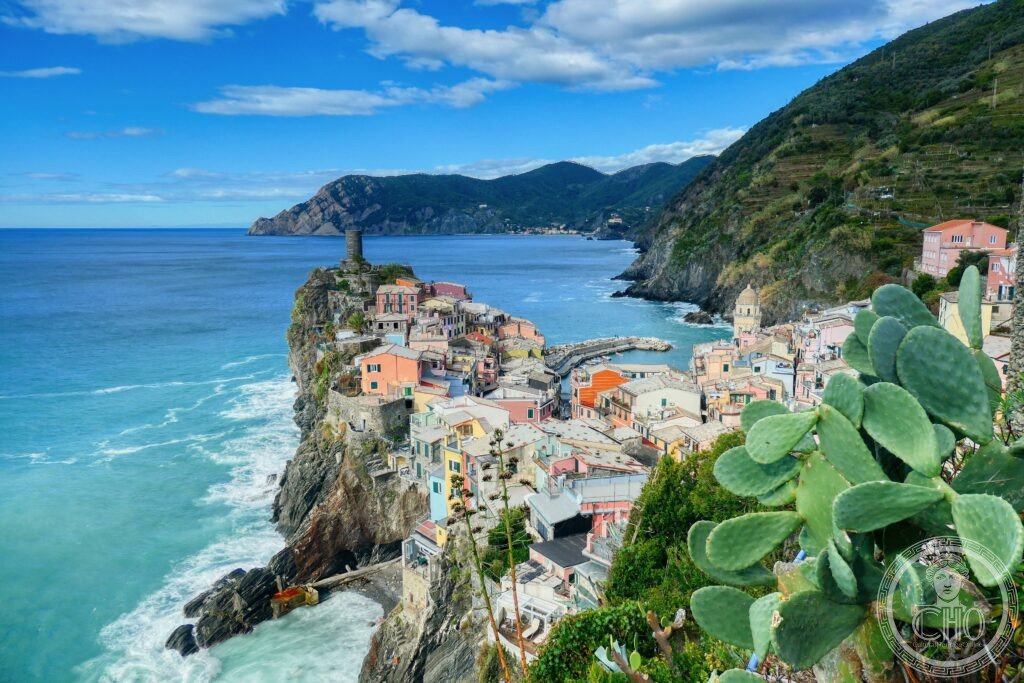
Five villages clinging to a stretch of Ligurian cliff, linked by terraced vineyards, dry stone walls and a coastal path, where fishing colours and medieval towers survive above the sea. Car-free and connected mainly by train and boat, the Cinque Terre remain one of Italy’s most distinctive coastal landscapes.
At a glance
The Cinque Terre are five villages strung along a stretch of the Ligurian Riviera di Levante between Levanto and La Spezia: Monterosso al Mare, Vernazza, Corniglia, Manarola and Riomaggiore, running north to south. Their vineyards and olive groves are held up by dry stone walls built over centuries, many of which fell into disrepair as farming was abandoned in the twentieth century and are now the subject of restoration work supported by EU and regional programmes.
None of the village centres can be reached by car. Access is by train, boat or on foot, and the villages are linked by a network of coastal and ridge trails.
Key facts
- Location: Ligurian coast between Levanto and La Spezia, Italy
- The five villages: Monterosso al Mare, Vernazza, Corniglia, Manarola, Riomaggiore
- Heritage status: UNESCO World Heritage Site, inscribed 1997
- Character: medieval origins, Genoese defensive towers, terraced vineyards, no cars in village centres
- Local wine: Sciacchetrà, a dessert wine produced in small quantities from grapes grown on the terraces
History
The Cinque Terre formed part of the Republic of Genoa from the 11th to the 18th centuries, and each of the five villages retains a defensive tower or castle from that period. The Genova–La Spezia railway, opened in 1874 and running through numerous tunnels cut into the Ligurian rock, connected the villages to the wider world and allowed fish and wine to be exported quickly.
The traditional fishing and wine economy declined through the twentieth century, and the villages that were close to being abandoned by 1960 are today among the most visited places in Italy. The area was inscribed as a UNESCO World Heritage Site in 1997.
What you see
Each village has its own character. Monterosso al Mare is the largest and flattest of the five and the only one with a sandy beach. Vernazza’s piazza opens directly onto its small harbour beneath the Torre Doria, a Genoese watchtower, and is widely considered the most striking of the five. Corniglia is the only village not directly on the sea, reached from its train station by the 382 steps of the Lardarina staircase. Manarola is known for the view of its coloured houses reflected in the rocks below at dusk. Riomaggiore lies at the southern end of the group.
The coloured façades that define the villages were originally a practical device, allowing fishermen to identify their own homes from the sea; the specific palette was shaped by the pigments available from local minerals.
Walking the coast is central to the experience. The Via dell’Amore, the well-known path between Manarola and Riomaggiore, was closed after a landslide in 2012 and fully reopened in 2024. A higher trail along the ridge above the villages connects all five and offers wider views over the coast.
Practical information
- Cinque Terre Card: covers regional Trenitalia trains between Levanto and La Spezia together with the hiking trails; check current terms on the National Park’s official site
- Visitor numbers: the villages receive very heavy seasonal footfall relative to their small resident population, and some municipalities apply visitor limits on peak days
- Timing: travelling by train outside the middle of the day, and staying overnight rather than visiting on a day trip, gives a much quieter sense of the villages
- Getting around: village centres are car-free; movement between villages is by train, boat or on foot
Getting there
The five villages are reached by regional train from La Spezia Centrale, with services running roughly every half hour and each village under fifteen minutes away. Genoa is connected by Intercity or regional train, and Pisa and Florence are reachable via La Spezia. Boats also link several of the villages along the coast.
Nearby
- Portovenere — a short distance south-east of Riomaggiore, reachable by boat or bus; inscribed as a UNESCO World Heritage Site in 1997 together with the Cinque Terre, known for the Church of San Pietro on its striped rocky promontory and for Byron’s Cave
- Palmaria Island — off Portovenere, part of the same protected coastal area
- Portofino and Santa Margherita Ligure — north-west along the Ligurian coast, reachable by car or by train and boat via Rapallo, with the San Fruttuoso Abbey accessible only by sea
- Genoa — a UNESCO World Heritage Site since 2006 for its Strade Nuove and Palazzi dei Rolli, the Renaissance palaces once used to host state guests
Sources
- Wikipedia
- UNESCO
- Cinque Terre National Park official website (Parco Nazionale delle Cinque Terre)
Find it on the map
See this place and what’s around it →📷 Become a Cultural Heritage Online photographer
Share your photos of places: they stay published under your name as the author. The more they're seen, the more you get noticed — and soon a contest will reward the most appreciated photos.
Log in or sign up free to add a photo