
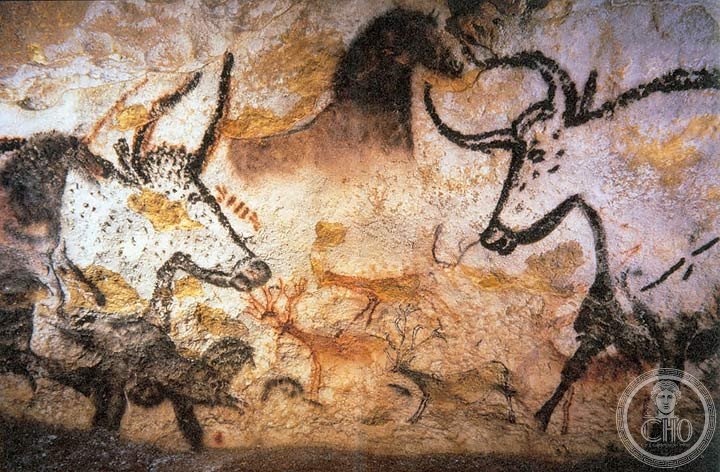
Lascaux holds the densest concentration of Paleolithic paintings known in any cave, some 1,900 animal figures and 600 signs applied to limestone walls around 17,000 BCE. The original is closed for conservation, but a full-scale replica lets visitors stand before the same images that stopped four boys and a dog in their tracks in 1940.
At a glance
Lascaux, in the Dordogne region of south-west France, is decorated with roughly 1,900 identified animal images and around 600 abstract signs, painted by Magdalenian hunter-gatherers using manganese dioxide, iron oxide and calcite pigments, sometimes blown through hollow bones for a soft, airbrushed finish. Horses are the most common animal depicted, followed by deer, ibex, aurochs, bison, felines, and single figures of a rhinoceros and a bear. The animals are not scattered at random: many appear grouped and sequenced in ways that suggest deliberate composition rather than casual accumulation.
The cave was discovered on 12 September 1940 by eighteen-year-old Marcel Ravidat and three friends, who followed a dog through a small opening in the ground and found themselves inside a painted world unseen for millennia.
Key facts
- Location: Montignac, Dordogne, Nouvelle-Aquitaine, France
- Period: Upper Paleolithic, Magdalenian, around 17,000 BCE
- Content: approximately 1,900 animal figures and 600 signs across the Hall of the Bulls, the Axial Gallery and the Shaft of the Dead Man
- Discovery: 1940, by Marcel Ravidat and three companions
- Access today: the original cave is closed; visitors see the Lascaux IV replica, opened 2016
- Heritage status: part of the Prehistoric Sites and Decorated Caves of the Vézère Valley, inscribed as a UNESCO World Heritage Site in 1979
History
Lascaux’s paintings belong to the Magdalenian period, generally regarded as the high point of European Paleolithic cave art, and were made during the Last Glacial Maximum, when southern France was cold steppe-tundra. The cave was found in September 1940 and opened to the public in 1948, becoming a major draw that at its peak drew large numbers of visitors each day. By 1963 the carbon dioxide and body heat brought in by so many visitors had begun to encourage the growth of Mondmilch algae and fungi, turning parts of the walls green and permanently damaging some of the paintings. Culture Minister André Malraux ordered the cave closed to the public that year to halt the damage.
The site is part of the Prehistoric Sites and Decorated Caves of the Vézère Valley, inscribed as a UNESCO World Heritage Site in 1979.
What you see
Since the original cave is closed, visitors experience Lascaux through the Lascaux International Cave Art Centre at Montignac-Lascaux, known as Lascaux IV, which opened in 2016 and was designed by the architectural practice Snøhetta. Its reproduction was built using digital photogrammetry, 3D scanning and precision manufacturing to replicate every surface of the original chambers, including the Hall of the Bulls and the Axial Gallery. The acoustic properties of the cave have also been reproduced, so that standing inside the replicated Hall of the Bulls is intended to recreate the sensory experience of the original space as closely as possible.
Within the Hall of the Bulls itself, one aurochs figure measures around 5.2 metres, among the largest painted animals in any cave of this age, and the figures appear to move together across the wall from right to left. The first figure on the left wall, a creature with two straight horns, is sometimes referred to as the unicorn. Elsewhere, the Shaft of the Dead Man shows a wounded bison, a falling man and a bird perched on a stick, a scene that has been read variously as a hunting accident, a shamanic ritual or a mythological narrative.
Practical information
- Where to go: the Lascaux International Cave Art Centre at Montignac-Lascaux is the only way to see the Lascaux imagery today; the original cave is not open to visitors
- Booking: check the centre’s official channels for current visiting arrangements
- Nearby caves: the Vézère Valley contains around 25 decorated caves in total, including Font-de-Gaume, which has very limited daily access and should be booked well in advance
Getting there
Lascaux IV can be reached by car from Périgueux or from Sarlat, both within a short drive, or by TGV from Paris to Périgueux followed by a car journey. The site lies at coordinates 44.9351° N, 1.1681° E.
Nearby
- Font-de-Gaume — around 20 km south-east; the only Paleolithic cave with polychrome paintings still open to the public in France, with over 200 depictions of bison, horses and mammoths, but with very limited daily access
- National Museum of Prehistory, Les Eyzies — around 20 km south-east; described as the most comprehensive single European Paleolithic museum, holding the Venus of Laussel among its collections
- Cap Blanc — a rock shelter with a 13-metre carved frieze of horses
- Rouffignac Cave — visited by electric train through its painted galleries
- Rocamadour — around 60 km south-east; a cliff-hung medieval pilgrimage village built around the shrine of the Black Madonna, on the historic route to Santiago de Compostela
Sources
- Wikipedia, Lascaux
- Wikipedia, Hall of the Bulls
- Wikipedia, Vézère Valley
- UNESCO, Prehistoric Sites and Decorated Caves of the Vézère Valley, WHS reference 175, inscribed 1979
- Mario Ruspoli, The Cave of Lascaux: The Final Photographs, Abrams, 1987
Find it on the map
See this place and what’s around it →📷 Become a Cultural Heritage Online photographer
Share your photos of places: they stay published under your name as the author. The more they're seen, the more you get noticed — and soon a contest will reward the most appreciated photos.
Log in or sign up free to add a photo