
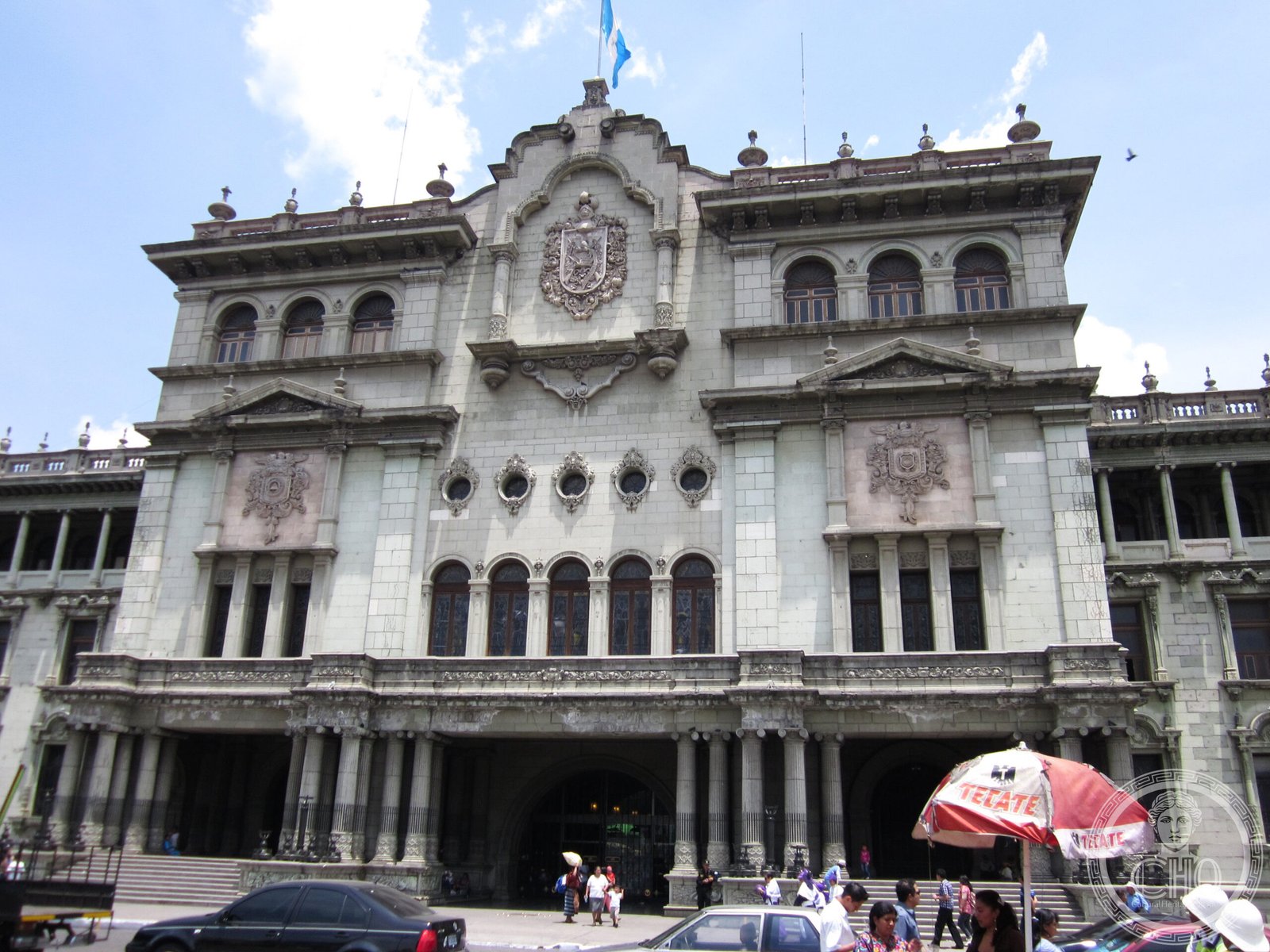
Known colloquially as the Palacio Verde — the Green Palace — for its distinctive jade-hued stone facade, the Palacio Nacional de la Cultura stands at the north side of the Plaza de la Constitución in the historic center of Guatemala City. Completed in 1943 under the dictatorship of Jorge Ubico, the building served for decades as the seat of presidential and executive power. Its architecture is an extraordinary hybrid: Mudéjar-inspired arches, Baroque towers, and Art Deco interior details coexist in a massive structure that speaks simultaneously of colonial heritage, indigenous roots, and 20th-century authoritarian ambition. The stained-glass windows inside narrate Guatemala’s full history — Mayan civilization, Spanish conquest, independence, and republican aspiration. Today it functions as a museum and venue for state ceremonies, and remains the most recognizable symbol of Guatemala City’s built heritage.
At a glance
- Type
- Government palace / cultural museum
- Period
- 1939–1943
- Style
- Neo-Colonial, Spanish Baroque, Spanish Renaissance with Art Deco interior details
- Location
- Plaza de la Constitución, Guatemala City, Guatemala
- Coordinates
- 14.6429° N, 90.5132° W
- Architect(s)
- Rafael Pérez de León; engineers Enrique Reyes, Luis Angel Rodas, Arturo Bickford
Overview
The Palacio Nacional de la Cultura occupies the entire north face of Guatemala City’s central plaza — the spatial and political heart of the Guatemalan capital. Its green volcanic-stone facade, arcaded ground floor, and twin Baroque towers give it a commanding presence that blends colonial ecclesiastical forms with 20th-century state grandeur. President Jorge Ubico commissioned the palace as a replacement for an earlier structure and insisted on a design that would project permanence, modernity, and national pride. The building’s hybrid aesthetic — Spanish colonial forms on the exterior, Art Deco coffered ceilings and stained-glass panels in the reception halls — reflects the tensions of a nation caught between its indigenous and European heritages. Today it houses cultural collections, restored presidential salons, and regularly hosts government functions alongside public museum visits.
History
Construction began in January 1939 under President Jorge Ubico, a dictator who used monumental architecture as a tool of political legitimacy. Ubico employed thousands of workers — many under conditions of forced labor — and the palace was inaugurated on November 10, 1943, the same year Ubico was deposed by a popular uprising. On June 29, 1954, the building was targeted during CIA-backed air raids that supported Operation PBSUCCESS, the coup that overthrew democratically elected President Jacobo Árbenz. The palace survived the February 4, 1976 earthquake that killed 23,000 Guatemalans, its massive stone construction absorbing the magnitude-7.5 shock. During the 1982 military coup, General Efraín Ríos Montt established secret tribunals here that executed 15 people within a month. The building was converted into a cultural center in the 1990s and opened to the public as a museum.
Architecture & Design
Architect Rafael Pérez de León drew on Spanish Baroque and Renaissance sources for the exterior while incorporating Mudéjar ornamental details — interlaced geometric patterns, horseshoe arches — that reference Guatemala’s Moorish-Spanish colonial heritage. The palace’s most celebrated interior features are the large-format stained-glass windows in the Recepción Room, designed to tell Guatemala’s national narrative in light: scenes of Mayan cosmology, the Spanish conquest, independence, and visions of the country’s future. The ceilings are coffered and gilded in Art Deco geometric patterns. The main courtyard is arcaded on three levels, with carved stone balustrades and bronze lamp fittings. The green volcanic stone used on the exterior is quarried locally and gives the building its distinctive hue and its popular nickname.
Cultural significance
The Palacio Verde is the visual symbol of Guatemala City and the stage on which decisive moments of Guatemalan history have played out: Ubico’s authoritarian rule, the CIA coup of 1954, the military dictatorships of the 1970s and 1980s, and the peace accords of the 1990s. Its stained-glass windows — depicting both Mayan heritage and colonial history — embody the contested nature of Guatemalan national identity. The building’s survival through earthquakes, coups, and political upheaval has made it a symbol of institutional continuity. For Guatemalans it is simultaneously a monument to authoritarian power and a repository of collective memory.
Visiting today
The Palacio Nacional de la Cultura is open to the public as a museum, with free or low-cost admission. Visitors can tour the ornate reception halls, the presidential balcony overlooking the plaza, and the stained-glass windows. Guided tours in Spanish and English are available. The palace is at its most dramatic during national celebrations, when the Plaza de la Constitución fills with crowds and the illuminated facade is especially striking. Photography is permitted in most areas.
Getting there
The palace sits directly on the Plaza de la Constitución (Parque Central) in Guatemala City’s historic Zone 1. It is easily reachable by any bus or taxi heading to the city center. The Transmetro bus rapid transit system has stops within walking distance. From Guatemala City’s Aurora International Airport (GUA), the center is approximately 7–10 km by taxi (20–30 minutes depending on traffic).
Sources & resources
Find it on the map
See this place and what’s around it →Record researched and written by Luigi De Marchi for Cultural Heritage Online, 2026.
📷 Become a Cultural Heritage Online photographer
Share your photos of places: they stay published under your name as the author. The more they're seen, the more you get noticed — and soon a contest will reward the most appreciated photos.
Log in or sign up free to add a photoIs this page about you?
This page is read by travellers and heritage enthusiasts who find it on Google. Tell us how you are connected to this place and we will take it from there.