

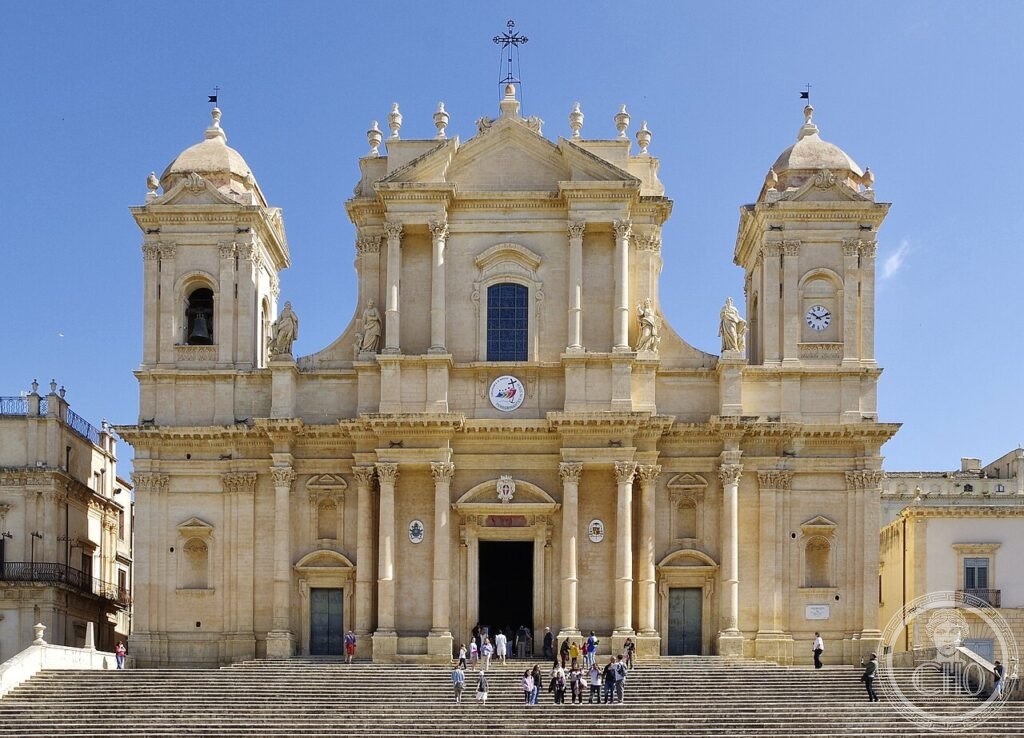
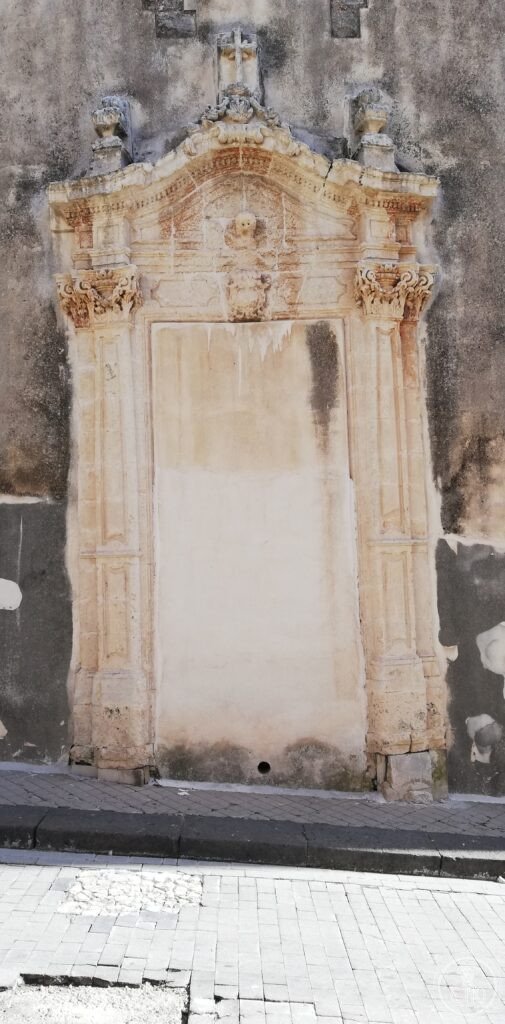
The finest ensemble of Sicilian Baroque architecture in the world — a complete city rebuilt on a new site after the catastrophic earthquake of 1693, designed in a single thirty-year burst by a generation of Sicilian architects (Rosario Gagliardi, Antonio Mazza, Paolo Labisi) who had absorbed the Baroque of Rome and Naples and transformed it into something uniquely Sicilian: warm honey-gold local limestone, facades that curve and project in the golden afternoon light, balconies supported by grotesque stone figures, and at the end of every street axis, the broad staircase of the cathedral rising against the clear Sicilian sky.
At a glance
Noto is a city in the province of Syracuse in south-eastern Sicily, 32 kilometres south-west of Syracuse on the limestone plateau of the Iblean Mountains. The present city was founded in 1703, three kilometres south-west of the medieval city (now called “Noto Antica”) which was destroyed beyond repair by the earthquake of 11 January 1693 — the most destructive earthquake in Sicilian history, which killed approximately 60,000 people and destroyed 45 towns and cities in south-eastern Sicily in less than one minute.
The Noto UNESCO inscription (2002, ref. 1024, “Late Baroque Towns of the Val di Noto, South-Eastern Sicily”) covers eight towns in south-eastern Sicily: Caltagirone, Militello in Val di Catania, Catania, Modica, Noto, Palazzolo Acreide, Ragusa, and Scicli. All were rebuilt in the Baroque style after the 1693 earthquake; Noto is considered the finest example and the symbolic capital of the group.
Key facts
- Earthquake of 1693: 11 January 1693; estimated Mw 7.4; ~60,000 killed in south-east Sicily; Noto Antica completely destroyed
- New city: Founded 3 km south-west, on an accessible plateau ridge; designed 1703–1720 by Giuseppe Lanza, Duke of Camastra (the Spanish viceroy’s deputy)
- Cattedrale di San Nicolò: 1703–1776; Giuseppe Sinatra (façade); the dominant monument of the Corso; partially collapsed 1996 (dome fell); restored 2007
- Palazzo Ducezio (Town Hall): 1746; Vincenzo Sinatra; a curved colonnade Baroque palazzo facing the Piazza Municipio across from the cathedral
- Palazzo Villadorata (Nicolaci): 1737; famous for its six balconies supported by grotesque figures (horses, lions, griffins, monsters); Via Corrado Nicolaci
- Corso Vittorio Emanuele: the main axis; three piazzas in sequence; the street is listed as one of the most beautiful streets in Italy
- UNESCO: 2002, ref. 1024 — “Late Baroque Towns of the Val di Noto”
- GPS: 36.8904, 15.0682 — Google Maps
History
The earthquake of 11 January 1693 — which struck at 21:00 local time, after a foreshock two days earlier had persuaded many people to spend the night outdoors in fear — remains the deadliest natural disaster in Italian history. Estimates of the total death toll in Sicily range from 54,000 to 100,000; in south-eastern Sicily, entire cities were flattened. The speed and completeness of the destruction created an opportunity — unprecedented in European history — to rebuild cities from scratch according to a unified Baroque plan, rather than incrementally repairing and expanding medieval fabrics.
The decision on where to rebuild Noto was contested: some favoured rebuilding on the same site (Noto Antica, on a ridge 3 km to the north-east), others favoured the new site on the Meti ridge to the south-west, which was more accessible and had a better water supply. Giuseppe Lanza, Duke of Camastra, the Spanish viceroy’s deputy responsible for rebuilding south-eastern Sicily, chose the new site in 1703. The rebuilding was rapid by any standard: the Cathedral was begun in 1703, the main street layout established by 1710, and the major palaces and churches completed between 1720 and 1780 — approximately 70 years for a complete Baroque city.
What you see
The Corso Vittorio Emanuele runs east-west along the spine of the Meti ridge for approximately 600 metres, with three successive piazzas: Piazza dell’Immacolata (west), Piazza Municipio (centre, with the Cathedral and Palazzo Ducezio facing each other), and Piazza XVI Maggio (east, with the Teatro Vittorio Emanuele). The Cathedral of San Nicolò closes the north side of the Piazza Municipio at the top of a wide ceremonial staircase; from the base of the staircase, looking up, the facade rises in two tiers with engaged columns, volutes, and statues of saints — a composition that shifts and deepens as you walk toward it, in the way characteristic of Baroque theatrical architecture.
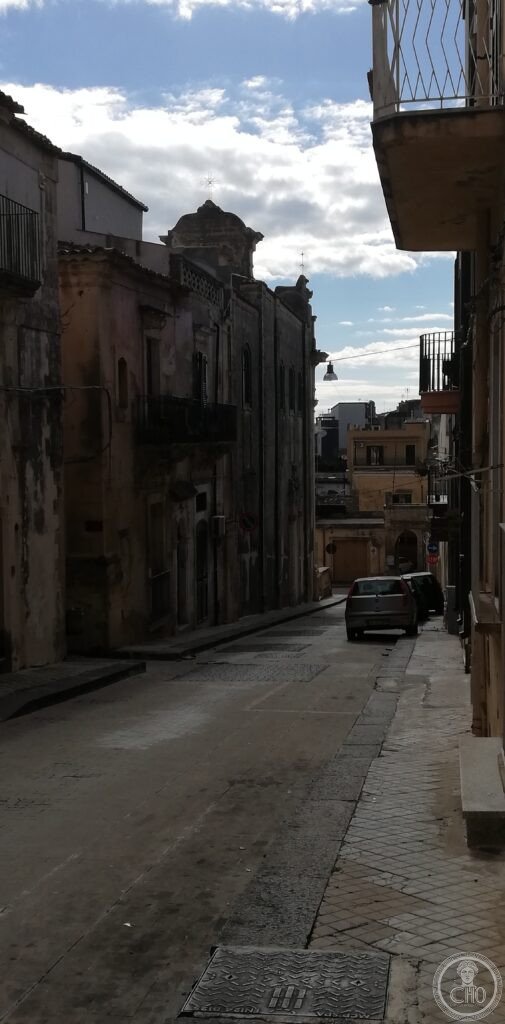
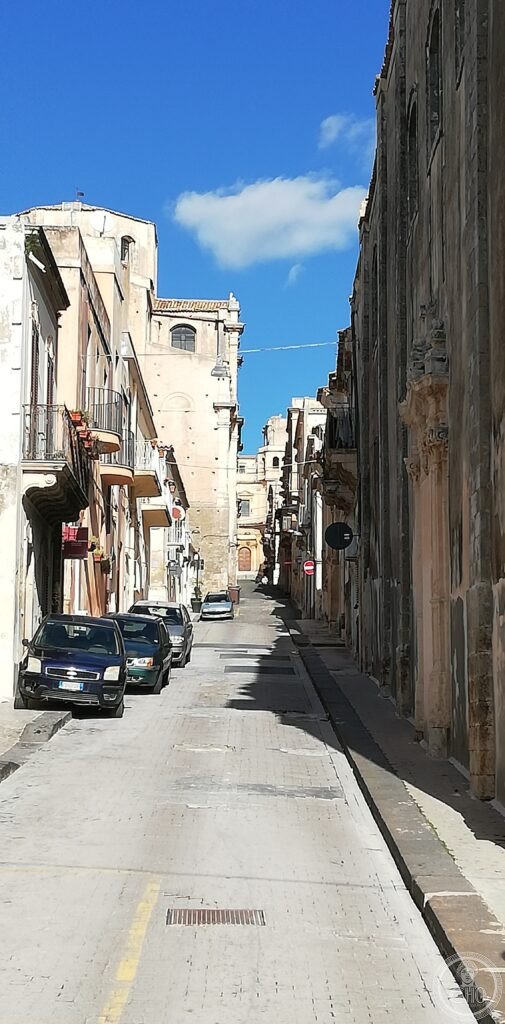
The most remarkable single street in Noto is Via Corrado Nicolaci, which runs north from the Corso at a right angle: looking west along this street from the Corso, the eye is led along a row of identical Baroque palaces to the church of Montevergini at the far end, in a perspective composition so deliberate that it reads as a stage set. On this street is Palazzo Villadorata, whose six balconies are supported by an extraordinary variety of grotesque figures — no two the same.
Gallery
Practical information
- Cathedral: Open daily 9:30–12:30 and 16:30–19:30. Free. The crypt and the panoramic terrace (above the dome) can be visited with a guide (small fee; enquire in the sacristy).
- Palazzo Nicolaci: Open daily 10:00–13:00 and 15:00–19:00. Admission ~€3. The state rooms are decorated with 18th-century furniture and painted ceilings.
- Infiorata: Third Sunday of May; Via Corrado Nicolaci is carpeted with flower petal images — the most famous annual event in Noto.
- Best light: Late afternoon (16:00–19:00 in summer); the west-facing Cathedral facade turns gold in the late sun. The Corso is particularly beautiful in the first and last two hours of daylight.
- Duration: 2–3 hours for a thorough visit to the historic centre.
Getting there
Noto, Siracusa, Sicilia. 32 km south-west of Siracusa. By train: Trenitalia regional service from Siracusa (25 minutes, about 8 trains daily); the station is 1 km from the Cathedral (15 minutes on foot uphill; bus from station available). By car: A19 or SS115 from Siracusa; by car from Catania (70 km, 1h); by car from Ragusa (55 km, 45 min). By bus: SAIS / AST buses from Siracusa, Catania, and Ragusa. From Palermo: 3h15 by car or 3h20 by train (change at Catania Centrale). Parking: Piazzale Ainis (free) or Piazzale Alcide De Gasperi (paid) near the historic centre; ZTL applies in the Corso area from late morning.
Nearby
- Riserva Naturale di Vendicari — 15 km south; coastal wetland and archaeological site; flamingos, herons, and migratory birds; Byzantine tuna factory (tonnara) ruins; one of the finest beaches in Sicily (Calamosche, Marianelli)
- Modica — 25 km west; UNESCO 2002; famous for its Baroque Churches (San Giorgio, San Pietro) on hillside staircases; and for the Modica chocolate made without cocoa butter (Aztec recipe, pre-Spanish recipe preserved by the Spaniards in Sicily)
- Siracusa e Ortigia — 32 km north-east; UNESCO 2005 (ref.1200); the Greek city of Archimedes and Cicero; the Temple of Athena inside the Baroque Duomo; Archimedes’s fountain; the Greek theatre (V century BCE)
Sources
- UNESCO: whc.unesco.org/en/list/1024
- Wikipedia EN: Noto, Sicily
- Tobriner, Stephen: The Genesis of Noto, University of California Press, 1982
- Gerbino, Giuseppe; Kieven, Elisabeth; Schubert, Dirk (eds.): Filippo Juvarra: Architect to the Kings of Sardinia, London, 2003 (Sicilian baroque context)
Find it on the map
See this place and what’s around it →📷 Become a Cultural Heritage Online photographer
Share your photos of places: they stay published under your name as the author. The more they're seen, the more you get noticed — and soon a contest will reward the most appreciated photos.
Log in or sign up free to add a photo