
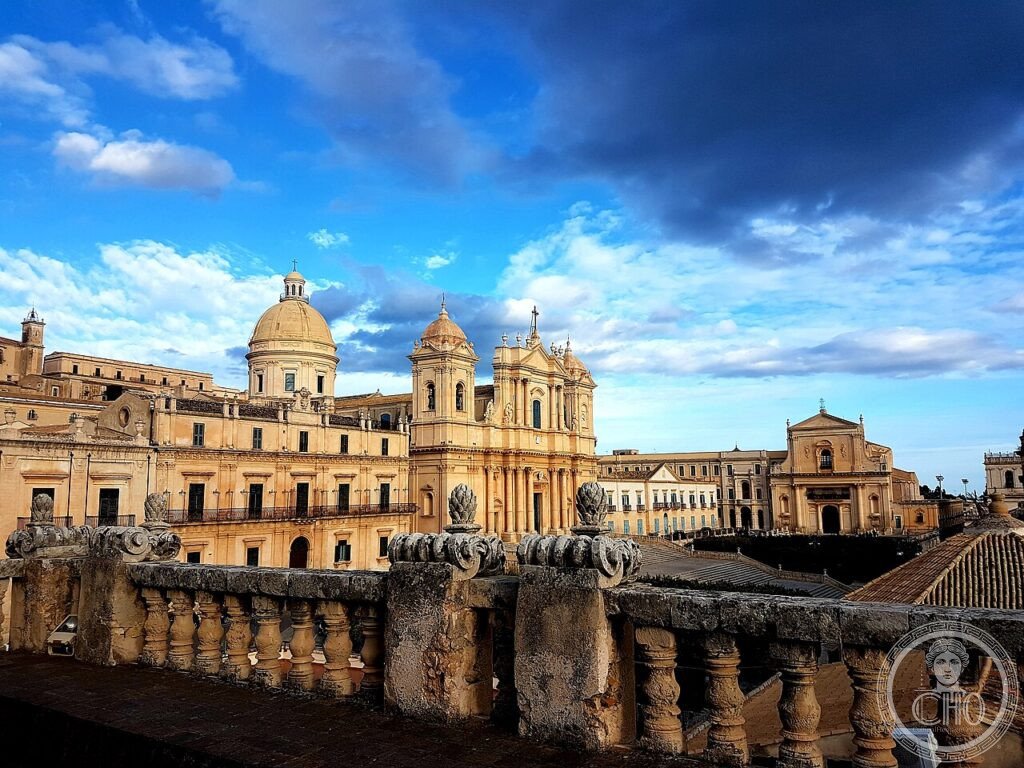
Noto — la Capitale del Barocco Siciliano (1693-1776): il Duomo di San Nicolò, il Corso Vittorio Emanuele e la Città-Palcoscenico Ricostruita in Pietra Dorata dopo il Terremoto del 1693 (UNESCO 2002)
Noto, rebuilt from scratch on a new site (the plateau of Meti, 8 km from the destroyed medieval city) after the earthquake of 11 January 1693, is the only city in the Val di Noto group that was entirely planned and built in a single coherent campaign — making it the most complete surviving Baroque urban composition in Italy and the one most deserving of its title as “the capital of Sicilian Baroque.”
At a glance
Noto (province of Syracuse, Sicilia) is the most celebrated of the eight cities inscribed in the UNESCO serial property “Late Baroque Towns of the Val di Noto” (2002, ref. 1024). Unlike Modica or Ragusa, which were rebuilt on their original sites, the old city of Noto (Noto Antica) was abandoned after the 1693 earthquake and the population relocated to the nearby plateau of Meti, where an entirely new city was planned from a blank slate. The result is the most deliberately theatrical Baroque urban composition in Sicily: three parallel streets (the upper Via Cavour, the middle Corso Vittorio Emanuele, and the lower Via Silvio Spaventa) are connected by lateral streets forming a rectangular grid laid on the hillside; the principal public buildings (cathedral, town hall, bishop's palace, convents) are arranged along the central Corso Vittorio Emanuele as a sequence of set pieces — stairs, facades, courtyards, and terraces — that form a continuous promenade of Baroque architecture approximately 600 m long and unequalled in southern Italy.
Key facts
- The 1693 earthquake and the new Noto: The earthquake of 11 January 1693 (one of the strongest in Italian history, estimated M 7.4) destroyed virtually all of the old Noto (Noto Antica, on a hilltop site 8 km from the current city); the survivors debated between rebuilding on the same site or relocating; the faction in favour of relocation (led by the Lombard military engineer Giuseppe Lanza, Duke of Camastra, the royal commissioner appointed to oversee the reconstruction) prevailed; the new city was laid out on the plateau of Meti, on a level site that allowed the grid plan; the first buildings were completed by c.1700, the cathedral by 1776
- Duomo di San Nicolò (1694-1776): The cathedral of Noto, on the upper side of Piazza Municipio (the principal public space on the Corso Vittorio Emanuele), designed by Rosario Gagliardi and Giovanni Battista Landolina; the three-aisle facade (three concave bays framed by paired Corinthian columns on two superimposed storeys, crowned by a pediment) is the finest Baroque church facade in Sicily; the dome (the visual termination of the composition when seen from the Corso) collapsed in 1996 (structural failure during restoration) and was rebuilt and completed in 2007. The cathedral restoration (1990-2007) was the most complex and expensive single monument conservation project in Sicilian history
- Palazzo Nicolaci di Villadorata (1737): The finest Baroque aristocratic palace in Noto, on Via Corrado Nicolaci (the street leading north from the Corso); the six balconies on the Via Nicolaci facade have the most elaborate carved corbels in Sicily — bearing human faces, horses, mermaids, lions, and sphinxes designed by Paolo Labisi; the annual Infiorata di Noto (flower festival, May) is held on Via Nicolaci
- Noto Antica (old Noto, abandoned 1693): The ruins of the medieval city (on a rocky hilltop, 8 km from the current city) are accessible via a dirt road and form the most extensive abandoned medieval town site in Sicily; the ruins of the Castle, the Cathedral, and the urban fabric are partially visible but unexcavated
- UNESCO: 2002, ref. 1024
- GPS: 36.8897, 15.0676 — Google Maps
History
The old Noto (Noto Antica) was a Sicel and then Greek settlement (known as Netum to the Greeks) that became one of the most important Arab fortified towns in Sicily (the Arabs called it Naud) and then a Norman, Swabian, Angevin, and Aragonese city; at the time of the 1693 earthquake it was a city of approximately 12,000 people with a substantial built environment (the cathedral and several palaces and churches). The earthquake destroyed it so completely that the Duke of Camastra reported to the viceroy that reconstruction on the original site was impossible. The new Noto (begun 1694, substantially complete by 1750, definitively finished with the cathedral in 1776) was entirely planned as a formal urban composition: the street grid, the public building placement, the standardized plot sizes, and the regulation of facade treatment (the warm golden limestone of the Iblean hills — the same stone used for all public buildings) were all specified in the original plan. This uniformity of material and planning gives the city a coherence that individual Baroque buildings in other contexts lack.
What you see
The principal monument circuit of Noto is along the Corso Vittorio Emanuele (the middle of the three parallel streets, at the level of the cathedral). Walking from east (Porta Reale, the triumphal arch at the city entrance, 1838, neoclassical) to west, the sequence is: the church of San Francesco all'Immacolata (1704, on the left, with a wide staircase leading to the 18th-century convent now the Museo Civico); Piazza Municipio (the main square, with the Cathedral on the right — atop its three-flight staircase — and the Palazzo Ducezio/municipio on the left; the perspective of the Cathedral facade from the piazza is the most-photographed view in Noto); and further west, the convent of Santa Chiara and the church of the SS. Salvatore with its tower.
The upper parallel street (Via Cavour) runs along the terrace above the Corso and offers the finest elevated views over the lower parts of the city and the Iblean hills; Via Corrado Nicolaci (leading north from mid-Corso) has the Palazzo Nicolaci di Villadorata (the balconies with the carved corbels). The lower parallel street (Via Silvio Spaventa) has less touristic traffic and preserves the most authentic residential fabric of 18th-century Noto.
Gallery
Practical information
- Duomo di San Nicolò: Piazza Municipio, Noto; open daily 9:00-12:00 and 16:00-19:00; admission to treasury and dome terrace ~€4. The dome terrace (accessible via a staircase inside the cathedral, ticket required) offers a 360-degree view over the city and the Iblean hills to the sea (18 km south).
- Palazzo Nicolaci di Villadorata: Via Corrado Nicolaci 18; open Tuesday-Sunday 10:00-13:30 and 14:30-18:00 (summer extended); admission ~€5; the Sala delle Feste (principal reception room) has an elaborate fresco ceiling and rococo furniture.
- Infiorata di Noto (flower festival): Every May (third Sunday), Via Corrado Nicolaci is covered in elaborate patterns made from fresh flowers; the city is extremely crowded during this period (book accommodation 6+ months in advance). Best avoided if you prefer the city quiet.
- Season: April-June and September-October. July-August is very hot (38-40°C) and crowded.
Getting there
Corso Vittorio Emanuele, Noto (SR), Sicilia. GPS 36.8897, 15.0676. By train: Trenitalia from Syracuse (30 min, regional; 5-6 trains/day), Catania (1h30 with change at Syracuse). By car: from Syracuse, SS115 south-west (32 km, 30 min); from Catania, A18/SS114 then SS115 (100 km, 1h20); from Palermo, A19 then SS514 and SS115 (260 km, 3h). Parking at Piazzale Marconi (outside Porta Reale, main gate at the eastern end of the Corso).
Nearby
- Modica — 35 km west; (CHO card: Modica — il Barocco del Val di Noto UNESCO 2002); the Duomo di San Giorgio (Gagliardi, 1702-1738) and the Cioccolata di Modica (cold-process chocolate, pre-Columbian Aztec recipe via Spanish)
- Ragusa Ibla — 45 km west; (CHO card: Ragusa Ibla — il Barocco Tardo del Val di Noto UNESCO 2002); the Duomo di San Giorgio (Gagliardi, 1746) on the famous balconied ridge; the Palazzo Cosentini corbels
- Ortigia (Siracusa storica) — 32 km north-east; the island historic centre of Syracuse with the Cathedral (built inside the Doric temple of Athena, 480 BCE) and the Fonte Aretusa (the freshwater spring on the sea, already described by Pindar); UNESCO separately inscribed 2005 (Necropoli rupestri di Pantalica e Siracusa, ref.1185)
Sources
- UNESCO: whc.unesco.org/en/list/1024
- Wikipedia EN: Noto, Sicily
- Blunt, Anthony: Sicilian Baroque, Weidenfeld and Nicolson, 1968
- Comune di Noto: comune.noto.sr.it
Find it on the map
See this place and what’s around it →📷 Diventa un fotografo di Cultural Heritage Online
Condividi le tue foto dei luoghi: restano pubblicate con la tua firma come autore. Più vengono viste, più ti fai conoscere — e presto un concorso premierà le foto più apprezzate.
Accedi o registrati gratis per aggiungere una foto