
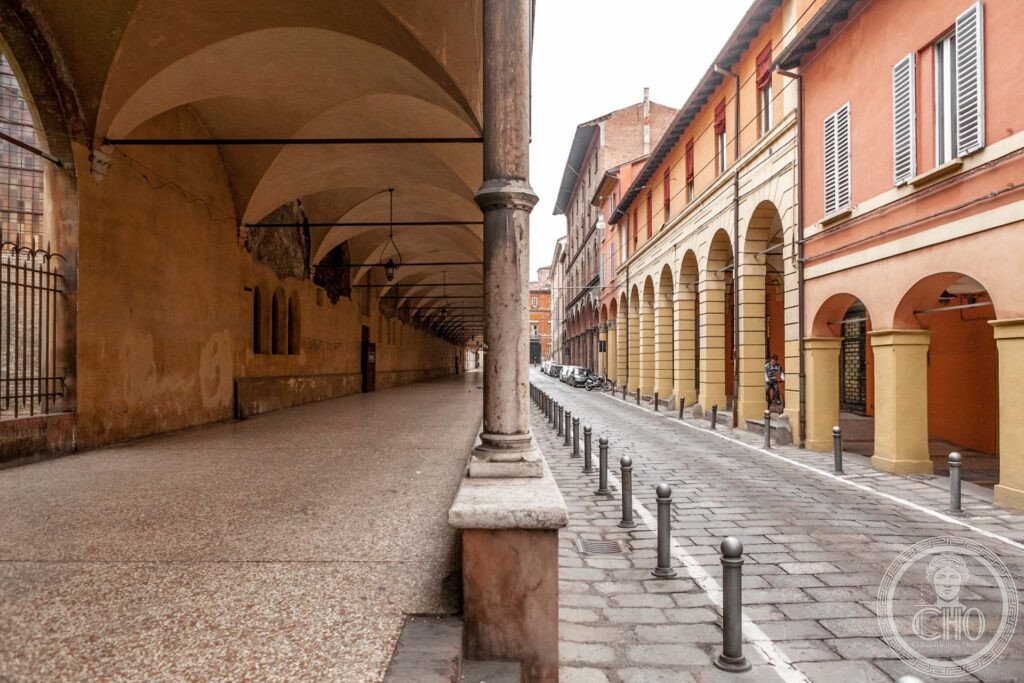
Portici di Bologna (XI-XX sec.): i 38 Km di Arcate Pedonali della Prima Città Universitaria d’Europa — da Via Rizzoli alla Basilica di San Luca (UNESCO 2021)
Bologna’s arcaded walkways — 62 km total, 38 km of which are protected by local law, and 12.5 km of which form the UNESCO-inscribed core property — represent the most extensive and most socially embedded portico system in any European city: not a decorative addition to existing buildings but a structural feature inseparable from the Bolognese urban form since the 11th century, when the wooden-roofed projections of upper-storey rooms over the street (the “sporti”) were regularized into stone arcades to provide covered circulation for the students and merchants of the first European university town.
At a glance
The Porticoes of Bologna (UNESCO 2021, ref. 1650) is a serial property with 12 component elements that illustrate the range of portico typologies in Bologna across the entire period of their construction: from the 11th-century wooden porticoes (represented by the portico of Strada Maggiore) to the 19th-century and early 20th-century neoclassical and Art Nouveau arcades; and including the Portico di San Luca (a single continuous covered walkway of 3.8 km, 666 arches, and 15 oratories connecting the centre of Bologna to the hilltop sanctuary of the Madonna di San Luca). The inscription also recognizes the social dimension of the porticoes: they are not a museum artifact but a continuously inhabited infrastructure — the bars, shops, restaurants, and university departments that occupy the ground-floor bays of the arcades are the same functions they have served for over 900 years.
Key facts
- Origins (11th-12th centuries): The Bolognese porticoes emerged in the 11th century with the growth of the city after the establishment of the university (1088 CE, the oldest university in the Western world); the university attracted students from across Europe who needed housing, and the most economical solution was the extension of the upper floor of residential buildings over the street (the “sporto”), supported on wooden columns; a municipal statute of 1288 regulated the minimum height of the arcade (7 Bolognese feet = 2.66 m, sufficient to allow a man on horseback to pass) and required all new buildings on the main streets to have arcades. The wooden columns were progressively replaced by brick piers in the 14th-15th centuries
- The Portico di San Luca: The most exceptional single portico in Bologna: 3.8 km long, 666 arches (including 15 oratories incorporated in the arcade at irregular intervals, each with a panel with a scene from the life of the Virgin), connecting the Meloncello arch (at the foot of the Apennine hill, 1.5 km from the city centre) to the Sanctuary of the Madonna di San Luca (on the top of the Colle della Guardia, 291 m above sea level); built between 1674 and 1793; it is the longest continuous covered walkway in the world and was built specifically to protect the annual procession carrying the image of the Madonna di San Luca from the hilltop sanctuary to the Cathedral of Bologna and back
- Statistical facts: 62 km total length of porticoes in Bologna; 38 km protected by local and national law; 12.5 km inscribed in the UNESCO property; 666 arches in the Portico di San Luca; Bologna is the city with the highest density of porticoes per inhabitant in the world (approximately 61 m of portico per 100 inhabitants in 2021)
- The university (1088 CE): The Alma Mater Studiorum (University of Bologna, founded 1088 CE) is the oldest university in Western history; it began as a school of law (the systematic study of Justinian's Corpus Juris Civilis, rediscovered in the 11th century in a Pisa manuscript) and expanded to theology, medicine, and philosophy; it attracted students from every European country, including notable alumni such as Dante Alighieri, Francesco Petrarch, Pico della Mirandola, Erasmus of Rotterdam, and Copernicus (who studied medicine here 1496-1500)
- UNESCO: 2021, ref. 1650
- GPS: 44.4949, 11.3426 — Google Maps (Piazza Maggiore / start of portico circuit)
History
Bologna was a flourishing Roman colony (Bononia, founded 189 BCE) and an important medieval commune (one of the leading Lombard League cities against Frederick Barbarossa in the 12th century). The university's foundation (1088, when Irnerius began teaching Roman law systematically at Bologna) transformed the city from a medium-sized commune into a major European intellectual centre within two generations: by the late 12th century, Bologna had 10,000-15,000 students (in a city of perhaps 30,000-40,000 total), most of them transient foreigners who needed affordable housing and covered market areas. The porticoes became the architectural solution to this pressure: the city government (the Commune di Bologna) regulated their construction, standardized their dimensions, and integrated them into the property law (the arcaded bays were legally part of the public street — the landowner built and maintained them at his own expense but could not charge rent for their use). This 12th-century regulatory framework created the extraordinary continuity of Bolognese street frontage that survives today.
What you see
The portico walk in central Bologna begins at the Piazza Maggiore (the main civic space, flanked by the Basilica of San Petronio, the Palazzo dei Banchi, and the Palazzo Comunale) and proceeds along Via Rizzoli to the Piazza del Nettuno and then Via dell'Indipendenza (19th-century arcaded boulevard) northward, or along Via Rizzoli eastward to the Due Torri (the two surviving medieval towers — Torre degli Asinelli, 97.2 m, the tallest leaning medieval tower in Italy, and Torre della Garisenda, 48 m, leaning 3.2 degrees; both from the 11th-12th century) and then along Strada Maggiore to the Santuario della Madonna di San Luca.
The Portico di San Luca (the 3.8 km single covered walkway to the hilltop sanctuary) is the most unusual architectural experience in Bologna: the 666 arches run continuously from the Arco del Meloncello (Luigi Ferdinando Marsili, 1722) at the foot of the hill to the Sanctuary (Carlo Francesco Dotti, 1723-1765) at the summit, never interrupted by a cross street; the 15 small oratories are incorporated at intervals. The uphill walk takes approximately 50-60 minutes at a normal pace; the downhill return is 35-40 minutes. The Sanctuary terrace (at 291 m) has the best panoramic view of Bologna and the Po Plain available on foot.
Gallery
Practical information
- Porticoes (central Bologna): No admission fee; the arcades are public streets accessible 24 hours. The main shopping and historical arcade circuit (Piazza Maggiore → Via Rizzoli → Due Torri → Strada Maggiore → Via Santo Stefano → Piazza Mercanzia → Via Castiglione → Via Farini → Piazza Maggiore) is approximately 3 km and takes 1.5 hours at a leisurely walking pace with stops.
- Torre degli Asinelli: Piazza di Porta Ravegnana (the Due Torri); open daily 10:00-17:00 (winter), 9:00-20:00 (summer); admission ~€5 (500 steps); the views from the top over the terracotta rooftops of Bologna are the finest available in the city.
- Portico di San Luca: The arcade itself is free and open at all times; the Sanctuary of Madonna di San Luca (Colle della Guardia) is open daily 7:00-12:30 and 14:30-18:00 (summer extended); the funicular (San Luca Express) from the Meloncello arch operates weekends and holidays; admission ~€3 each way.
- Season: Year-round; the porticoes were specifically designed to allow year-round pedestrian use in any weather; summer rain and winter cold are equally irrelevant under the arches. July-August is hot (35-37°C inland in the Po plain) but the arcades provide shade.
Getting there
Piazza Maggiore, Bologna (BO), Emilia-Romagna. GPS 44.4949, 11.3426. By train: Bologna Centrale is a major Italian railway hub on the Milan-Florence-Rome high-speed line (Milan: 65 min; Florence: 35 min; Rome: 2h10; Venice: 1h35 by high-speed). From Bologna Centrale, 15-min walk or bus to Piazza Maggiore. By car: from Milan, A1 south (200 km, 1h50); from Florence, A1 north (110 km, 1h15); from Venice, A13 then A14 (155 km, 1h35). Limited Traffic Zone (ZTL) in the historic centre — park at the Autostazione parking (Via Riva Reno) or use park-and-ride.
Nearby
- Ferrara — 50 km north-east; the Renaissance city planned by the Este family in the 15th-16th centuries (Addizione Erculea, 1492 — the first urban extension in Europe designed as a whole according to a new grid plan); the Este Castle (14th century, with moat) and the extraordinary Cathedral (12th-century Romanesque facade with Wiligelmus carvings); UNESCO 1995 (ref.733)
- Ravenna — 75 km east; UNESCO 1996 (ref.788); 8 early Christian and Byzantine monuments including Sant'Apollinare in Classe (c.534 CE, the finest apse mosaic in Italy: the golden standing Christ+bishop+procession in the semi-dome), San Vitale (547 CE, the mosaics of Justinian and Theodora), and the Mausoleo di Galla Placidia (c.430 CE)
- Modena — 40 km north-west; the Romanesque Cathedral (Duomo di Modena, 1099-1184, Wiligelmus sculptor; UNESCO 1997 ref.827); the Este collection (Galleria Estense, one of the finest Italian old-master collections); Ferrari Museum (Maranello, 15 km south)
Sources
- UNESCO: whc.unesco.org/en/list/1650
- Wikipedia EN: Porticoes of Bologna
- Ricci, Giovanni: Bologna, Laterza, 1980
- Comune di Bologna, portici: comune.bologna.it/portici
Find it on the map
See this place and what’s around it →📷 Diventa un fotografo di Cultural Heritage Online
Condividi le tue foto dei luoghi: restano pubblicate con la tua firma come autore. Più vengono viste, più ti fai conoscere — e presto un concorso premierà le foto più apprezzate.
Accedi o registrati gratis per aggiungere una foto