
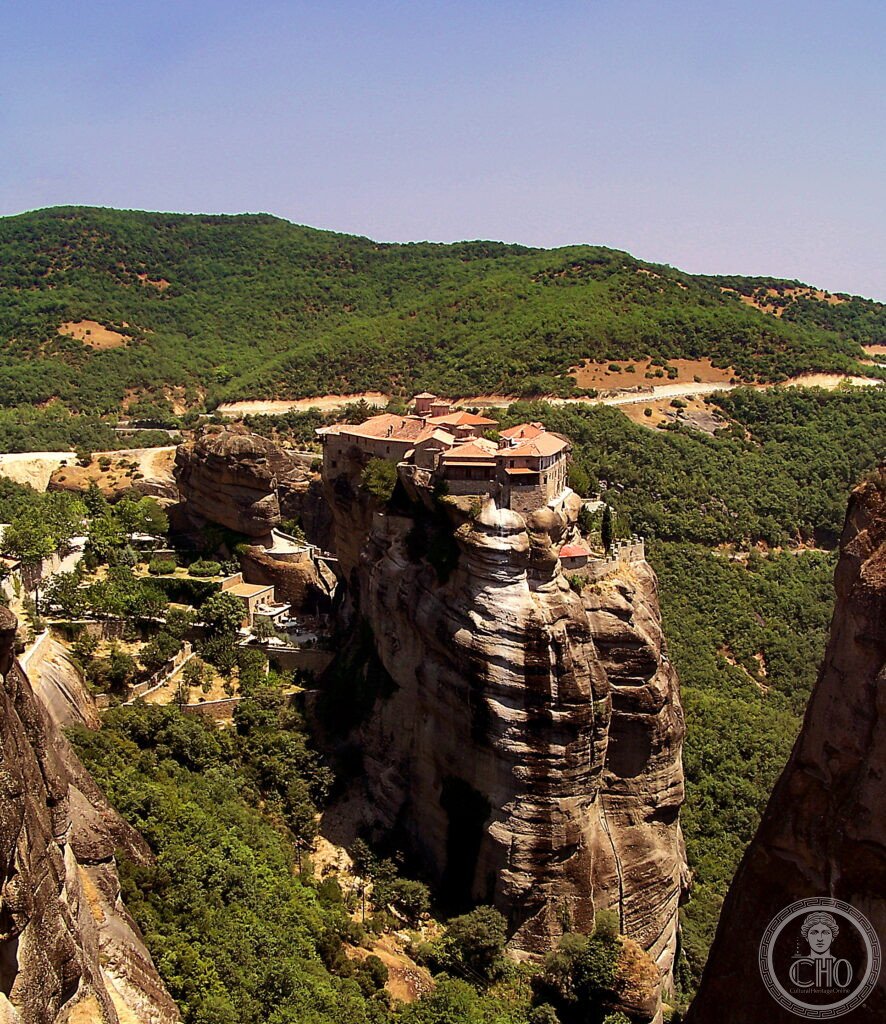
Meteora — Thessaly
Six Byzantine monasteries perched on top of free-standing sandstone columns 300 metres above the Thessaly plain — monks who chose the most inaccessible summits they could find and then built churches and libraries on them, hauling their building materials up in rope nets that were only replaced when God indicated the time had come.
At a glance
Meteora (Greek: Μετέωρα, “suspended in the air”) is a complex of Eastern Orthodox monasteries built on natural sandstone pillars in the Thessaly region of central Greece, near the town of Kalambaka at the northern edge of the plain of Thessaly. The rock formations — approximately 60 separate columns, the tallest 400 metres high, formed by geological uplift from an ancient seabed over millions of years — were first inhabited by hermit monks in the 11th century; the first monastery (the Holy Monastery of the Great Meteoron) was founded in the mid-14th century by Athanasios Koinovitis, who was followed by the Serbian Emperor Stefan Uroš IV Dušan as his patron. At the peak of the monastic community in the 16th century, there were 24 monasteries on the rocks; today six survive as active monasteries, all operating with monastic communities, all open to visitors outside prayer times. Meteora is a UNESCO World Heritage Site, inscribed 1988.
Key facts
- Monasteries: six active: Great Meteoron (the largest), Varlaam, Roussanou (nunnery), St Nicholas Anapafsas, Holy Trinity, St Stephen (nunnery); all accessible by modern stone-cut stairs replacing the original rope ladders and baskets
- Rock formation: approximately 60 sandstone columns; composed of Eocene conglomerate formed on the bed of an ancient lake 60 million years ago; geologists estimate the columns were shaped by a combination of earthquake uplift, water erosion, and wind erosion over tens of millions of years
- First monastery: Holy Monastery of the Great Meteoron, founded c. 1340–1380 by Athanasios Koinovitis (who climbed the 613-metre column with the help of an eagle, according to the monastery’s foundation legend); greatly expanded by King Stefan Uroš IV Dušan and subsequent donors
- Frescoes: the monasteries contain Byzantine fresco programmes of exceptional quality; the catholicon (main church) of each monastery has a complete iconographic programme; the Great Meteoron’s narthex (16th century) and Varlaam’s catholicon (1548) are the finest
- Libraries and manuscripts: the monasteries preserve extensive collections of Byzantine manuscripts and printed books; many were transferred to larger libraries (Athens, Vatican, Mount Athos) during the 20th century; significant collections remain, particularly in the Great Meteoron
- Heritage: UNESCO World Heritage Site, inscribed 1988
- GPS: 39.7217° N, 21.6306° E
History
The first hermits arrived at the Meteora rocks in the 11th century, seeking caves on the cliff faces as places of prayer inaccessible to both Ottoman raiding parties (which were increasing in frequency as Byzantium weakened) and to the temptations of the inhabited lowlands. The community of Stagoi (later Kalambaka) at the base of the rocks had been a bishop’s see since the 4th century; the hermits on the rocks were thus part of an established religious landscape rather than isolated individuals. The crucial development was the mid-14th-century decision by Athanasios Koinovitis to found a cenobitic (communal) monastery rather than merely a collection of hermitages; this institutionalised the community and attracted the patronage of wealthy donors, including the Serbian rulers who controlled Thessaly in the 14th century.
The monasteries’ peak was the 15th–16th century, when income from Serbian and later Byzantine aristocratic donors funded the construction of the main church buildings and the painting of their fresco programmes. The access problem was never fully solved in the medieval period: monks and supplies were hauled up in rope nets or on thin rope ladders; the saying that the ropes were replaced only “when it pleased God” (i.e. when they broke) appears in traveller accounts from the 17th century. The first steps carved into the rock faces were cut in 1920; the current access roads and stairs were completed in the 1960s.
The Ottoman period (from the 15th century) paradoxically helped preserve the monasteries; their inaccessibility made them resistant to Ottoman taxation and raiding, and Ottoman authorities generally tolerated the monasteries as non-threatening. The Greek War of Independence (1821–1829) disrupted the community; many monks fled or were killed; the monasteries declined through the 19th century. A revival in the 20th century increased the monastic communities; today the six active monasteries have small but committed communities of monks and nuns. UNESCO inscription in 1988 led to improved conservation of the fresco programmes.
What you see
The approach to Meteora from Kalambaka is one of the great landscape arrivals in Greece: the town gives way to rock formations that become progressively more extraordinary as you drive up the winding road; at a certain point you realise that the shapes on top of the rocks are buildings, not natural formations. The monasteries are small — each one comprises a catholicon (main church), a refectory (often used as a secondary chapel), cells, storerooms, and a garden terrace — all fitted into the few hundred square metres of summit available.
The interior of each catholicon follows the same Byzantine scheme: the narthex (entrance hall) with the Last Judgement and scenes of martyrdom on the west wall; the naos (main body) with the iconostasis separating the nave from the sanctuary; the dome above the crossing with the Pantocrator (Christ as ruler of all) in the central medallion. The frescoes at Varlaam (1548) and the Great Meteoron are painted by artists from the Cretan school in a style that synthesises Byzantine formality with late-Gothic spatial depth. The view from any monastery terrace — across the Thessaly plain to the mountains of Pindus — is extraordinary at any time of day but particularly at sunset, when the rock columns cast long shadows across the valley.
Practical information
- Access: all six monasteries are accessible by road and walking paths; the town of Kalambaka at the base has hotels, restaurants, and the railway station; a circular road connects all six monasteries (approximately 12 km by car)
- Hours: generally 9 am–5 pm (some to 6 pm in summer); each monastery closes one day per week (different days, so at least 4 are open on any given day); check individual monastery hours as they vary seasonally
- Admission: EUR 3–4 per monastery; modest dress required (no shorts, covered shoulders; sarongs provided at the entrance for those who are inappropriately dressed)
- Best time: spring (April–June) for wildflowers and green slopes; autumn (September–October) for crowds and golden light; summer is hot and extremely crowded; winter gives empty monasteries and often snow on the rocks
- Sunrise and sunset: the rocks are most dramatically lit at these times; the best viewpoint for photography is the road between Varlaam and the Great Meteoron, looking west at sunset
Getting there
Kalambaka has direct trains from Athens (4 hours) and Thessaloniki (2.5 hours); the Intercity Express from Athens runs twice daily. By car from Athens: 4 hours via E75/A1 motorway north to Trikala, then west to Kalambaka. The monasteries are 2–5 km by road from Kalambaka town. GPS: 39.7217, 21.6306.
Nearby
- Kalambaka and Kastraki — the two towns at the base of the rocks; Kastraki is the smaller and quieter, immediately below the rocks; several excellent tavernas serving Thessalian food (lamb, pies, local cheese)
- Mount Olympus — the highest mountain in Greece (2,918 metres) and the mythological home of the gods; 2 hours north-east of Kalambaka; hiking trails to the summit from the village of Litochoro
- Delphi — the Oracle sanctuary of Apollo on the slopes of Mount Parnassus; the Museum of Delphi has the Bronze Charioteer and the Omphalos; 3 hours south of Kalambaka
- Thessaloniki — the second city of Greece, 2.5 hours north; Byzantine churches and museums, the Rotunda, the Thessaloniki Archaeological Museum (Alexander the Great finds)
Sources
- Wikipedia, Meteora, accessed June 2026
- UNESCO, Meteora, WHS reference 455, inscribed 1988
- Nikiphoros Metsovitis, Meteora: History, Art and Life in the Monasteries, Ekdotike Athenon, 1999
Find it on the map
See this place and what’s around it →📷 Diventa un fotografo di Cultural Heritage Online
Condividi le tue foto dei luoghi: restano pubblicate con la tua firma come autore. Più vengono viste, più ti fai conoscere — e presto un concorso premierà le foto più apprezzate.
Accedi o registrati gratis per aggiungere una foto