
Pompeii
On 24 August 79 AD, Vesuvius buried a prosperous Roman city of 11,000 people under 4–6 metres of volcanic ash and pumice, preserving it in extraordinary completeness — the daily life of Roman Italy sealed in real time, the election notices still on the walls, the loaves still in the bakery ovens, the graffiti still on the street corners.
At a glance
Pompeii lies at the foot of Vesuvius in the Campania region of southern Italy, 25 kilometres south-east of Naples, its 66-hectare excavated area one of the most visited archaeological sites in the world (approximately 3 million visitors annually). The city was founded in the 6th century BC, probably by the Oscan-speaking Samnite people; it became a Roman colony in 80 BC under Sulla; by 79 AD it was a prosperous commercial city with a Forum, two theatres, an amphitheatre (the oldest surviving stone amphitheatre in the Roman world), multiple bathhouses, temples, and a dense network of commercial streets. The eruption of 79 AD buried Pompeii under 4–6 metres of lapilli (volcanic debris) and ash, sealing the city and preserving its contents to an extent unparalleled in the ancient world. Excavations began under the Bourbon King of Naples in 1748 and have continued since; approximately one third of the site remains unexcavated. Pompeii is a UNESCO World Heritage Site, inscribed 1997.
Key facts
- Size: 66 hectares excavated; approximately 20 hectares unexcavated; the city walls enclose an area of approximately 170 hectares; population at 79 AD estimated at 11,000–20,000
- Eruption: 24 August 79 AD (some scholars argue October 79 AD based on pomegranate seeds and autumn clothing found in deposits); the eruption lasted approximately 19 hours; the city was buried under 4–6 metres of lapilli, pumice, and ash; Pliny the Younger’s two letters to Tacitus are the primary textual source
- Plaster casts: Giuseppe Fiorelli (director of excavations 1863–1875) pioneered the technique of injecting liquid plaster into the voids left by decomposed organic matter, producing casts of human bodies, animals, and wooden objects in their final positions; approximately 1,150 casts have been made
- Key monuments: Forum (the political, religious, and commercial centre); Basilica (the oldest known example of this building type, 2nd century BC); Temple of Apollo (6th century BC, predating Roman colonisation); House of the Faun (the largest private house in Pompeii, source of the Alexander Mosaic, now in Naples); Lupanar (brothel, with explicit frescoes of services offered above each room)
- The Great Pompeii Project: a major EU-funded conservation and excavation initiative (2012–2023) has stabilised many damaged structures, discovered new frescoes, and excavated entirely new zones including a ceremonial banquet room (Regio V) with extraordinary intact frescoes discovered 2018–2023
- Heritage: UNESCO World Heritage Site, Archaeological Areas of Pompei, Herculaneum and Torre Annunziata, inscribed 1997
- GPS: 40.7508° N, 14.4857° E
History
Pompeii was a Samnite city before it became Roman; the oldest layer of excavation reveals an Oscan-speaking community whose urban plan and religious buildings predate the Roman colonisation. After the Social War (91–87 BC), during which Pompeii sided with the Italian allies against Rome, Sulla besieged and took the city in 89 BC; the marks of Roman slingshots are still visible on the city wall near the Herculaneum Gate. The Roman colony (80 BC) brought a wave of new building: the Forum was enlarged, the Basilica constructed, the amphitheatre built. The city experienced a severe earthquake in 62 AD; much of the Forum area was still under repair when the 79 AD eruption occurred, which is why so many Forum buildings were in a partially dismantled state when excavated.
The eruption began with a column of ash and gas that rose 33 kilometres into the atmosphere before collapsing in a series of pyroclastic surges (fast-moving currents of superheated gas and rock). Most Pompeians who died did so not from the initial fall of pumice but from the pyroclastic surge in the early hours of 25 August; the plaster casts show people in postures of asphyxiation and thermal shock, not burial. The wealthier residents, who had time to flee, survived; the bodies found in the city are disproportionately the poor, the enslaved, and those who returned for their belongings.
The systematic excavations since 1748 have made Pompeii the most studied ancient city in the world. The volume of graffiti alone — over 11,000 inscriptions — has transformed our understanding of Roman literacy, commercial life, sexuality, and political culture. The evidence of election advertising (programmes — literally painted endorsements on house walls), tavern menus, love poetry, obscenities, and philosophical quotations has shifted the scholarly perception of Roman urban culture from the formal and official to the vernacular and chaotic. The ongoing Regio V discoveries since 2018 have added a carbonised horse harness with bronze and silver fittings, a rich ceremonial room with mythological frescoes, and a snack bar (thermopolium) with painted images of its menu items and the carbonised remains of the food being served on the day of the eruption.
What you see
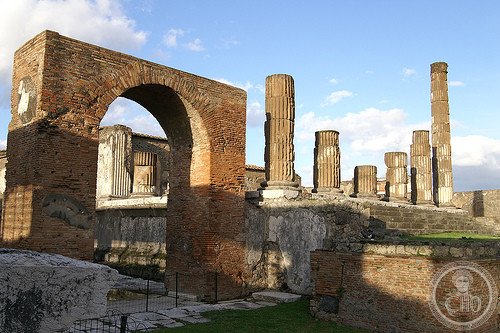
The entry to the site through the Marine Gate leads down the Via Marina to the Forum — the long rectangular plaza flanked by the columns of the Basilica, the Temple of Apollo, the Temple of Jupiter, and the macellum (covered market) at the north end, with Vesuvius rising behind the temple in the distance. The Forum is the spatial anchor of the city; from it, the grid of streets radiates outward to the eight city gates. The Via dell’Abbondanza running east from the Forum is the main commercial street: bars (thermopolia) with their stone counters and ceramic pot-holes, bakeries with the grinding stones still in place, laundry establishments, and election slogans painted on every flat surface.
The most affecting experience is the scale and completeness of the ordinary life preserved: the wheel ruts in the stone paving at intersections, the stepping stones across the street that allowed pedestrians to cross without stepping in the drainage channel (and between which the carts had to navigate), the phallus carved into a paving stone pointing toward the brothel, the garden beds still recognisable in the excavated soil of the atrium houses. The plaster casts in the Garden of the Fugitives — nine people huddled together in their final posture — are the most directly emotional objects in the site.
Practical information
- Address: Via Villa dei Misteri 2, 80045 Pompei (NA); main entrance near Pompeii Scavi railway station
- Hours: daily 9 am–5 pm (last entry 3:30 pm) in winter; to 7 pm (last entry 5:30 pm) in summer
- Admission: EUR 18 full; EUR 9 reduced (18–25 EU citizens); free for EU citizens under 18; combined ticket with Herculaneum available
- Booking: advance online booking (ticketone.it) strongly recommended April–October; the site is heavily visited and timed entry helps avoid the worst crowds
- Wear sensible shoes: the paving stones are uneven and slippery; no heels; sun hat and water essential in summer (little shade in the Forum)
- Time needed: the full site requires 4–6 hours; a focused visit (Forum, House of the Faun, amphitheatre, Lupanar) takes 2–3 hours
Getting there
Circumvesuviana railway (Napoli–Sorrento line) from Naples Piazza Garibaldi station to “Pompei Scavi–Villa dei Misteri” (35 minutes, EUR 3). From Sorrento: 30 minutes. By car: A3 motorway exit “Pompei Est” or “Pompei Ovest”. GPS: 40.7508, 14.4857.
Nearby
- Herculaneum (Ercolano) — the smaller, wealthier Roman town buried by the same eruption; better-preserved wooden structures, frescoes, and carbonised organic material than Pompeii; UNESCO WHS; 15 km north on the Circumvesuviana
- National Archaeological Museum, Naples (MANN) — holds the greatest collection of objects from Pompeii and Herculaneum including the Alexander Mosaic, the Secret Room (erotic objects), and the carbonised papyri from the Villa of the Papyri at Herculaneum
- Vesuvius — the only active volcano on the European mainland; the summit crater is accessible by a 30-minute walk from the car park; the view of the Bay of Naples from the rim is among the best in southern Italy
- Amalfi Coast — the UNESCO World Heritage coastal road from Positano to Amalfi; 30 km south of Pompeii; best accessed by ferry from Naples or Sorrento
Sources
- Wikipedia, Pompeii, accessed June 2026
- Parco Archeologico di Pompei: pompeii.it
- UNESCO, Archaeological Areas of Pompei, Herculaneum and Torre Annunziata, WHS reference 829, inscribed 1997
- Mary Beard, Pompeii: The Life of a Roman Town, Profile Books, 2008 — the best modern scholarly synthesis for a general audience
Find it on the map
See this place and what’s around it →📷 Diventa un fotografo di Cultural Heritage Online
Condividi le tue foto dei luoghi: restano pubblicate con la tua firma come autore. Più vengono viste, più ti fai conoscere — e presto un concorso premierà le foto più apprezzate.
Accedi o registrati gratis per aggiungere una foto