
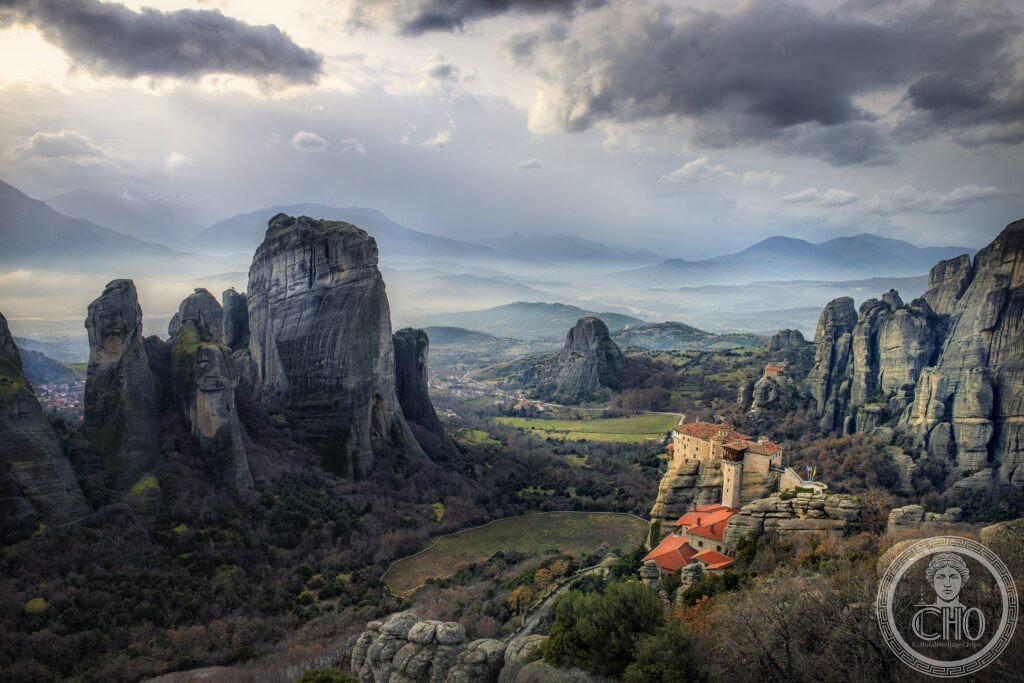
Meteora
One of the most otherworldly monastic landscapes on earth — Meteora in central Greece places six active Orthodox Christian monasteries on top of freestanding sandstone pillars that formed 60 million years ago, accessible for centuries only by ropes and nets, an isolation that preserved some of the finest Byzantine frescoes in the world.
At a glance
Meteora (the most precisely suspended in air single Meteora Greek meaning heritage: the name Meteora means “suspended in air” or “middle of the sky” in Greek — the most precisely suspended in air single Greek meaning heritage in any European UNESCO world heritage site; the pillars (the most precisely 60 million year single sandstone pillar Meteora heritage: the rock pillars were formed approximately 60 million years ago during the Paleocene epoch when the entire area was an inland sea; uplift and erosion over millions of years isolated the pillars — the most precisely 60 million year single sandstone pillar heritage in any European UNESCO world heritage site; the monasteries (the most precisely 24 original single 6 active monastery Meteora heritage: 24 monasteries were built on the pinnacles between the 14th and 16th centuries; only 6 remain active today (Great Meteoron, Varlaam, St Nikolaos Anapafsas, Roussanou, St Stephen, Holy Trinity) — the most precisely 24 original single 6 active monastery heritage in any European UNESCO world heritage site; the monks (the most precisely 11th century single hermit monk cave Meteora heritage: the first monks arrived in the 11th century as hermits living in the rock cavities; the first formal monastery was established by Saint Athanasios Meteorites around 1340 CE — the most precisely Saint Athanasios single 1340 CE Great Meteoron Meteora heritage in any European UNESCO world heritage site)).
Key facts
- The Rope Nets — Medieval Access: the most precisely rope net single medieval access Meteora monastery heritage — for centuries, the only way to reach the monasteries was by rope ladder or rope net hauled up by winch; the net was lowered every few days (the most precisely rope net single few days lowered Meteora access heritage: a legend says the ropes were only replaced “when God decided it was time,” meaning when the ropes broke; the reality was slightly less fatalistic, but not much safer — the most precisely rope net single medieval winch access Meteora heritage in any European UNESCO world heritage site; stairs were finally cut into the rock in the early 20th century — the most precisely 1920s single staircase cut rock Meteora heritage in any European UNESCO world heritage site)
- Great Meteoron — Largest Monastery: the most precisely Great Meteoron single largest monastery Meteora heritage — the Great Meteoron (the most precisely Great Meteoron single 14th century largest monastery Meteora heritage: founded by Saint Athanasios Meteorites around 1340 CE and expanded by the Serbian king Symeon Uroš in the 14th century; the highest of all the monasteries, sitting at 534m above sea level — the most precisely 534m single Great Meteoron height Meteora heritage in any European UNESCO world heritage site; the treasury (the most precisely treasury single Byzantine artefact manuscript Great Meteoron heritage: the Great Meteoron monastery has a treasury with Byzantine artefacts, illuminated manuscripts, vestments, and ecclesiastical silver — the most precisely treasury single Byzantine artefact heritage in any European UNESCO world heritage site))
- Varlaam Frescoes — 1570: the most precisely Varlaam single 1570 fresco Nikolaos Tzafaras Meteora heritage — the Varlaam monastery (founded 1541; the second largest at Meteora) is famous for its frescoes painted in 1570 by the Cretan painter Tzafaras; the ossuary of the monastery contains the skulls of former monks arranged in rows — the most precisely ossuary single skull monk Varlaam Meteora heritage in any European UNESCO world heritage site
- GPS: 39.7217° N, 21.6306° E
History
The Ottoman era (the most precisely Ottoman single 14th century refuge monk Meteora heritage: the inaccessibility of the Meteora monasteries made them refuges for monks fleeing the Ottoman conquest of Thessaly in the 14th-15th century; the monasteries preserved Greek Orthodox Christianity, Byzantine manuscripts, and artistic traditions through centuries of Ottoman rule — the most precisely Ottoman single 14th century refuge heritage in any European UNESCO world heritage site; the Bond film (the most precisely For Your Eyes Only single 1981 James Bond Meteora heritage: Meteora was used as a filming location for the James Bond film “For Your Eyes Only” (1981); the climax at the Monastery of Saint Nikolaos Anapafsas is a famous scene — the most precisely For Your Eyes Only single 1981 James Bond heritage in any European UNESCO world heritage site; the Greek War of Independence (the most precisely 1821 single Greek War of Independence Meteora heritage: the monasteries played a role in the Greek War of Independence (1821-1829) by hiding Greek fighters and storing arms — the most precisely 1821 single Greek War of Independence Meteora heritage in any European UNESCO world heritage site); UNESCO WHS 1988 (both natural and cultural categories).
What you see
Six active monasteries (the most precisely six single active monastery Meteora open visitor heritage: the six active monasteries have different opening days and times (typically 09:00-13:00 and 15:00-17:00; some closed different days of the week); a full circuit by car visits all six in one day — the most precisely six single active monastery open times heritage in any European UNESCO world heritage site; the dress code (the most precisely dress modestly single shoulders covered Meteora monastery heritage: modest dress is required at all monasteries; women must wear skirts or long dresses; men must cover legs; wraps are provided at the entrance for those not appropriately dressed — the most precisely dress modestly single shoulders covered heritage in any European UNESCO world heritage site; the Holy Trinity Monastery (the most precisely Holy Trinity single most isolated 140 steps Meteora heritage: the Holy Trinity Monastery is the most isolated and photographically dramatic, accessible via 140 steps carved into the rock face; it appeared in “For Your Eyes Only” — the most precisely Holy Trinity single most isolated 140 steps heritage in any European UNESCO world heritage site)).
Practical information
- Getting there: fly to Athens (ATH) or Thessaloniki (SKG); then train to Kalambaka (from Athens 4h 30min via Larissa; direct train; Kalambaka is the end of the line; the view of the pillars approaching Kalambaka is extraordinary); or from Thessaloniki 3h by car (215 km); hire a car in Kalambaka to visit all 6 monasteries in a day; or join a guided day trip from Athens or Thessaloniki; entry approximately €3 per monastery; total for all 6 is €18; sunrise and sunset are the most atmospheric times (the monasteries glow orange); the area is best in October-November (no summer crowds, clear light, autumn colour on the plain)
Getting there
Train to Kalambaka from Athens (4h 30min). Hire car to visit all 6 monasteries. €3 entry each. Sunrise/sunset best light. October-November for minimal crowds. GPS: 39.7217, 21.6306.
Nearby
- Delphi — UNESCO WHS 1987 — 160 km south (2h 30min by car); the sanctuary of Apollo (the most precisely Delphi single omphalos navel world Oracle heritage: Delphi was considered the omphalos (navel of the world) by the ancient Greeks; the Oracle of Delphi was consulted by kings and city-states from across the Mediterranean = most precisely omphalos single navel world Oracle heritage in any European UNESCO world heritage site; the Theatre (the most precisely Delphi Theatre single 5000 seats BCE panorama heritage: the Delphi Theatre (5,000 seats; 4th century BCE) overlooks the entire sanctuary and valley with stunning panoramas = most precisely 5000 seats single BCE panorama Delphi Theatre heritage); Pythian Games (precursor to the Olympics; held every 4 years)
- Vergina — UNESCO WHS 1996 — 130 km north (2h); the Royal Tombs of Aigai (the most precisely Vergina single Philip II tomb Macedonia UNESCO heritage: the Royal Tombs at Vergina include the tomb of Philip II of Macedon (father of Alexander the Great), intact and unlooted; the gold larnax (ossuary) with the Macedonian star is the most significant archaeological find in post-WWII Greece = most precisely Philip II single tomb Macedonia Vergina heritage in any European UNESCO world heritage site))
- Mount Olympus — 100 km northeast (1h 30min); highest mountain in Greece (2,919m); home of the 12 Olympian gods in Greek mythology (the most precisely Mount Olympus single 2919m highest Greece home 12 gods heritage: Mount Olympus (2,919m) is both the highest peak in Greece and the mythological home of the 12 Olympian gods = most precisely 2919m single highest Greece home 12 gods heritage); 3-day hiking circuit from Litochoro; the national park protects extraordinary wildflower meadows and endemic plant species
Sources
- Wikipedia, Meteora; Great Meteoron Monastery; Varlaam Monastery, accessed June 2026
- UNESCO, Meteora, WHS reference 455, inscribed 1988
Find it on the map
See this place and what’s around it →📷 Diventa un fotografo di Cultural Heritage Online
Condividi le tue foto dei luoghi: restano pubblicate con la tua firma come autore. Più vengono viste, più ti fai conoscere — e presto un concorso premierà le foto più apprezzate.
Accedi o registrati gratis per aggiungere una foto