
Ferrara Rinascimentale degli Este (1452-1598): l'Addizione Erculea di Biagio Rossetti (1492) — la Prima Estensione Urbanistica Moderna d'Europa e le Residenze Estensi tra il Castello Estense e il Palazzo dei Diamanti (UNESCO 1995)
Ferrara, ruled by the Este dynasty from 1264 to 1598, was extended in 1492 with the Addizione Erculea — a new district of 17 km² planned by Biagio Rossetti for Duke Ercole I d'Este, the first urban extension in European history designed as a complete new district with a orthogonal street grid, standardized building heights, public open spaces, and tree-lined boulevards, making it the prototype of the modern European planned city.
At a glance
Ferrara (province of Ferrara, Emilia-Romagna; UNESCO 1995+1999, ref. 733) was inscribed first in 1995 for its Renaissance city and the Addizione Erculea, then extended in 1999 to include the Po Delta landscape. The city's importance in architectural history derives from the 1492 decision of Ercole I d'Este (Duke of Ferrara) to commission his court architect Biagio Rossetti to design a new district (the “Addizione Erculea” = Herculean Addition, named after the Duke) that would roughly double the area of the existing city: an entirely planned orthogonal grid of streets, with the Corso Ercole I d'Este as the main axis (straight, wide, tree-lined), crossing the Corso Rossetti at a major junction where the four main Este palaces were built. This was the first urban planning operation in European history in which a new district was designed as a whole before construction began, rather than growing incrementally: it is the founding document of modern urban planning.
Key facts
- The Addizione Erculea (1492): Ercole I d'Este (1431-1505, Duke of Ferrara 1471-1505) commissioned the architect Biagio Rossetti (1447-1516) in 1492 to plan a new district north of the existing medieval city; the plan covered approximately 17 km² (more than doubling the size of the existing city of approximately 12 km²); the design specified the main street axes (Corso Ercole I d'Este running north-south, Via delle Scienze and Corso Rossetti running east-west), the building plot dimensions, the location of the four major Este palaces at the main intersection (the Palazzo dei Diamanti, the Palazzo Prosperi-Sacrati, the Palazzo Turchi di Bagno, and the Palazzo Roverella), and the open garden space (the Addizione's park, later built over). Burckhardt identified the Addizione Erculea in 1860 as the first example of what he called “the idea of a city that could be designed”: it enters art-historical discourse as the originating document of modern urbanism
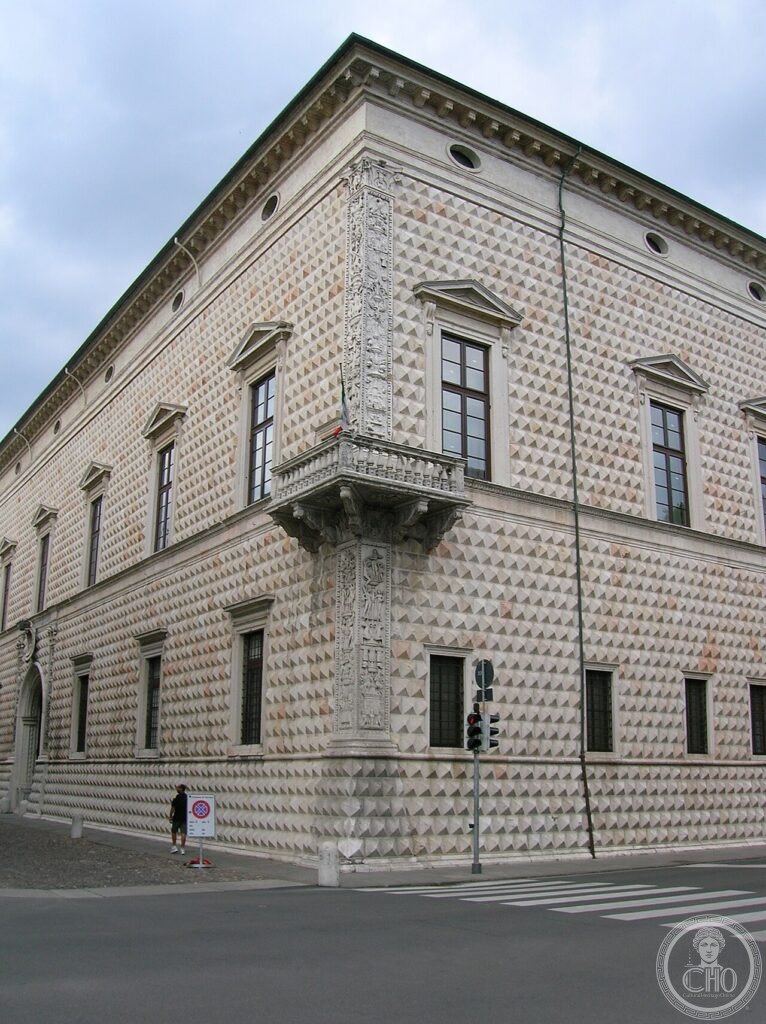
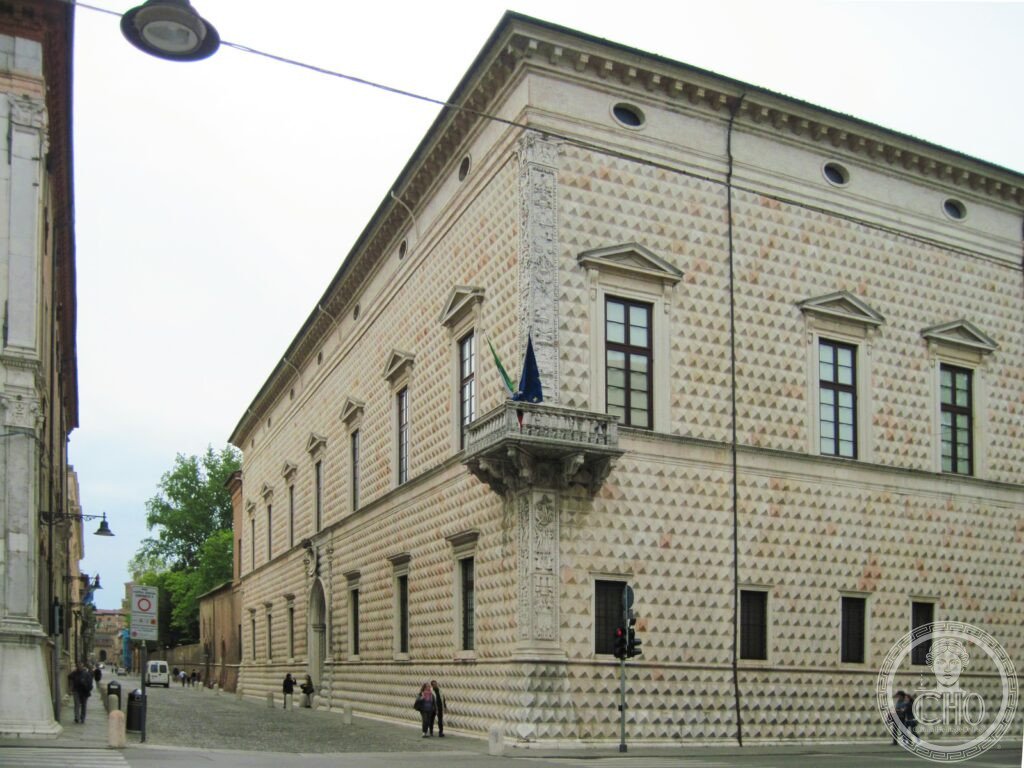
- Palazzo dei Diamanti (Biagio Rossetti, 1493-1503): The defining building of the Addizione Erculea: a palace on the corner of Corso Ercole I d'Este and Corso Rossetti whose entire exterior facing (all four facades, and the two upper storeys of the main corner facade) is covered in approximately 8,500 marble blocks carved in a three-dimensional pointed pyramid form (the “diamante” = diamond point); the visual effect (each block projects approximately 20 cm from the wall plane) creates a surface of extreme density and movement, unlike any other Renaissance building exterior in Italy; the building now houses the Pinacoteca Nazionale di Ferrara and the Palazzo dei Diamanti exhibition spaces (major temporary exhibitions, internationally recognized as some of the most important in Italy)
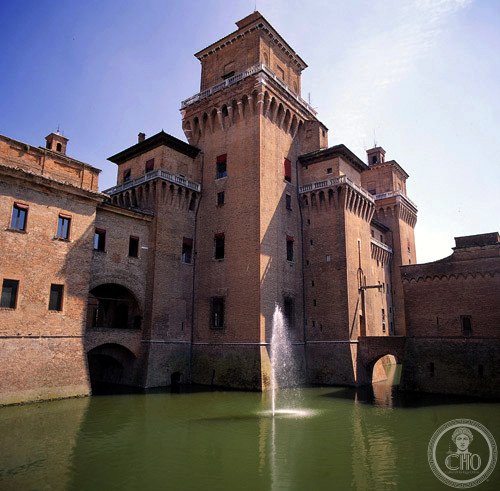
- Castello Estense (1385): The moated castle of the Este in the centre of the older part of Ferrara; built by Nicolò II d'Este beginning in 1385 (after a revolt in which the populace attempted to kill the Este ruler, requiring him to retreat into a fortified residence); the castle (with four corner towers and a wide water moat) remained the residence of the Este dukes until the Papal annexation of 1598; the dungeons (where Ugo d'Este and his stepmother Parisina Malatesta were executed for adultery in 1425 — the event that inspired Browning's “My Last Duchess”) are accessible on the guided tour
- UNESCO: 1995 (city), extended 1999 (Po Delta), ref. 733
- GPS: 44.8381, 11.6197 — Google Maps (Palazzo dei Diamanti)
History
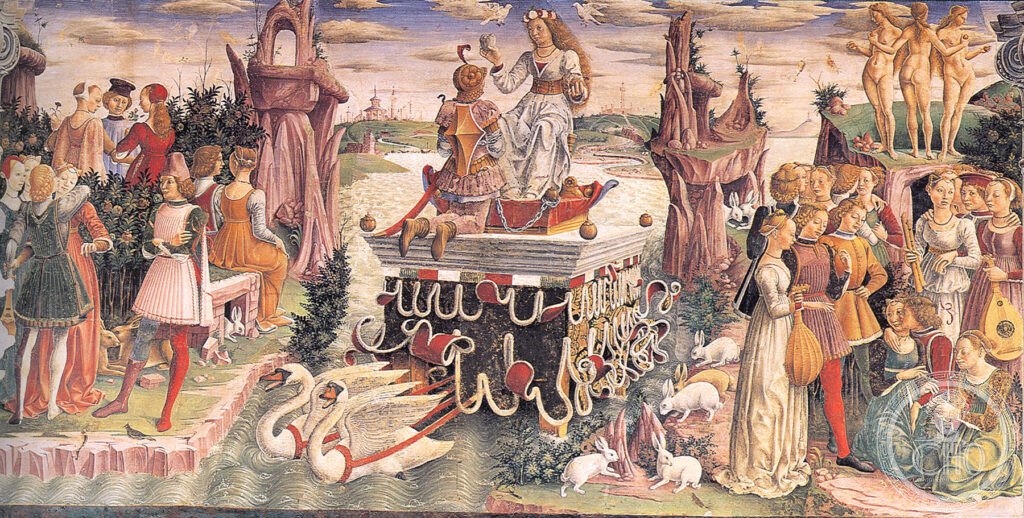
The Este family dominated Ferrara from 1264 to 1598: a period of 334 years during which the city was one of the most important cultural centres in Italy (the court of the Este attracted Ariosto, Tasso, Boiardo, and other major literary figures; Josquin des Préz worked as court musician; Ercole de' Roberti and Cosmè Tura developed the Ferrara school of painting under Este patronage). The city's historical trajectory ended abruptly in 1598 when, on the death of Duke Alfonso II d'Este without legitimate heirs, Pope Clement VIII claimed Ferrara as a lapsed papal fief (it had been a papal fief under Este administration for over two centuries) and annexed it directly to the Papal States; the Este family moved their court to Modena (where they continued to rule until 1797). The departure of the Este and the administrative marginalization of Ferrara under Papal governance left the city's Renaissance infrastructure largely intact but economically stagnant, which paradoxically preserved the Addizione Erculea's 15th-century street plan almost unchanged to the present.
What you see
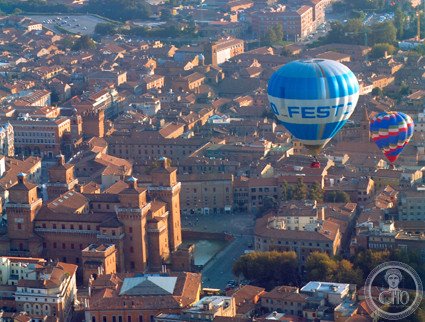
The walk in Ferrara begins at the Castello Estense (the moated Este castle, 1385, in the old city centre) and proceeds north along the Corso Ercole I d'Este (the main axis of the Addizione Erculea): a wide, tree-lined boulevard laid out in 1492, still maintaining its original dimensions and most of its 15th-century palazzo frontages on both sides. At the major intersection with Corso Rossetti, the four Este palaces stand at the four corners of the crossing: the Palazzo dei Diamanti (8,500 diamond-pointed marble blocks; now Pinacoteca Nazionale and exhibition spaces) is the largest and most visible. The Corso Ercole I ends at the Porta degli Angeli (the northern gate of the Addizione, 1492) and the Mura Estensi (the surviving circuit of the Este walls, 9 km total length, now a public park and cycling route).
The older medieval city (south of the Castello) has the Cathedral (Duomo di Ferrara, 12th-century Romanesque facade, notable exterior by Wiligelmus school; the Museo della Cattedrale has the original bronze doors and the cycle of Months from the facade) and the Palazzo Comunale (adjacent to the Cathedral, with the loggia and the Este-period facade renovation).
Gallery
Practical information
- Palazzo dei Diamanti: Corso Ercole I d'Este 21, Ferrara; Pinacoteca Nazionale open Tuesday-Sunday 9:00-18:00; admission ~€6. The temporary exhibition spaces (ground floor) have separate ticketing for each exhibition (some are major international loans — check the current programme at palazzodiamanti.it).
- Castello Estense: Piazza Castello, Ferrara; open Tuesday-Sunday 9:30-17:30; admission ~€10 (full), ~€8 (reduced). The guided tour includes the dungeon (where Ugo and Parisina were held) and the Este apartments (with frescoed ceilings and the Este coat of arms).
- Mura Estensi: The Este walls (9 km circuit) are freely accessible as a public park; cycling on the walls is the best way to appreciate the full circuit; bike hire is available from several shops near the station.
Getting there
Corso Ercole I d'Este 21, Ferrara (FE), Emilia-Romagna. GPS 44.8381, 11.6197. By train: Trenitalia from Bologna (35 min by regional; 25 min by Intercity); from Venice (1h15 regional with change at Rovigo); from Ravenna (1h20 regional with change at Bologna). Ferrara station is 15-20 min on foot from the Castello (or 10 min by bike). By car: from Bologna, A13 north (45 km, 30 min); from Padova, A13 south (110 km, 1h10). The historic centre has ZTL; park at Piazzale Medaglie d'Oro outside the walls.
Nearby
- Ravenna — 75 km south-east; (CHO card: Ravenna mosaici paleocristiani UNESCO 1996); the 8 early Christian and Byzantine mosaic sites; Sant'Apollinare in Classe; San Vitale
- Delta del Po — 50 km east; the UNESCO extension of the Ferrara inscription (ref.733, 1999); the Valle di Comacchio lagoon; the ancient Etruscan port of Spina (6th-3rd c. BCE; major finds in the Museo Nazionale Archaeologico di Ferrara)
- Modena — 50 km south-west; the Romanesque Cathedral (Duomo di Modena, 1099-1184, Wiligelmus; UNESCO 1997 ref.827); the Este collection (Galleria Estense, transferred to Modena after the 1598 papal annexation); the Ferrari Museum in Maranello (15 km south)
Sources
- UNESCO: whc.unesco.org/en/list/733
- Wikipedia EN: Ferrara
- Burckhardt, Jacob: Die Cultur der Renaissance in Italien, 1860 (section on Ferrara and urban planning)
- Benevolo, Leonardo: Storia della città, Laterza, 1975
Find it on the map
See this place and what’s around it →📷 Diventa un fotografo di Cultural Heritage Online
Condividi le tue foto dei luoghi: restano pubblicate con la tua firma come autore. Più vengono viste, più ti fai conoscere — e presto un concorso premierà le foto più apprezzate.
Accedi o registrati gratis per aggiungere una foto