
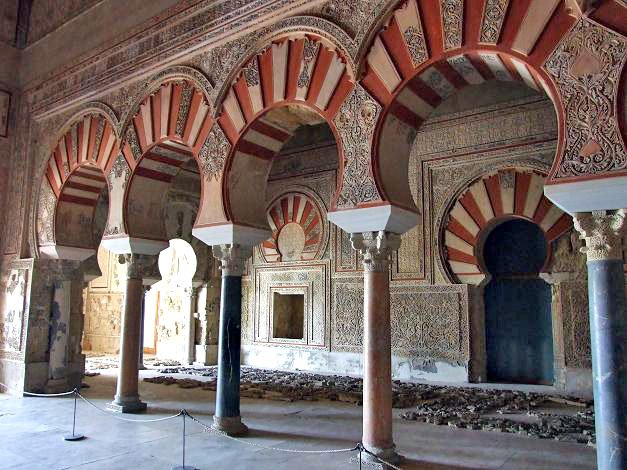
Built in forty years as the gleaming capital of the most powerful state in 10th-century Europe, then sacked, buried, and forgotten for nine centuries — Madinat al-Zahra is still only 10 percent excavated.
At a glance
Madinat al-Zahra (Arabic: the Shining City) was a complete planned capital built on the slopes of the Sierra Morena mountains 8 km west of Cordoba, Spain, between approximately 936 and 976 CE. The Umayyad Caliph Abd al-Rahman III and his son al-Hakam II constructed the entire city — palaces, mosques, gardens, barracks, markets, baths — from scratch, housing a court of 12,000 in an area of approximately 112 hectares. In use for fewer than 75 years, it was sacked and burned during the civil war that destroyed the Caliphate of Cordoba in 1010 CE. UNESCO inscribed the site in 2018 as the outstanding surviving monument of the Western Umayyad tradition outside the Levant.
Key facts
- Built: c. 936–976 CE by Caliph Abd al-Rahman III and al-Hakam II
- Destroyed: 1010 CE during the Fitna civil war that ended the Caliphate of Cordoba
- Area: approximately 112 hectares (1,518 m east-west × 745 m north-south)
- Layout: three terraced levels — upper (royal palace), middle (government), lower (servants city and mosque)
- UNESCO inscription: 2018
- Excavation begun: 1911; approximately 10% of site excavated to date
- Museum: Museo de Madinat al-Zahra (2009), designed by Nieto Sobejano Arquitectos
History
When Abd al-Rahman III proclaimed himself Caliph in 929 CE — breaking from the Abbasid caliphs in Baghdad — he needed a capital that announced western Islamic sovereignty to the world. Arab sources record the extraordinary construction effort: 10,000 labourers, 1,500 pack animals working daily for 25 years; 6,000 carved marble blocks for the throne room alone imported from North Africa; columns sourced from Roman quarries across Spain, North Africa, and Syria. The Salon Rico (Hall of Abd al-Rahman III), completed around 953-957 CE, was the stage where the Caliph received ambassadors from Constantinople, the Holy Roman Empire, and the Christian kingdoms of the north. A mercury pool in one reception hall was agitated mechanically to produce a hypnotic shimmer of light across the ceiling.
Al-Hakam II (r. 961-976 CE) expanded the palace library to a collection Arab sources estimate at 400,000 volumes — a number that may be exaggerated but signals an intellectual culture producing original work in astronomy, medicine, and philosophy when most of Europe had no institutional libraries. The political order collapsed after the regent al-Mansur died in 1002 CE. Berber mercenary troops sacked the palace-city in 1010 CE and burned it; by 1013 CE it was definitively abandoned. Over the following two centuries, the site was quarried systematically — the Great Mosque of Seville and the Alcazar of Cordoba both incorporate Madinat al-Zahra stonework. By the 12th century only farmland remained visible. Excavation resumed in 1911 after a landowner uncovered carved marble, and systematic work began in 1944 under Feliz Hernandez Gimenez.
What you see
The excavated middle terrace is the heart of the visitor experience. The Salon Rico preserves its carved marble dados in situ — a virtuoso display of intertwined acanthus scrolls, palmettes, and pine cones in the deeply undercut style that distinguishes Madinat al-Zahra from earlier Umayyad work. The adjoining Jardin Alto (Upper Garden) has been replanted in geometric patterns based on archaeobotanical evidence from the excavations. The mosque, the Dar al-Mulk (House of Sovereignty), and the gatehouse complex are all accessible. The lower terrace — servants city, baths, workshops, barracks — is largely still under excavation. The museum at the entrance displays carved stucco panels, marble architectural fragments, ceramics, glass weights, and bronze objects, building a comprehensive picture of the material culture of the Western Caliphate at its peak.
Practical information
- Address: Carretera Palma del Rio km 5.5, Cordoba, Andalusia, Spain
- Hours: Tue-Sat 09:00-18:00 (winter) / 09:00-21:00 (summer); Sun and public holidays 09:00-15:00; closed Mondays
- Admission: EUR 1.50 (EU citizens with ID); free under 18, over 65; free Tuesdays for EU residents
- Photography: permitted throughout site and museum; no flash in museum galleries
- Time needed: 2-3 hours for site and museum combined
Getting there
Madinat al-Zahra lies 8 km west of central Cordoba along the A-431 road toward Palma del Rio. By car: follow signs for Medina Azahara from the city ring road; parking is free at the museum. A seasonal shuttle bus departs from the Glorieta Ibn Rushd near the Alcazar in central Cordoba — check locally for current schedules, as services change by season. No regular urban bus reaches the site directly. Taxi from Cordoba centre takes approximately 15 minutes. Cordoba itself is on the high-speed AVE rail line: Madrid approximately 1 hour 45 minutes; Seville 45 minutes.
Nearby
- Mosque-Cathedral of Cordoba (La Mezquita) — 8 km east; the greatest surviving monument of Umayyad architecture in Europe and a UNESCO WHS
- Alcazar de los Reyes Cristianos — 8 km east; the palace of the Christian kings who took Cordoba in 1236
- Cordoba Historic Centre — medieval Jewish quarter, Roman bridge, and old city; UNESCO WHS since 1984
Sources
- UNESCO World Heritage List, Caliphate City of Medina Azahara (2018): whc.unesco.org/en/list/1560
- Vallejo Triano, Antonio. La ciudad califal de Madinat al-Zahra. Almuzara, 2010.
- Dodds, Jerrilynn D. Architecture and Ideology in Early Medieval Spain. Penn State UP, 1990.
- Wikipedia, Medina Azahara: en.wikipedia.org/wiki/Medina_Azahara
Find it on the map
See this place and what’s around it →📷 Become a Cultural Heritage Online photographer
Share your photos of places: they stay published under your name as the author. The more they're seen, the more you get noticed — and soon a contest will reward the most appreciated photos.
Log in or sign up free to add a photo