
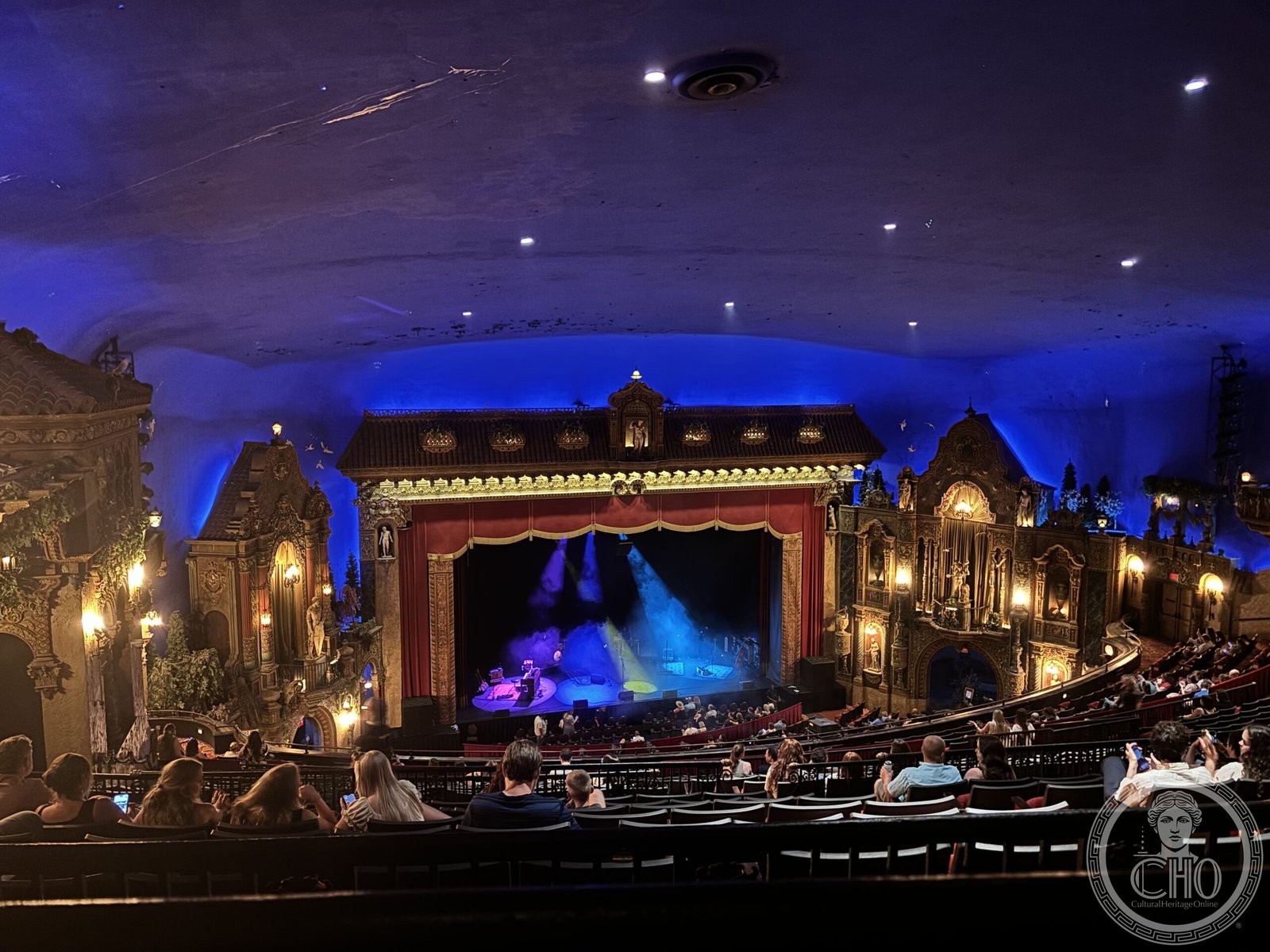
One of the most ornate surviving movie palaces in the American South — a Spanish Baroque interior of painted ceilings, a two-ton chandelier and approximately 3,000 seats that opened on 4th Street in Louisville in 1928.
At a glance
The Louisville Palace opened on 1 September 1928 as the grandest movie house in Kentucky — a fully realised Spanish Baroque interior in which every surface was treated as an opportunity for ornament. The auditorium ceiling is painted with clouds and stars; a two-ton chandelier descends from a central dome; carved plasterwork covers the walls in a dense programme of Baroque cartouches, putti and architectural fantasy. Outside, a terracotta facade on South 4th Street announces the building in a register proportioned for the pedestrian age of downtown Louisville. The Palace is still operating today, hosting national touring concerts, comedy acts and special events.
Key facts
- Address: 625 S 4th St, Louisville, KY 40202
- Opened: 1 September 1928
- Style: Spanish Baroque / atmospheric
- Capacity: approximately 3,000 seats
- Chandelier: approximately two tons, suspended from the central dome
- Status: National Register of Historic Places
- Current use: Live entertainment venue
- GPS: 38.2527°N, 85.7585°W
History
Louisville in the late 1920s was a prosperous river city on the cusp of its most confident decade. South 4th Street was the city’s main theatrical and commercial spine, and the Palace was conceived as its crown: a building that would bring to Louisville the kind of theatrical spectacle previously available only in New York or Chicago. The result was a Spanish Baroque interior of an ambition unusual even in the golden age of movie palaces — not the Mediterranean village atmosphere of the major Eberson commissions, but something more formally Baroque, in which the ornamental programme references the palace architecture of 17th-century Spain.
The Palace operated continuously as a cinema from its opening through the decades of Hollywood’s studio era, the transition to wide-screen formats, and the slow decline of downtown movie-going that accelerated through the 1960s and 1970s. By the late 1970s many of Louisville’s grand theatres had been demolished or subdivided. The Palace survived largely intact and was listed on the National Register of Historic Places, which gave it the legal framework for renovation financing.
The building was transformed into a live entertainment venue, a transition that has proved durable. The acoustic properties that made the building an effective cinema — the coffered ceiling, the plush auditorium surfaces, the contained volume — translate well to amplified music and comedy performance, and the Palace now draws national touring acts that fill all 3,000 seats on busy weekends.
What you see
The facade on South 4th Street is terracotta-clad and relatively restrained — a series of arched window bays above a canopied marquee, framed by pilasters and topped by a shallow parapet. The scale is domestic compared to the interior ambitions; the building’s real statement is invisible from the street.
Inside, the transition is immediate and complete. The lobby introduces carved plasterwork at an intensity that grows as you move into the auditorium itself. The ceiling is the culminating element: a painted sky of clouds and ochre light, ringed by carved Baroque motifs and centred on the chandelier — a mass of bronze and crystal that focuses the space and provides its defining vertical element. The walls continue in the same register, with cartouches, garlands, column capitals and figural plaster reliefs forming a continuous surface that leaves no wall section neutral.
Practical information
- Events calendar: national touring concerts, comedy, special screenings; check venue website for schedule
- Lobby access: viewable on event days and during occasional open-house tours
- Time needed: 45 minutes for the interior on a tour; an evening for a performance
- Dress code: none; the Palace is a casual live-events venue
Getting there
The Louisville Palace stands at 625 S 4th St in downtown Louisville, on the pedestrian-friendly corridor between Market and Liberty Streets. Louisville Muhammad Ali International Airport (SDF) is approximately 8 miles south via I-65. Downtown Louisville is served by TARC bus routes along 4th Street; the venue is also within easy walking distance of the Louisville Slugger Museum and the Yum! Center arena.
Nearby
- Louisville Slugger Museum & Factory — The home of baseball’s most famous bat brand, three blocks north on W Main Street; the 120-foot steel bat leaning against the facade is visible from 4th Street.
- Muhammad Ali Center — The cultural and humanitarian centre dedicated to Louisville’s most celebrated native son, on the Ohio River waterfront four blocks northwest.
- Speed Art Museum — Kentucky’s premier art museum at 2035 S 3rd Street, on the University of Louisville campus; the building (1927, expanded 2016) holds one of the largest collections in the Southeast.
- Ohio River waterfront — Waterfront Park and the Belle of Louisville steamboat dock, giving the city its most direct connection to the river that shaped its commercial history.
Sources
- National Register of Historic Places nomination, Louisville Palace Theatre, Jefferson County, Kentucky
- Kentucky Heritage Council, historic theatres survey
- Louisville Courier-Journal historical archive
- Cinema Treasures database, Louisville Palace entry
- Louisville Palace Theatre official history documentation
Find it on the map
See this place and what’s around it →Record researched and written by Luigi De Marchi for Cultural Heritage Online, 2026.
📷 Become a Cultural Heritage Online photographer
Share your photos of places: they stay published under your name as the author. The more they're seen, the more you get noticed — and soon a contest will reward the most appreciated photos.
Log in or sign up free to add a photoIs this page about you?
This page is read by travellers and heritage enthusiasts who find it on Google. Tell us how you are connected to this place and we will take it from there.