
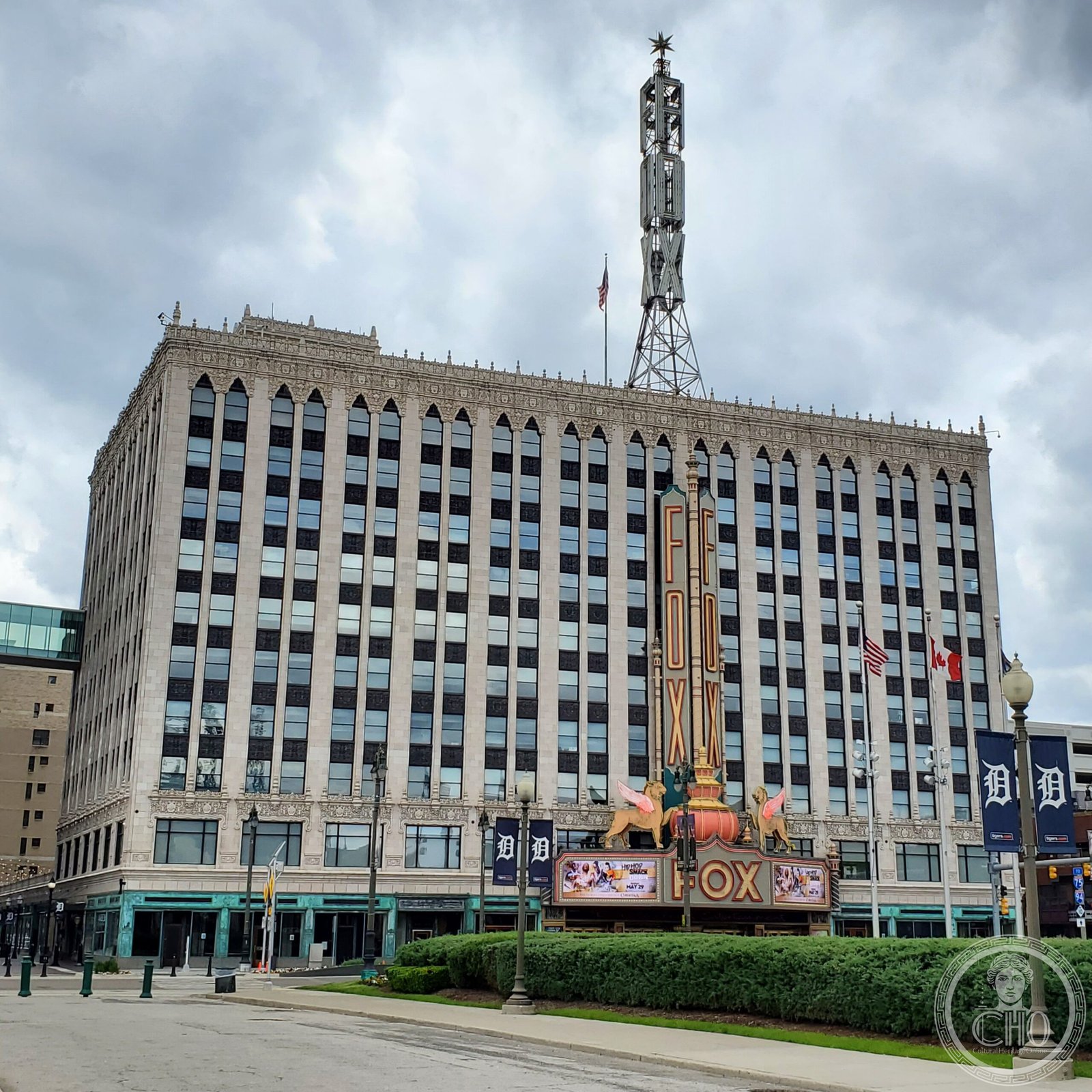
A six-story auditorium of carved plaster, gilded domes and painted silk ceilings — the Fox Theatre opened in 1928 as one of the largest movie palaces in the world and stands today as the anchor of Detroit’s entertainment district.
At a glance
C. Howard Crane designed the Fox Theatre for the Fox Film Corporation, completing it in the summer of 1928. With approximately 5,000 seats on opening night, it briefly ranked among the three largest theaters ever built. The auditorium combines Moorish arches, Hindu temple ornament and Baroque plasterwork in the eclectic “atmospheric” tradition — a style that placed audiences inside an imaginary outdoor courtyard under a painted sky. The Fox survived Depression-era closures, decades of neglect, and a near-demolition campaign in the 1980s, when Mike and Marian Ilitch purchased the building for $6 million and invested $8 million in a meticulous restoration that returned it to active use in 1988.
Key facts
- Opened: 21 September 1928, Detroit, Michigan
- Architect: C. Howard Crane (leading Detroit theater architect of the era)
- Style: Grand Moorish atmospheric — ecletic interiors blending Mughal, Hindu and Baroque motifs
- Capacity: approximately 5,000 seats; six-story auditorium
- Client: Fox Film Corporation (William Fox)
- Address: 2211 Woodward Avenue, Detroit, MI 48201
- GPS: 42.3385°N, 83.0508°W
- Status: National Register of Historic Places; active live-entertainment venue (313 Presents)
History
William Fox opened his theatres across the United States at a pace few rivals could match. The Detroit Fox arrived in September 1928, two months before the nationwide release of The Jazz Singer brought synchronised sound to mainstream cinema — meaning the building was designed for a silent-film world and rapidly adapted to the talking-picture era it helped inaugurate. In its first decade the Fox presented first-run films alongside vaudeville acts and live orchestras in the grand Detroit tradition.
The Depression thinned audiences across the city’s picture palaces, and the Fox changed ownership more than once between the 1930s and 1970s. By the early 1980s the building had fallen into severe disrepair, and a proposal to demolish it prompted preservation advocates to launch a campaign that drew national attention. Mike Ilitch, the founder of Little Caesars Pizza, intervened in 1987 with a purchase and restoration that is now regarded as a model for urban theatre preservation. The restored Fox reopened on 2 November 1988 with a Smokey Robinson concert and quickly reclaimed its role as the region’s premier live-entertainment venue.
Today the Fox hosts Broadway touring productions, rock and pop concerts, stand-up comedians and sporting event broadcasts, drawing more than 400,000 visitors a year and anchoring the rebirth of Midtown Detroit’s Woodward corridor.
What you see
The exterior on Woodward Avenue announces itself through a ten-story vertical sign reading FOX, one of the largest neon theatre signs in the United States. The lobby, clad in travertine and bronze, leads into a grand foyer where carved plaster panels depict winged figures, lotus columns and Mughal lattice screens. The six-story auditorium overhead is organised around a shallow dome painted in midnight blue, from which gilded sunbursts descend toward the boxes. Crane layered Hindu temple elements — including stylised elephants and deity figures in the proscenium arch capitals — with Baroque cartouches and Persian tilework in a coherent spectacle that feels simultaneously ancient and machine-age.
The proscenium arch rises 110 feet; the stage itself is 100 feet wide. A theatre pipe organ — one of the largest ever installed in a movie palace — remains playable. The 1988 restoration used archival photographs, original plaster moulds and specialist craftspeople to return the interior to its 1928 palette. A rooftop penthouse suite, added for the Ilitches and now used for private events, sits invisibly above the painted sky.
Practical information
- Access: 2211 Woodward Ave, Detroit MI 48201 — between Columbia and Montcalm Streets
- Tours: public guided tours offered several times a year; check the Fox Theatre website for dates
- Events: active venue — concerts, Broadway, comedy, film screenings; tickets via 313 Presents
- Parking: surface lots and garages on Columbia St; QLINE streetcar stop at adjacent Grand Circus Park
- Time needed: 1.5–2 hours for a guided tour; 2.5–4 hours for an evening performance
Getting there
The Fox sits at the heart of Detroit’s entertainment district on Woodward Avenue, three blocks north of Campus Martius Park. The QLINE streetcar stops at Grand Circus Park, half a block south, connecting to Downtown and Midtown. Detroit Metropolitan Wayne County Airport (DTW) is approximately 22 miles southwest via I-94 — allow 30–45 minutes by car or rideshare. Amtrak’s Wolverine line terminates at Detroit’s New Center station on Milwaukee Ave, about 2 miles north; the QLine links the two. On foot from Downtown’s Renaissance Center, the Fox is a pleasant 15-minute walk north along Woodward.
Nearby
- Comerica Park — Home of the Detroit Tigers, one block west of the Fox on Woodward, part of the same entertainment precinct.
- Fisher Building (1928) — Albert Kahn’s gilded Art Deco masterpiece, 2 miles north in the New Center neighbourhood — Detroit’s best companion piece to the Fox in the same opening year. See the CHO guide.
- Detroit Institute of Arts — World-class art museum housing Diego Rivera’s Detroit Industry Murals (1932–33), approximately 10 blocks north on Woodward.
- Michigan Theatre Ann Arbor (1928) — Italian Renaissance movie palace 35 miles west via I-94, opened the same year as the Fox. See the CHO guide.
Sources
- Fox Theatre Detroit official site — programme and tour information
- National Register of Historic Places nomination, Fox Theatre, Detroit
- Michael G. Smith, Designing Detroit: Wirt Rowland and the Rise of Modern American Architecture (2017) — context for Detroit’s architectural golden age
- Detroit Free Press archives — opening night coverage, September 1928
- Marian Ilitch, public statements on the 1987–1988 restoration
Find it on the map
See this place and what’s around it →📷 Become a Cultural Heritage Online photographer
Share your photos of places: they stay published under your name as the author. The more they're seen, the more you get noticed — and soon a contest will reward the most appreciated photos.
Log in or sign up free to add a photoIs this page about you?
This page is read by travellers and heritage enthusiasts who find it on Google. Tell us how you are connected to this place and we will take it from there.