
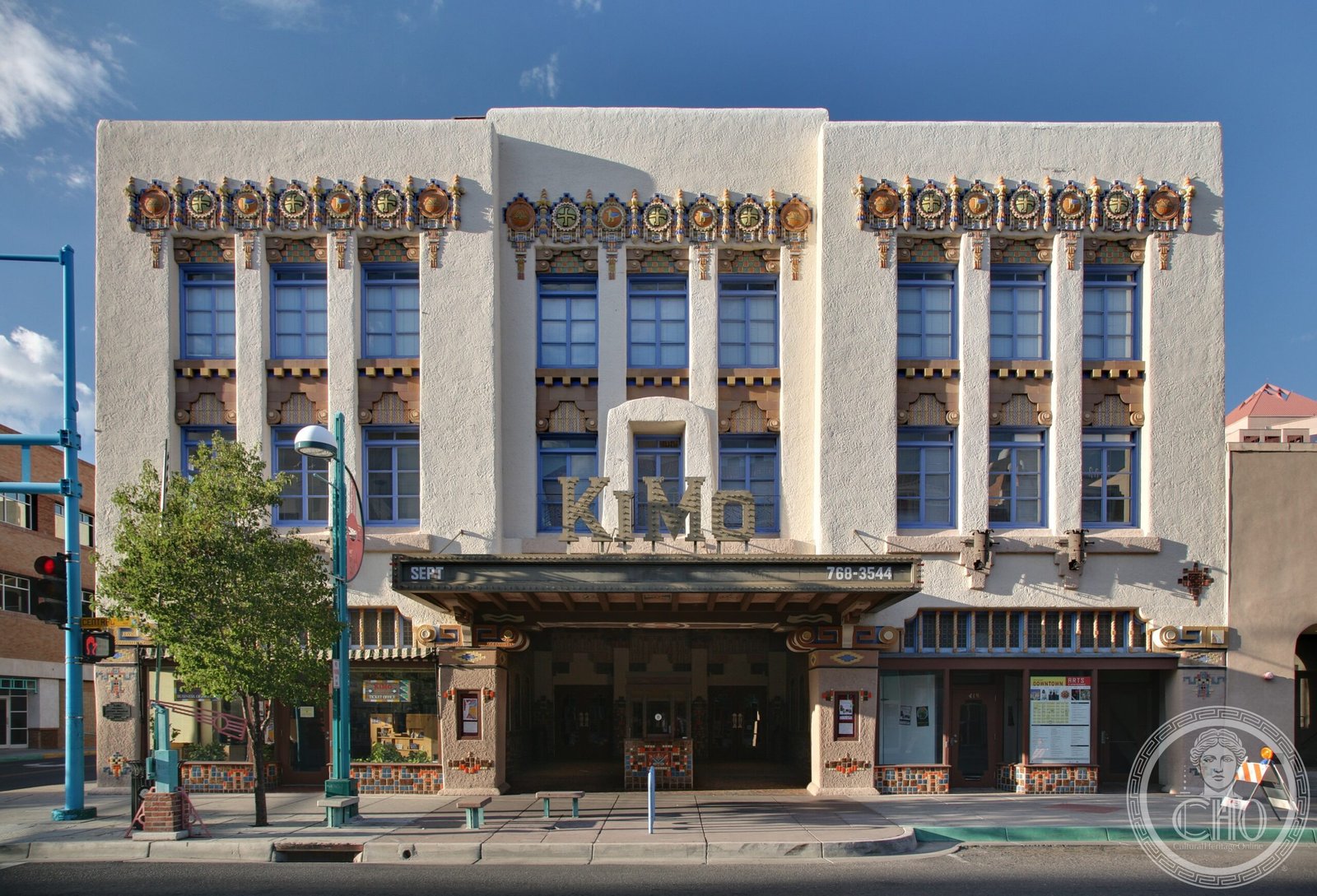
The definitive example of Pueblo Deco — Albuquerque’s 1927 cinema where Art Deco geometry meets Navajo ornament, steer-skull light fixtures and Route 66 theatricality.
At a glance
Nowhere else in America did Art Deco and the Pueblo world meet so literally as at the KiMo Theatre on Central Avenue. Built in 1927 on the road that would carry Route 66 four months after the building opened, the KiMo fuses a terracotta-clad Deco exterior with an interior covered in steer-skull light sconces, ceiling patterns drawn from Navajo weaving, and painted kachina-like figures. The name comes from a Tiwa Pueblo phrase meaning “King of its kind.” In the vocabulary it invented, the building remains without equal.
Key facts
- Address: 423 Central Ave NW, Albuquerque, NM 87102 (Route 66)
- Commissioner: Oreste Bachechi (Italian immigrant entrepreneur)
- Opened: 19 September 1927
- Style: Pueblo Deco (Art Deco / Pueblo Revival fusion)
- Original capacity: approximately 700 seats
- Status: National Register of Historic Places (1977)
- Owner: City of Albuquerque
- GPS: 35.0854°N, 106.6509°W
History
Oreste Bachechi arrived in New Mexico from Italy in the 1880s and built a commercial empire that extended from a downtown grocery and saloon to a chain of motion-picture ventures. For his grandest theatre he commissioned a building that would reflect New Mexico rather than simply import a standard movie palace template from Chicago or Kansas City. The result was a building whose exterior owed something to the Deco cinemas proliferating across America but whose interior was unlike anything that had been attempted in American theatrical design.
The KiMo opened on 19 September 1927 to silent films. Central Avenue had been incorporated into the newly designated US Route 66 the previous November (1926), so from its first day the theatre stood on the most famous road in America. The building’s position at the crossing of downtown Albuquerque and the transcontinental highway gave it a commercial significance that lasted through the sound era and into the 1960s, when suburban multiplex development began to drain downtown of its audience.
The theatre closed in 1968 and passed through several owners before the City of Albuquerque purchased it in 1977, the same year it entered the National Register of Historic Places. In 1951 a water heater beneath the lobby had exploded during a Saturday matinee, killing six children. Their memory is preserved in a small altar along the lobby wall where residents still leave toys and mementos — a ritual of remembrance that has outlasted the movie palace era itself.
What you see
The exterior reads as a horizontal Deco composition — bands of terracotta ornament on a stucco facade, framed by corner pilasters and topped by a stepped parapet. The geometric patterns pressed into the terracotta panels are the first signal that the building speaks a local language: they derive not from European Modernism but from Navajo textile designs and Pueblo pottery motifs. The marquee canopy and neon signage maintain the Route 66 commercial vernacular, so that the building looks simultaneously like a Deco cinema and a piece of the American highway.
Inside, the ornamental programme becomes fully immersive. The steer skulls that serve as light sconces along the auditorium walls were cast in plaster to approximate those found in Southwest cattle country; each holds a light fitting behind the eye sockets. The ceiling of the lobby and auditorium reproduces the striped and stepped patterns of Navajo blankets in painted plasterwork. Figural murals depict Pueblo village life, mounted riders and mountain landscapes — a panoramic backdrop that makes the KiMo less a cinema than a theatrical landscape in its own right.
Practical information
- Public lobby: open during business hours; free entry
- Performances: live events, film screenings and community programmes throughout the year; check City of Albuquerque website for current schedule
- Time needed: 20–30 minutes for the lobby ornament; longer if attending a performance
- Note: the memorial altar for the 1951 victims is in the lobby; it is maintained respectfully by the community
Getting there
The KiMo Theatre stands at 423 Central Ave NW, on the Route 66 corridor through downtown Albuquerque. Albuquerque International Sunport (ABQ) is approximately 5 miles south via Central Ave or I-25. ABQ Ride Route 66 Bus runs the length of Central Avenue with a stop directly outside the KiMo. On foot from downtown Albuquerque’s transit hub, the theatre is approximately 10 minutes east.
Nearby
- Old Town Albuquerque — The 18th-century Spanish colonial plaza half a mile west on Central Ave; the oldest continuously inhabited neighbourhood in New Mexico.
- Albuquerque Museum of Art and History — Adjacent to Old Town, with permanent galleries on New Mexico’s cultural and natural history.
- Indian Pueblo Cultural Center — Two miles north; the most comprehensive overview of New Mexico’s 19 pueblos, operated collectively by the pueblos themselves.
- Route 66 neon corridor — The stretch of Central Ave east of downtown preserves some of the finest mid-century neon signage surviving on the original route.
Sources
- National Register of Historic Places nomination, KiMo Theatre, Bernalillo County, New Mexico, 1977
- City of Albuquerque Heritage Preservation Office, KiMo Theatre historical file
- New Mexico Historic Preservation Division records
- Route 66 New Mexico: The Illustrated Guidebook (University of New Mexico Press)
- Albuquerque Museum of Art and History, architectural collection
Find it on the map
See this place and what’s around it →Record researched and written by Luigi De Marchi for Cultural Heritage Online, 2026.
📷 Become a Cultural Heritage Online photographer
Share your photos of places: they stay published under your name as the author. The more they're seen, the more you get noticed — and soon a contest will reward the most appreciated photos.
Log in or sign up free to add a photoIs this page about you?
This page is read by travellers and heritage enthusiasts who find it on Google. Tell us how you are connected to this place and we will take it from there.