
The Spiš Region: Crossroads of Central European History
The Spiš (Zips in German, Szepesség in Hungarian) region of eastern Slovakia is one of the most historically layered territories in Central Europe, a crossroads where German, Hungarian, Polish, Ruthenian, and Slovak cultural streams have intersected and competed for centuries. Settled by German colonists — known as Saxons — from the twelfth century onward under invitation from the Hungarian crown, the region developed as a wealthy trading zone connecting the Baltic amber routes with the Danubian economy. The German settlers brought with them their urban planning traditions, their architectural vocabulary, and their legal frameworks, producing a cluster of walled medieval towns of exceptional quality. The UNESCO World Heritage designation, first granted to Spišský Hrad and the town of Spišské Podhradie in 1993 and extended to include Levoča in 2009, recognises this concentration of medieval architectural heritage as an outstanding expression of the culture of the Central European Middle Ages.
Spišský Hrad: The Largest Medieval Castle Complex in Central Europe
Spišský Hrad (Spiš Castle) stands on a volcanic trachyte rock at an elevation of 634 metres above sea level, dominating the open landscape of the Spiš lowland from a distance of many kilometres. The castle complex covers approximately 4 hectares — making it one of the largest castle ruins in Central Europe by area — and its silhouette of concentric walls, towers, and inner palace ranges has become one of the iconic images of Slovak heritage. The site has been inhabited since the Neolithic period, and the first stone fortifications date to the eleventh or twelfth century. The castle reached its maximum extent in the fifteenth century under the Zápolya and Thurzó noble families, who expanded the residential palace and added Gothic chapel buildings. Spiš Castle was abandoned after a catastrophic fire in 1780 and has remained a ruin since, but its sheer scale and the drama of its position make it one of the most visited heritage sites in Slovakia.
Levoča Historic Town: Gothic Architecture Preserved
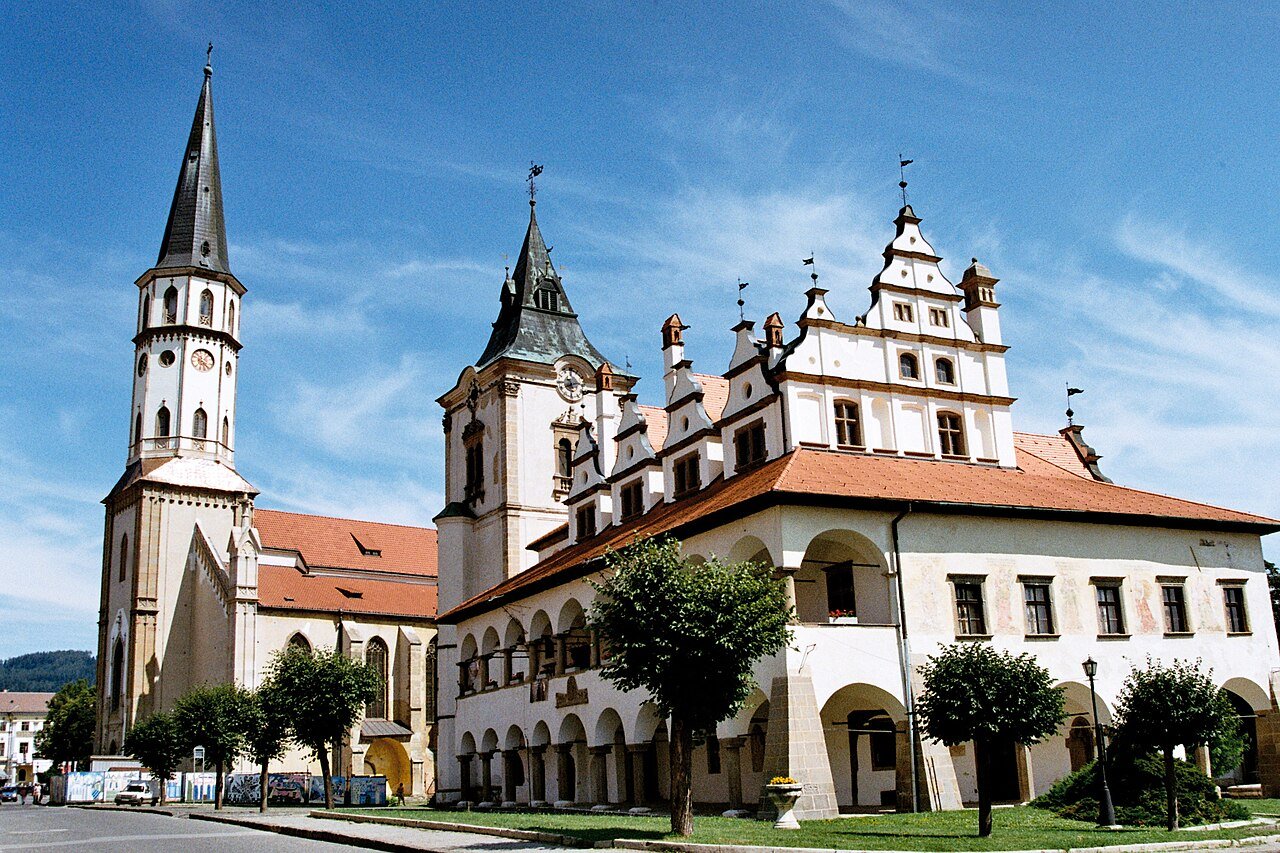
The walled town of Levoča, 15 kilometres west of Spiš Castle, is the best-preserved medieval urban ensemble in Slovakia. Founded as a Saxon German colony in the thirteenth century, Levoča became the capital of the Spiš Saxon community and one of the most prosperous trading towns in the Kingdom of Hungary. Its town walls, largely intact, enclose a grid of streets with a central market square of exceptional scale — 170 by 120 metres — surrounded by Gothic and Renaissance burgher houses of unusual quality. The facades range from late Gothic with stepped gables to Renaissance arcaded loggias to Baroque remodelling, but the overall coherence of the square is remarkable. Levoča was largely spared the major wars that destroyed comparable towns elsewhere in Central Europe, and it retains an authenticity of fabric — original stonework, historic cellars, intact street patterns — that few comparable towns in the region can match.
St. James Church and the Altar of Master Paul
The Church of St. James in Levoča contains the most important work of Late Gothic woodcarving in the world: the main altar carved by Master Paul of Levoča between 1507 and 1517. The altar stands 18.62 metres tall — the tallest Gothic polychrome wooden altar in existence — and is composed of a central shrine flanked by wings, all carved from linden wood and richly painted and gilded. The central shrine presents the Last Supper, with life-size figures of Christ and the twelve apostles in an arrangement of extraordinary compositional sophistication. The faces of the individual figures are portrayed with a psychological individuality unusual for the period. The wings unfold to reveal further narrative scenes from the life of Christ and the Virgin. Master Paul, whose identity and origin remain partially obscure despite decades of scholarly research, produced a total of eleven altars for churches in the Spiš region, but the Levoča main altar is the supreme achievement of his career and one of the masterworks of European Late Gothic sculpture.
The Jewish Quarter and Spiš Kapitol
The Spiš region contains additional components of the UNESCO designation beyond Spiš Castle and Levoča. The ecclesiastical settlement of Spišská Kapitula — a walled hilltop enclave containing the Romanesque-Gothic St. Martin Cathedral (one of the most significant medieval churches in Slovakia), the bishop residence, and associated canonical buildings — represents an intact medieval episcopal complex remarkably free of later alterations. The cathedral contains exceptional Gothic and Baroque artistic furnishings accumulated over seven centuries of continuous religious use. Separately, the town of Spišské Podhradie at the foot of Spiš Castle and the village of Žehra, with its Romanesque church decorated with fourteenth-century frescoes, are also included within the protected ensemble. Together these components create a cultural landscape in which medieval ecclesiastical authority, secular noble power, and merchant-burgher civic culture are all represented by buildings of the highest quality.
Decline, Abandonment, and Heritage Protection
The decline of the Spiš region began with the political upheavals of the eighteenth century — the collapse of the Kingdom of Hungary as an independent entity, the expulsion of the German Saxon community following World War II, and the subsequent socialist-era neglect of an architectural heritage associated with a displaced minority population. Spiš Castle was abandoned after the 1780 fire and stripped of usable stonework by local villagers over the following century. Many of the Levoča burgher houses fell into disrepair during the communist period when private ownership was suppressed and maintenance budgets were minimal. Heritage protection began seriously in the 1960s and 1970s under the Slovak Institute for Monuments, accelerating after the UNESCO inscription. Restoration campaigns funded by the Slovak state, the European Union, and international NGOs have stabilised the castle ruins, restored the church interiors, and rehabilitated many of the historic town buildings. The World Heritage status has been a crucial lever in securing funding and political attention.
Tourism in the Spiš Region Today
The Spiš region has developed as one of Slovakia most popular heritage tourism destinations, attracting visitors from across Central Europe and beyond. Spiš Castle is accessible on foot from the village of Spišské Podhradie and is open to visitors from spring through autumn; the walk up to the castle through vineyards and meadow provides sweeping views of the Tatra mountain range to the northwest. Levoča is easily reached by bus from Poprad or Košice, and the main square with St. James Church makes for a rewarding half-day itinerary. The entire Spiš cultural landscape — castle, cathedral complex, historic town, fresco church — can be visited in a two-day circuit using Poprad or Košice as a base. The region is also a gateway to the High Tatra National Park, combining heritage tourism with mountain hiking in an itinerary that has strong appeal across European and North American visitor segments.
Visiting Practical Information
The Spiš region is best accessed via Poprad, the nearest significant transport hub with rail connections to Bratislava, Prague, and Vienna, and limited direct air connections via Poprad-Tatry Airport. Košice, approximately 90 kilometres to the southeast, is the larger regional city and has more extensive flight connections. Car hire from either city provides the most flexible access to the dispersed components of the UNESCO site. Spiš Castle is signposted from the D1 motorway. Levoča has its own exit from the motorway and is easily reached as a day trip from either Poprad or Košice. Guided tours of the Levoča churches, including the St. James Church altar, are available through the local tourism office and through operators in Bratislava and Prague. The best time to visit is May through September, when all components are open and the mountain landscape provides its most dramatic visual backdrop. Levoča hosts an important Marian pilgrimage in early July attracting hundreds of thousands of visitors from across Slovakia and Poland.
Find it on the map
See this place and what’s around it →📷 Become a Cultural Heritage Online photographer
Share your photos of places: they stay published under your name as the author. The more they're seen, the more you get noticed — and soon a contest will reward the most appreciated photos.
Log in or sign up free to add a photo