
Ferrara
Most Italian cities grew by accident, street layered on street over a thousand years. Ferrara is the rare one that was drawn.
At a glance
Ferrara sits in flat Po-delta country in eastern Emilia-Romagna, an hour north of Bologna. For three centuries it was the seat of the Este dukes, who turned a river town into one of Europe’s sharpest courts for music, poetry and architecture. Its northern half, the Addizione Erculea, is often called the first modern urban plan on the continent; UNESCO listed the whole city in 1995. You come for the wide planned streets, the moated castle in the centre, and a quiet that larger art cities lost long ago.
Key facts
- Region: Emilia-Romagna · Province: Ferrara
- Ruled by: the House of Este, 1264–1598, then the Papal States
- UNESCO: Ferrara, City of the Renaissance, and its Po Delta (inscribed 1995, ref. 733)
- Signature site: the Addizione Erculea, planned by Biagio Rossetti from 1484
- Tied to: Savonarola was born here; Ariosto wrote at the Este court; Giorgio Bassani set The Garden of the Finzi-Continis in its streets
History
Ferrara became a free commune in 1115 and fell under Este control in 1264, when Obizzo II was made lord for life. The dynasty’s high point came under Ercole I (1471–1505), one of the great art patrons of the age: he drew Ludovico Ariosto and, later, Torquato Tasso into a court already famous across Europe.
His lasting act was urban. Around 1484 he commissioned the architect Biagio Rossetti to add a vast new district to the medieval core — wide straight avenues, planned crossings, room to breathe. Historians still rank the scheme among the most important examples of Renaissance planning, because it treated a city as something you design whole rather than inherit piecemeal.
The line ended in 1598, when the last legitimate Este heir died and the city passed to the Papal States, which froze it in place. That long stasis is why so much survives intact today.
What you see
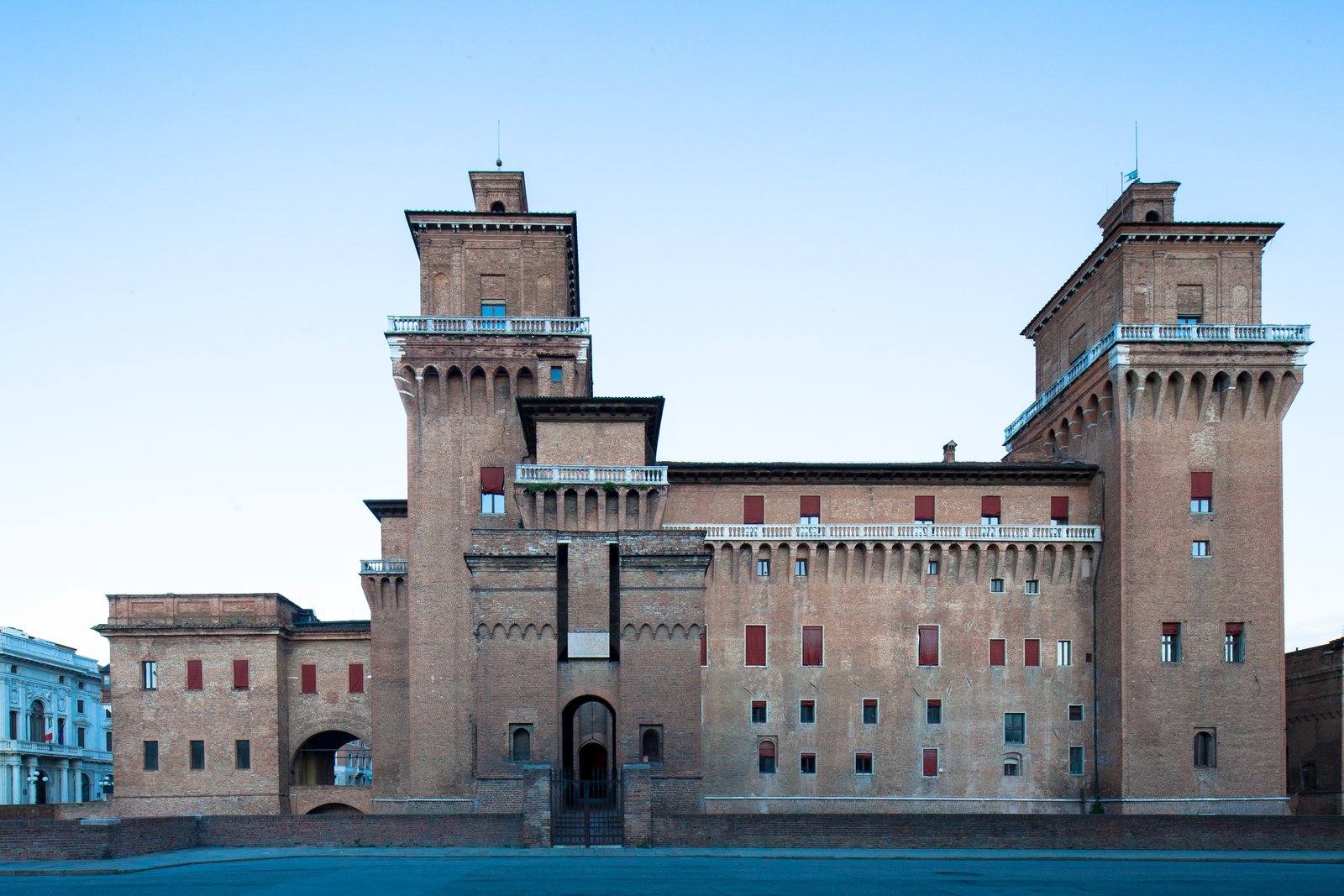
- Castello Estense — begun 1385 by Bartolino da Novara, a moated brick fortress turned ducal residence, still the pivot of the city centre.
- Palazzo dei Diamanti — its façade set with roughly 8,500 marble blocks cut to diamond points that catch the light differently hour by hour; it holds the Pinacoteca Nazionale.
- Cathedral of Saint George — consecrated 1135, a Romanesque-Gothic front with a campanile attributed to Leon Battista Alberti.
- Palazzo Schifanoia — its Salone dei Mesi carries a fresco cycle of the months painted for Borso d’Este, among the finest secular Renaissance interiors anywhere.
- Corso Ercole I d’Este — the spine of Rossetti’s addition: walk it to read the first modern city plan with your feet.
Practical information
- Time needed: a full day; two if you enter the museums.
- Getting around: the historic centre is compact and flat, made for bicycles — Ferrara is one of Italy’s great cycling cities, and most locals move that way.
- When to go: spring and autumn are kindest; the delta summer is humid.
Getting there
Trains from Bologna take about 30 minutes, from Venice around 1 hour 30. The nearest airport is Bologna (BLQ), roughly an hour by car or rail. Inside the walls, leave the car and walk or rent a bike.
Nearby
- The Po Delta wetlands and the former Este estates spread north and east.
- Ravenna and its early-Christian mosaics lie about an hour south.
Sources
- Wikipedia, Ferrara.
- UNESCO World Heritage List, Ferrara, City of the Renaissance, and its Po Delta, ref. 733 (inscribed 1995).
Find it on the map
See this place and what’s around it →Historical events at this place (8)
- 2018 Internazionale torna a Ferrara
- 2018 Sous Bois
- 2019 Ferrara ebraica, il Meis torna alle origini
- 2019 Boldini, l'incantesimo della pittura. Capolavori dal Museo Boldini di Ferrara
- 2022 Al via la XXVII edizione del Salone Internazionale del Restauro a Ferrara Fiere
- 2022 Fakes. Da Alceo Dossena ai falsi Modigliani
- 2022 La città del silenzio. Artisti ferraresi per Antonioni
- 2022 Il respiro della natura di Augusto Daolio
📷 Diventa un fotografo di Cultural Heritage Online
Condividi le tue foto dei luoghi: restano pubblicate con la tua firma come autore. Più vengono viste, più ti fai conoscere — e presto un concorso premierà le foto più apprezzate.
Accedi o registrati gratis per aggiungere una foto